
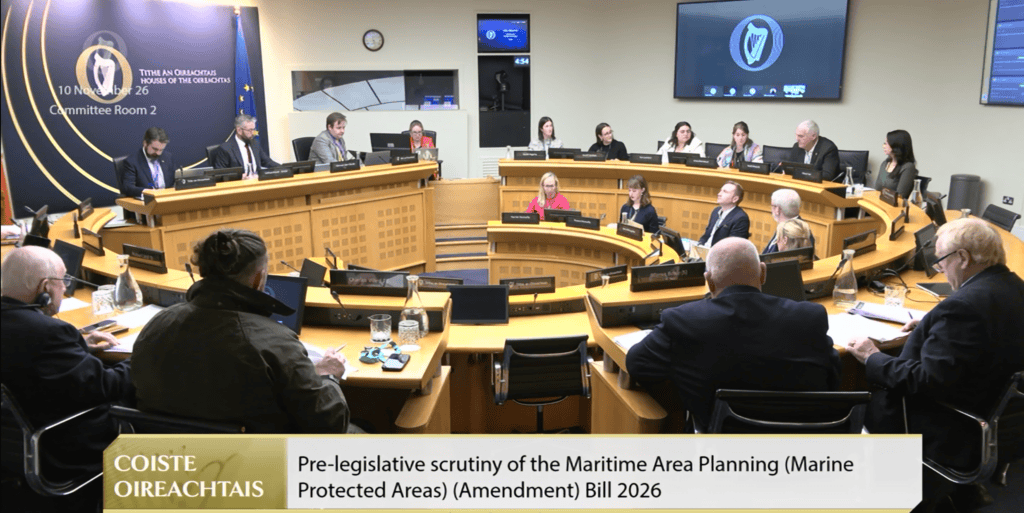
On 10 November 2026, the Irish Whale and Dolphin Group (IWDG) joined Fair Seas partners at Leinster House to contribute to discussions on Ireland’s proposed Marine Protected Areas legislation.
But what exactly happens at an Oireachtas Committee, why was IWDG there, and what could this mean for the future of Ireland’s seas?
Bringing marine conservation to the Oireachtas
Most of IWDG’s work takes place at sea, along our coastline, or behind the scenes through scientific research, conservation and public engagement. But protecting whales, dolphins and their habitats also requires something less visible: strong policies and legislation. This is where our marine policy and advocacy work comes in.
On Tuesday, 10 November, IWDG’s Marine Policy and Advocacy Officer, Eva Lambert, attended the Joint Oireachtas Committee on Fisheries and Maritime Affairs alongside colleagues from the Fair Seas coalition and the Coalition 2030.
For those unfamiliar with the Irish political system, a Joint Oireachtas Committee (JOC) is a group of TDs and Senators who examine specific policy areas, question Government officials and stakeholders, and make recommendations on legislation. That JOC meeting was part of what’s known as pre-legislative scrutiny, a process where a parliamentary committee examines the general outline of a proposed law before the final legislation is drafted.
In this case, the Committee was examining the General Scheme of the Maritime Area Planning (Marine Protected Areas) (Amendment) Bill 2026. In simpler terms, the Government is developing legislation that will provide a framework for creating and managing new Marine Protected Areas (MPAs) in Irish waters.
And this was an opportunity for organisations like IWDG to make sure that the needs of marine wildlife, the scientific evidence and the experiences of coastal communities are properly considered.
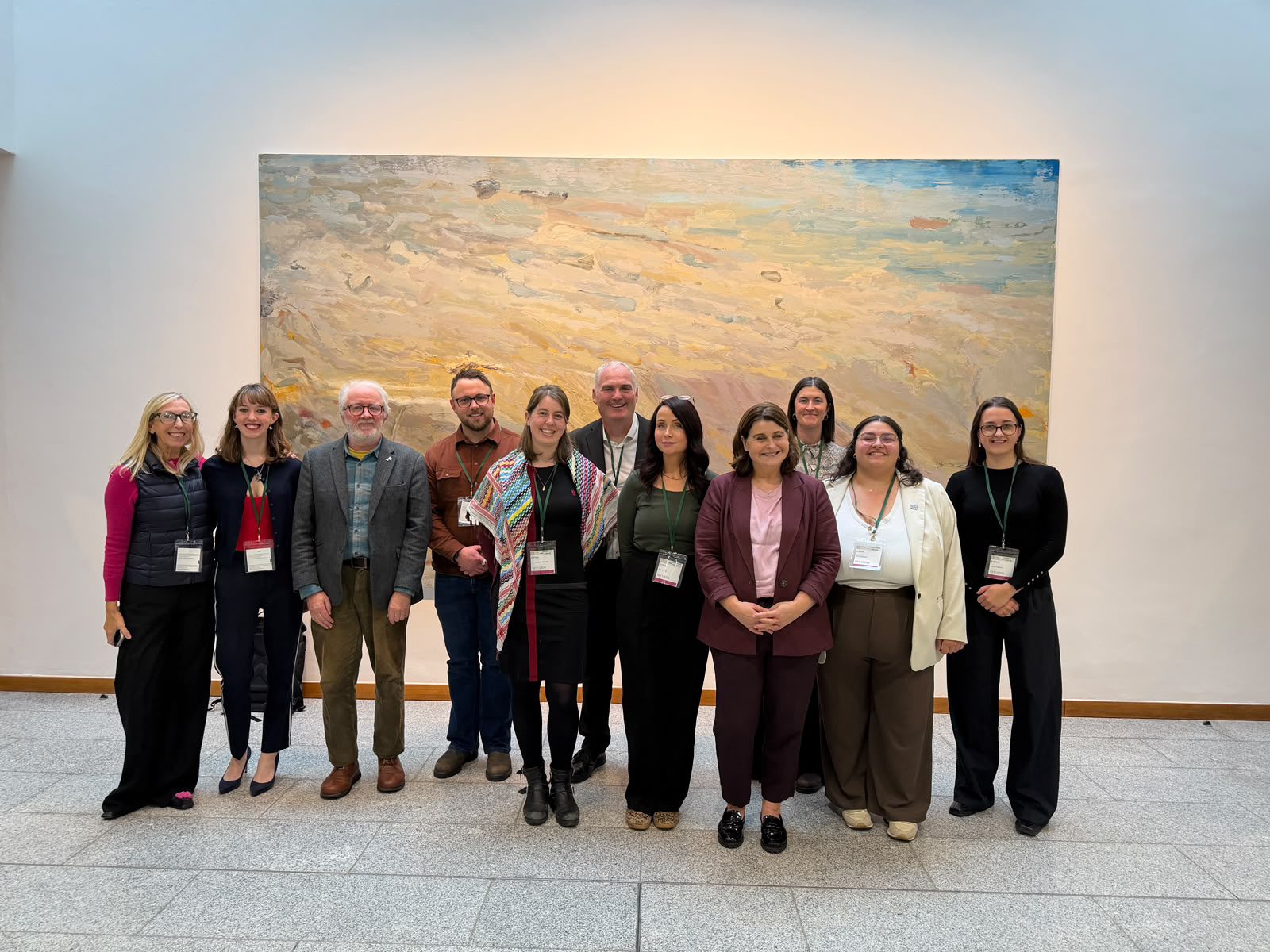
From left to right : Harriet Donnelly and Flossie Donnelly (Flossie and the Beach Cleaners), Michael Noonan (Department of Housing, Local Government and Heritage), Donal Griffin (Fair Seas), Jenny Bortoluzzi (IEN), Niall McGuirk (Coalition 2030), Grace Carr (IWT), Jennifer Whitmore (TD), Sarah Hegarty (BWI), Eva Lambert (IWDG), Iseult Cambay (Fair Seas)
Why do we need new MPA legislation?
Ireland has committed to protecting at least 30% of its marine area by 2030. However, less than 10% is currently designated as protected, and many existing sites still lack the management measures needed to deliver effective conservation. Marine Protected Areas are designated parts of the ocean where human activities are managed to protect or restore marine species, habitats and ecosystems. When properly designed and managed, they can help marine biodiversity recover, support healthier fish populations and strengthen the resilience of marine ecosystems.
But designation alone is not enough.
An area can be marked as protected on a map without necessarily having the management, monitoring or enforcement needed to protect the wildlife living there.
This is why the new legislation matters so much. It is an opportunity to make sure future MPAs deliver meaningful protection rather than simply adding more designated areas.
A seat at the table for Ireland’s marine wildlife
IWDG attended the Committee as part of Fair Seas, a coalition of seven Irish environmental organisations and networks working towards an ecologically coherent and well-managed MPA network. Throughout the session, Fair Seas representatives raised concerns and recommendations around conservation objectives, fisheries management, strict protection, stakeholder engagement, accountability and long-term funding.
Representing IWDG, Eva brought a particular focus to the ecological side of marine protection, drawing on her background in marine mammal research and spatial ecology.
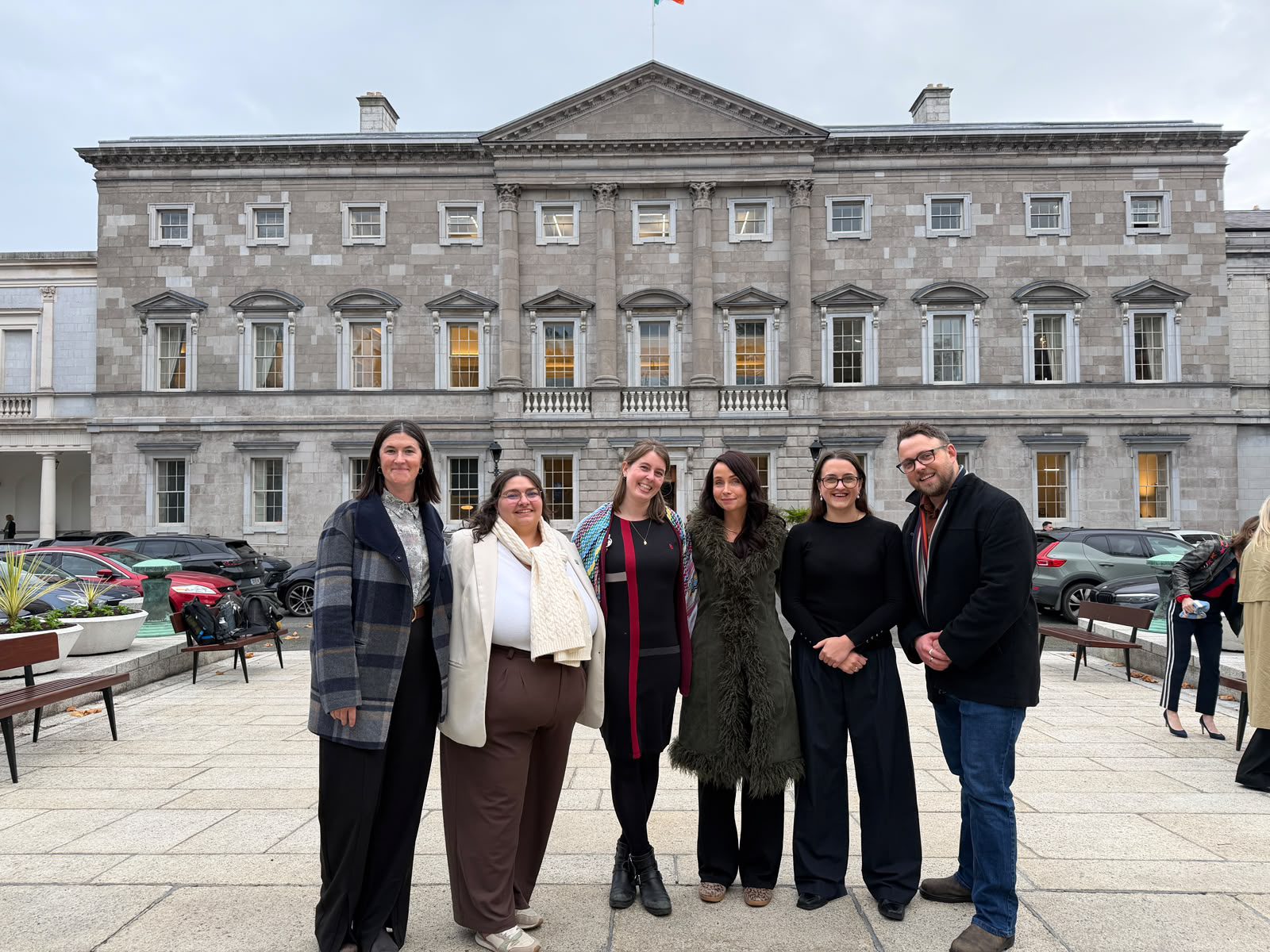
From left to right : Sarah Hegarty (BWI), Eva Lambert (IWDG), Jenny Bortoluzzi (IEN), Grace Carr (IWT), Iseult Cambay (Fair Seas), Donal Griffin (Fair Seas)
Four key issues were central to her contributions.
1. Protecting a network, not just individual areas
One of the main messages was the importance of looking beyond individual MPAs and considering how they connect.
The ocean is not made up of isolated ecosystems. Species move, habitats interact, and what happens in one area can affect another. This is particularly important for highly mobile species such as whales, dolphins, sharks and seabirds. Ireland occupies an important position in the North Atlantic, with waters that provide feeding habitats, breeding areas and migration routes for a wide range of marine wildlife. Some species travel thousands of kilometres throughout their lives, moving between Irish waters and those of other countries. Protecting a single feeding ground, for example, can be valuable, but it may not be sufficient if the same animals face significant pressures elsewhere.
This is why IWDG advocates for an ecosystem-based approach to marine conservation: one that considers not just individual species, but their habitats, prey, ecological relationships and movements throughout their life cycles. An effective MPA network needs to be ecologically connected, representative and capable of contributing to conservation beyond Ireland’s own maritime boundaries.
Watch Eva discuss the importance of an ecologically connected MPA network.
2. Planning for the ocean of tomorrow
Another important message was that marine protection cannot be based only on today’s environmental conditions. Our oceans are changing. Climate change is affecting marine habitats, species distributions and the conditions that influence where animals feed, breed and migrate. If we design protected areas solely around current patterns, there is a risk that they will become less effective as those patterns change. This is why adaptive management is so important.
MPAs need clear conservation objectives, continued scientific monitoring and the flexibility to review management measures as new information becomes available. Scientific evidence should guide both where we establish MPAs and how we manage them over time.
In other words, marine protection needs to respond to change rather than assume the ocean will remain the same.
Watch Eva discuss why MPAs need to be adaptable to future changes.
3. Understanding the bigger picture: cumulative impacts
Marine wildlife faces a growing range of human pressures, from fishing and underwater noise to pollution, shipping and offshore infrastructure. These activities cannot always be considered independently. A single activity may appear to have a limited impact, but when combined with other pressures affecting the same habitat or population, the overall consequences can be much greater. This is the principle of cumulative effects, and it is particularly relevant when planning how different activities will coexist in Irish waters.
IWDG believes that effective marine spatial planning needs to consider these combined pressures, using the best available scientific evidence to guide decisions and reduce impacts on marine ecosystems. Protecting biodiversity requires looking at the wider ecosystem, rather than assessing every activity or development in isolation.
Watch Eva discuss the importance of considering cumulative effects.
4. Bringing coastal communities into the conversation
Marine protection does not happen in isolation from the people who live and work alongside the sea. Fishing communities, local residents, researchers, conservation organisations and other marine users all have important knowledge and perspectives to contribute. Unfortunately, Ireland’s experience with some existing Natura 2000 sites has shown how limited engagement and inadequate management can create frustration and undermine trust. We have an opportunity to learn from that experience.
IWDG and Fair Seas believe that stakeholders should be involved from the beginning of the MPA identification and designation process, and continue to have a role in management, monitoring and review. In particular, fishermen hold valuable knowledge of their local waters, seasonal patterns and changes in marine ecosystems. Combining that knowledge with scientific research can help develop more effective and practical conservation measures.
For MPAs to succeed in the long term, communities need to be active participants in protecting their marine environment.
Watch Eva discuss the importance of stakeholder engagement.
What happens next?
The meeting on 10 November was one of three Committee hearings examining the proposed legislation, with contributions from environmental organisations, fishing representatives, the offshore renewable energy sector and other stakeholders. Following these discussions, the Committee will prepare a report setting out its findings and recommendations. These recommendations can help inform the next stages of drafting the legislation, ahead of its introduction to the Oireachtas.
For Fair Seas and IWDG, the work does not end with this meeting. We will continue advocating for legislation that is grounded in scientific evidence, provides clear conservation objectives, guarantees meaningful stakeholder participation and ensures that MPAs are properly managed, monitored and enforced.
Getting it right for Ireland’s seas
Ireland has a valuable opportunity to improve how we protect our marine environment. But achieving 30% protection by 2030 should not simply be an exercise in drawing boundaries on a map. The real measure of success will be whether these areas allow marine habitats and species to recover, support healthy and resilient ecosystems, and provide lasting benefits for both wildlife and coastal communities.
For IWDG, that means ensuring that the needs of whales, dolphins and the wider ecosystems they depend on remain central to how Ireland plans and protects its seas.
The aim is not simply to protect more of our ocean, but to protect it better.
You can watch the full Committee meeting through Oireachtas TV and read Fair Seas’ analysis and recommendations on the proposed MPA legislation at fairseas.ie.