There have been six confirmed species of beaked whales recorded in Ireland to date, all of which belong to the family Ziphiidae. These are elusive deep-diving offshore whale species, and the majority of what we know about them globally comes from the examination of stranded individuals.
The most frequently stranded beaked whale species in Ireland is the Cuvier’s beaked whale, followed by the Northern bottlenose whale. Other species recorded in Ireland include the Sowerby’s, True’s, Gervais’ and Blainville’s beaked whales. Sowerby’s have been recorded stranded on 37 occasions in Ireland, going back to 1864, while 21 records exist of True’s beaked whales strandings since 1899. The Gervais’ beaked whales had previously been recorded only twice, with strandings occurring in counties Sligo and Mayo in 1989 and 2011 respectively, and a single Blainville’s whale sighting was reported offshore in 2016 near the Rockall Plateau.
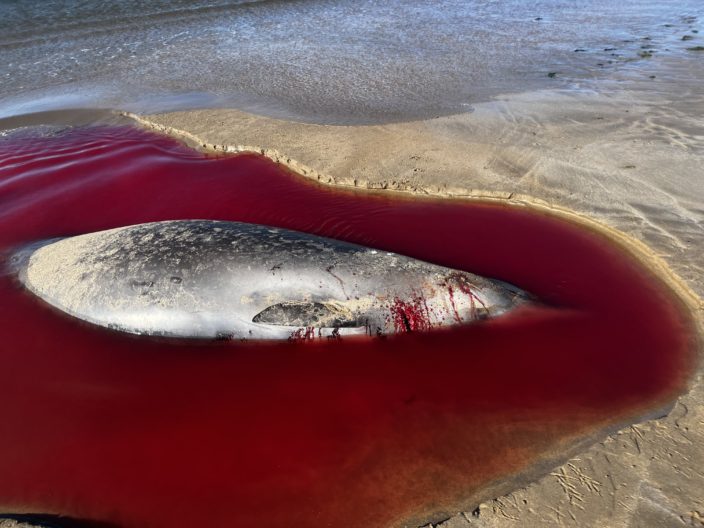
Image sent to IWDG by Gerard Griffin with stranding report
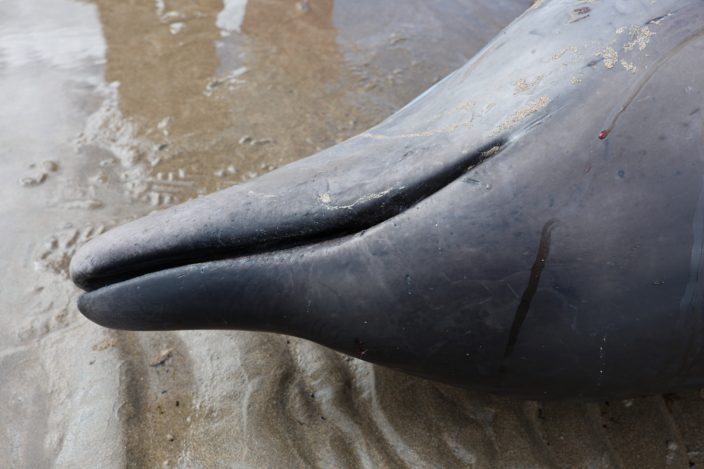
Jaws of the stranded beaked whale. Note no teeth have erupted from the lower jaws © Frances Bermingham/IWDG
Identifying beaked whales can be difficult, both at sea and even when the animal is stranded. A stranded beaked whale is typically identified by examining the dentition. Beaked whales generally have a single tooth on each lower jaw which only erupts through the gums in males, and is thought to be used for fighting rather than feeding. In females, the teeth remain within the gums and are non-functional.
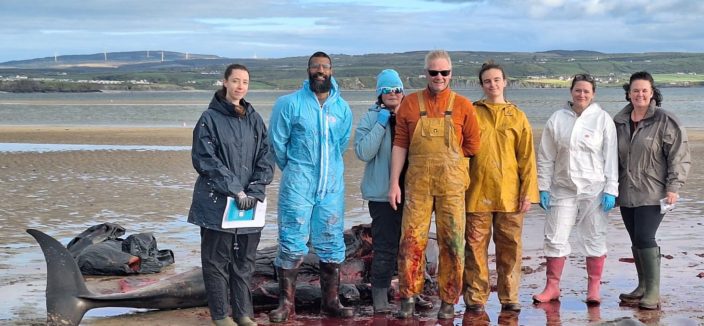
On May 10th, a whale stranded on Kilmacrehy Beach in Liscannor, Co Clare and was reported to the IWDG Stranding Scheme. It was immediately clear to the IWDG that this was a species of beaked whale, though the head and beak were not clearly visible in the photographs.
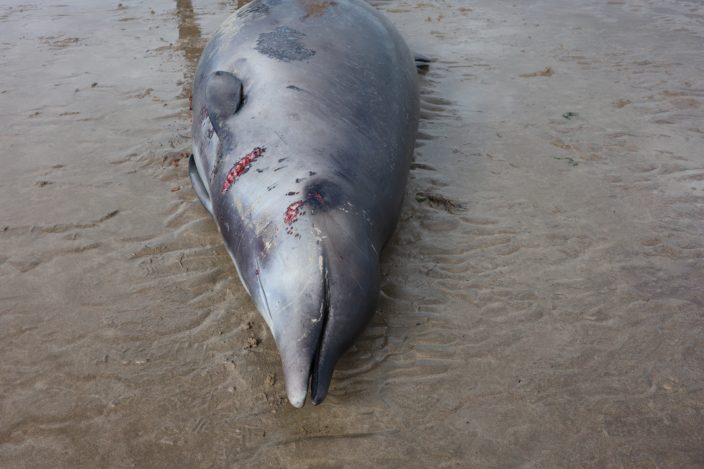
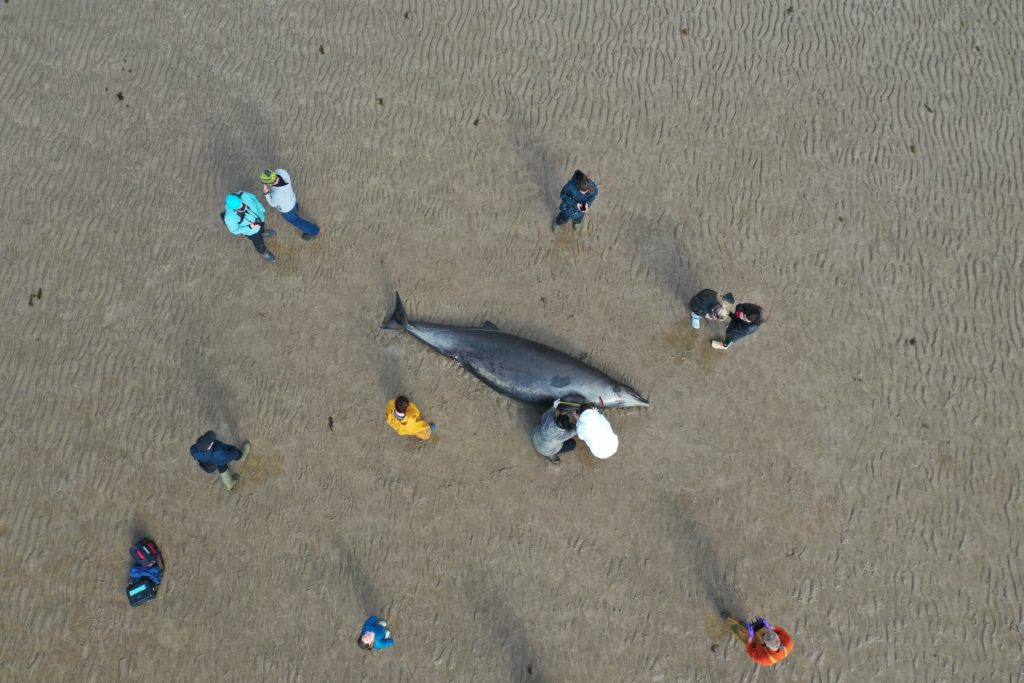
A team from IWDG headquarters immediately set off to examine the animal under our Deep Diving and Rare Species Investigation Programme (DDRIP), which is supported by the National Parks and Wildlife Service. We were also fortunate to have a team from our voluntary veterinary network on site with us. We arrived as the tide fell, further exposing the whale.
The animal was thoroughly examined, measured and photographed, and a post-mortem examination was carried out. The animal was identified as a 4.2 m female. Initial examination of the carcass revealed blood exuding from the genital slit, which led us to believe the animal was pregnant. We were therefore not surprised to find that she was carrying a near-term foetus measuring 194 cm and weighing 66 kg.
The preliminary cause of death was attributed to live stranding, likely associated with difficulties birthing her calf. A suite of samples and organs were taken for further analyses. Samples were deposited at the Regional Veterinary Laboratory, Cork for histological analyses, while the stomach and intestines were removed to provide a rare insight into this animal’s diet, along with other analyses.
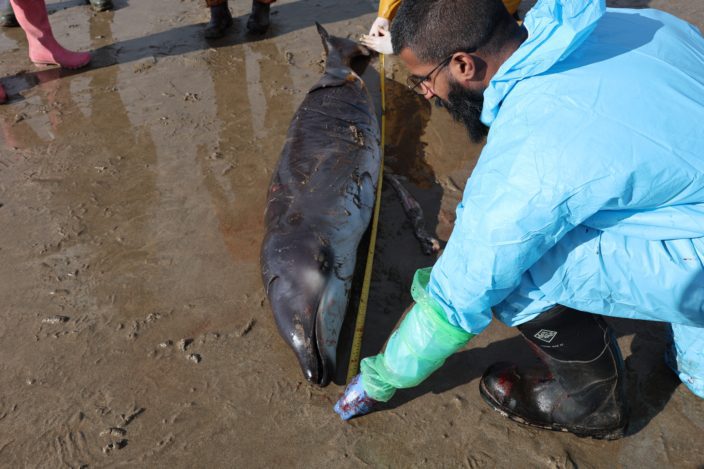
Measuring the near-term foetus © Frances Bermingham/IWDG
As the animal was female and the teeth had not erupted, species identification was a challenge on site. The skull was subsequently recovered and further examined the following day. We then reached out to international experts who confirmed the animal to be a Gervais’ beaked whale.
Although this is the third stranding of this species in Ireland, there have been only a handful of records elsewhere in Europe. The first recorded specimen of Gervais’ beaked whale was found floating in the English Channel in the early 1840s.
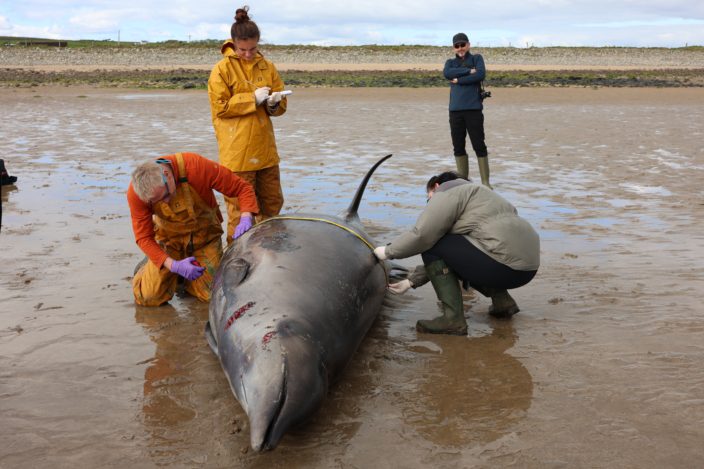
Measuring the girth of the adult female Gervais beaked whale stranded at Liscannor, Co Clare © Frances Bermingham/IWDG
Ireland
- County Sligo (1989): The only complete European specimen was a stranded whale found in Ballysadare Bay. The skeleton is currently housed in the Ulster Museum in Belfast.
- County Mayo (2011): A second stranding was identified on the Mullet Peninsula.
Macaronesia
- Canary Islands: A cluster of seven individuals stranded across the islands between 1985 and 1989.
Iberian Peninsula
- Portugal (1992): A record was documented from Praia de Inatel.
- Southern Spain (1996): A stranding was documented in Andalusia.
- Mediterranean (2007): A stranded individual was recorded in Rota, Cádiz, marking the first confirmed record of the species in Mediterranean waters.
France
- Atlantic/Channel Coast: An unpublished stranding record has been attributed to the French coastline.
As we appreciated the rarity of this whale, its excellent condition and advanced reproductive status, the female foetus was transported to the Vet school in University College Dublin for a CT scan to better understand its anatomy, before being handed over to the National Museum of Ireland (Natural History) (NHM). The IWDG subsequently recovered the whole skeleton, all of which will be donated to the NHM. Samples will be shared with researchers globally to help build a better understanding of this rare species.
Thank you to Gerard Griffin for initially reporting the whale to the IWDG, to Yasin Undre and Melanie O’Donoghue for their veterinary support, to Ana Vale of UCD for organising the CT scan, and to our team — Frances Bermingham, Simon Berrow, Jack O’Callaghan, Emilie de Loose, Kato de Mulder, Csilla Torok and Stephanie Levesque — for their hard work on the beach.