
As part of the Atlantic Whale Deal, it is my job to identify surveys that have a high chance of encountering large whales. These surveys would greatly improve our chances of capturing footage of the cetaceans and their blows on the Sea.AI Sentry thermal camera. So far we had mainly joined the Irish RV Celtic Explorer and had been welcomed by the Faroese Jakup Sverri, collecting hard drives full of video footage to analyse for detection distance, quality and the software’s ability to recognize the thermal signature of a whales blow within the roiling waves of the ocean. Still, we needed more to assess if the thermal camera would be suitable to detect large whales in the open ocean at a great enough distance to alert mariners of their presence and help prevent ship strikes.
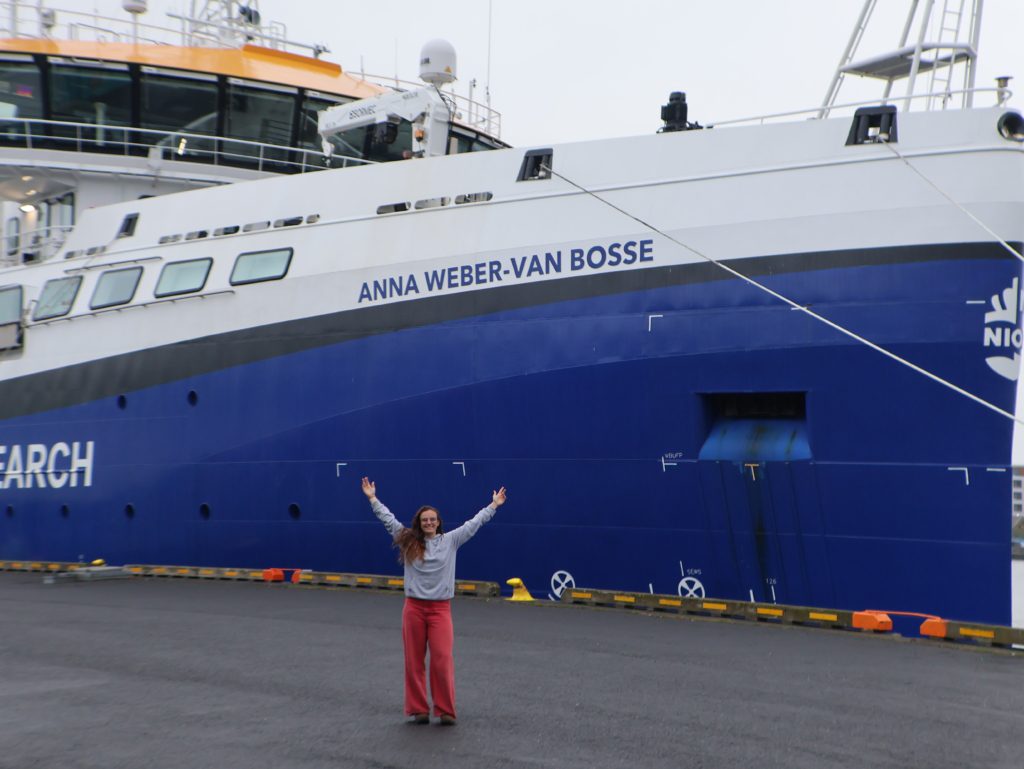
This is why I ended up in contact with Dr. Matthew Humphreys from Royal Netherlands Institute for Sea Research (NIOZ) regarding his SurfCO2 survey. The NIOZ had commissioned a brand-new research vessel, the RV Anna Weber-van Bosse, 80 meters long and full of equipment that needed testing. The ship was scheduled to sail from Reykjavik, Iceland to Genoa, Italy in early June, while Dr. Matthew tested the brand-new underway sampling equipment which would automatically measure various surface water conditions, particularly CO2. This system would allow data to be collected on every survey with limited to no additional handle requirements.
Interesting to us, however, was the route the survey would be taking. The vessel would depart from Iceland, an area known to be incredibly productive and a hot spot for cetaceans. From there it would sail down to the Porcupine Abyssal Plain and conduct deep water CTD’s to 3500m depth. The bathymetry of the Porcupine, with its seamounts and nutritious seafloor was another area where we were likely to encounter large whales. We would skirt the Bay of Biscay, along the Iberian Peninsula, through the renowned Strait of Gibraltar and into the Pelagos Sanctuary in the northern Mediterranean Sea. So, when Dr. Matthew agreed to let us join, we were delighted. He had only 1 stipulation, if we saw something cool, we had to notify the rest of the team too.
That is how I, Emilie De Loose and Carla Rubio Gonçalves from the University of La Laguna ended up boarding the RV Anna Weber-von Bosse in Reykjavik, Iceland.
02/06/2026
I knew that the waters surrounding Iceland were abundant with cetaceans, but I was still surprised by just how true that was. Carla and I had been in the bridge for only 30 minutes, scanning the horizon on either side of the platform when the first minke whale appeared. Within the next hour, two more surfaced. They were quick and quiet, not even a blow, just their small backs and proud fins giving away their position. Not long after that white-beaked dolphins shot by. One pod after the other sped by, leaving us shooting snapshots of the dolphins. By now the bridge was regularly filling with scientists. The rest had not begun sampling yet, still setting up various bits of equipment and preparing labels for the first CTD.
Then, just after lunch I spotted something I first mistook for a buoy. A large, pure black, triangular fin stood proudly above the water, but then it began to move and the beautiful back and tail of a bull killer whale were revealed. It took a second to process, as I had only ever seen these magnificent apex predators once before, far away on the horizon of a previous survey and they were the entire reason I went into marine biology. Then the bridge came alive with action. Coordinates were collected, the thermal camera manoeuvred, other cameras were raised and the team notified. We were greeted by the sight of 7 killer whales along the portside of the ship. They surfaced and swam alongside us for a few minutes, truly stunning us all with the sight. It was a remarkably stunning moment that felt like a good omen for what was yet to come.
By the time the dinner bell chimed, everyone had settled back down. I was standing in line in the mess hall when I noticed a commotion at the windows. “We think we saw a whale”, one of the others said. Sure enough, a tall blow appeared on the other side of the window. I rushed up, back up to the bridge to turn the thermal camera. There, two magnificent fin whales were travelling only a few 100 meters from the ship. It was an unexpected and exhilarating end to a busy first day.
04/06/2026
The next few days were a lot quieter as we passed through emptier patches of the European Atlantic. Then we entered the Porcupine Abyssal Plain, it was here that three CTD’s would be taking place. Each to 3500 meters depth and taking over 4 hours, if everything went right. Carla and I settled in for the long haul at the first station but did not remain settled for long. After only a few minutes the first blow appeared at the horizon. For the next few days, all across the Porcupine, we would be spotting tall and magnificent columnar blows. Most likely fin whales but achingly too far away to rule out blue or sei whales.
Particularly eventful was the PAP-50 weather buoy. We floated 500 meters away from the bright yellow buoy and spotted blow after blow. The whales seemed to taunt us. They knew we could not approach, tethered to the CTD. So, they stayed on the horizon, ever present but unknowable. It was almost laughable. After another 5 hours we began moving again, unfortunately not towards the blows but away. We had almost resigned ourselves to seeing only blows and no backs all day, when a ginormous grey figure appeared right by our bow. One of the whales had decided to stop hiding and swam along side us for several precious brilliant blows, allowing us to confirm that it was in fact, a fin whale.
7/06/2026
After completing the various deep water CTD’s we continued our way south, to the Strait of Gibraltar. The days were marginally quieter, with the occasional blow and the slightly worsening weather. Occasionally we would get another brilliant sighting. During one particularly rough day of seeing nothing but white caps and fog banks we were about ready to call it a day when a small pod of long-finned pilot whales came surging through the waves. The sighting was short, but sweet. Lifting our spirits immediately.
A day before reaching the Strait, the weather was warming and Atlantic Ocean was slowly calming down. We had spotted common dolphins earlier in the day, and a blow on the far horizon. Some of the others had joined us in the bridge and everyone was rather pleased by how the day was progressing. When dinner bell rang, we all aimably and unassuming returned to the messhall. Once again, in an oddly familiar fashion, our dinner was interrupted by a mass of blubber making itself known by blowing just outside our window. Sure enough, another pair of fin whales had decided to join us, foraging as the ship passed. Our dinner was quickly forgotten as we made our way to the deck to admire the animals. There is something to be said about having gigantic windows in messhalls.
11/06/2026
Finally, we arrive at the Strait of Gibraltar. After not seeing land for nearly 9 days, we finally watched as Spain and Morocco appeared on either side of us. Where previously we had been nearly alone out at sea, we now found ourselves surrounded by cargo ships and sailing vessels navigating the strait. While I had heard about the biodiversity in the strait, it was another thing entirely to see it. Despite being one of the planets busiest shipping channels we saw striped dolphins bow riding, mola mola basking in the sun and loggerhead turtles being caried through the waves. Even a handful of flying fish were seen as they broke through the clear waters and flew over the waves.
12/06/2026
It is a general rule of thumb that fire, of any kind, on a ship is bad. However, it is difficult to argue against the tradition of NIOZ holding a BBQ on a survey. Particularly when you are in the sunny Mediterranean Sea. The brilliant crew had organized a delicious BBQ on the back deck for everyone to come together and enjoy. Soon, there was laughter, music and talking as we discussed the final days of the trip and all that we had seen. As the sun rose and the temperature climbed, most of us ended up hanging over the railing like a bunch of seasick sailors, trying to catch the breeze while chatting it up.
It was at this BBQ that I realised that everyone else had prepared significantly better for the Mediterranean weather than I had. My previous surveys, even those in the summer months, had always involved wind and the Irish equivalent of “heat”. We had also started from the predictably cold Iceland, so I had prioritized cold weather clothing. I had completely neglected to bring any shorts or light pants. Thank god I remembered the sunscreen and hats.
14/06/2026
Marine mammal observing in the Mediterranean Sea is much like surveying on a lake. There was so little wind that by the end of the survey there were barely any ripples. This gave us the chance to see a variety of jellyfish and more mola mola. We also got the opportunity to learn the difference between a distant breach of a mobula ray, swordfish and dolphin, so that by the end we could distinguish between them by the shape of the splash.
As we entered the Pelagos Sanctuary or the Ligurian Sea Cetacean Sanctuary, we saw exactly why this international agreement to protect and conserve cetaceans was needed. With various large ships having to pass through this sea, traffic was noticeably increasing once again. Yet, every day we spotted large whales travelling, socialising and resting around us. We spotted several pods of sperm whales that appeared to be logging at the surface. Perhaps resting after a deep dive for food. On one occasion, a single sperm whale rested while the other continually dove and resurfaced around it, seemingly playful.
The sea, once again, turned out its pockets for us in the final 30 minutes of our survey. We were getting ready to wrap it up and saying our goodbye to the water when the show started. Fin whale after fin whale had us running around, collecting coordinates, moving the thermal camera and snapping pictures. The rest of the scientific crew had come together on the bow to enjoy the evening breeze and were now hurrying from side to side as we shouted directions back down at them. It felt so incredibly surreal and was the most beautiful end to a survey I could have asked for.
Our gratitude goes out to Dr. Matthew Humphreys and Captain Meile Bootsma for welcoming us onboard the SurfCO2 survey and the RV Anna Weber-van Bosse, as well as the Royal Netherlands Institute for Sea Research (NIOZ) for being so accommodating.
You can read the NIOZ blog here: https://www.nioz.nl/en/news-and-blogs/blog/surfco2-expedition
Emilie De Loose
Project Officer of the Atlantic Whale Deal