
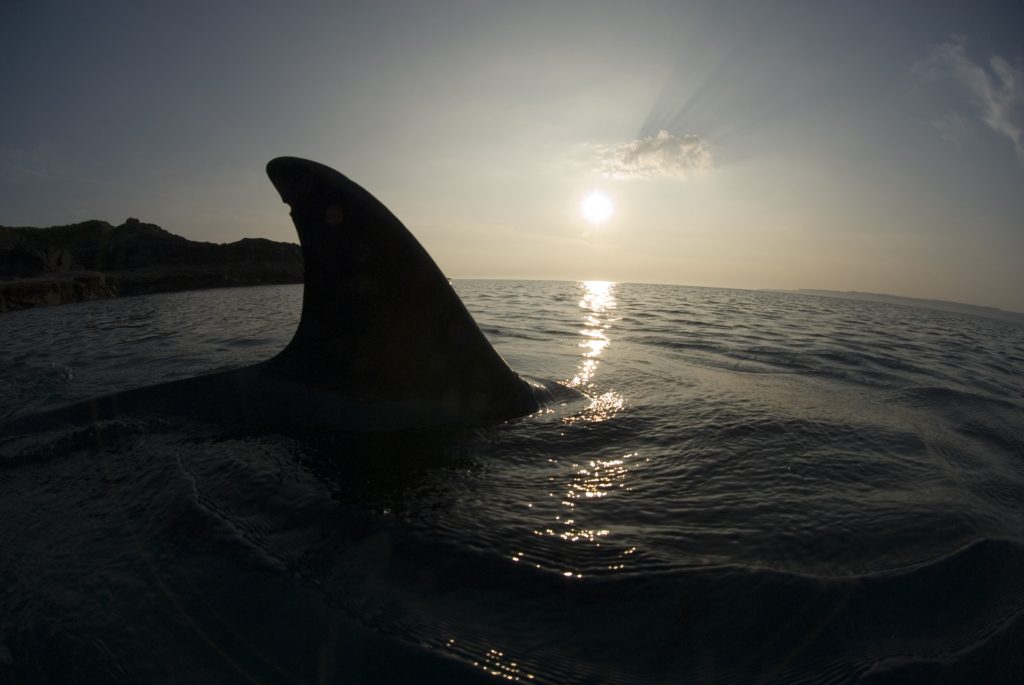
New research has shown that Fungie’s (the Dingle Dolphin) genetic make-up was a mix between the Shannon Estuary bottlenose dolphin population and the Offshore population.
In Ireland there are three genetically discrete populations of bottlenose dolphins: the Shannon Estuary, which is a relatively small population mostly found in the Shannon Estuary, a second Coastal population which ranges primarily along the Connemara-Mayo-Donegal coast in the Northwest of the country and an Offshore population which is part of a much larger group possibly numbering in their thousands and ranging from Scotland to the Azores along the edge of the continental shelf. In parts of the west of Ireland the shelf edge may be as close as 75-100km while in other places greater than 250km from the coast.
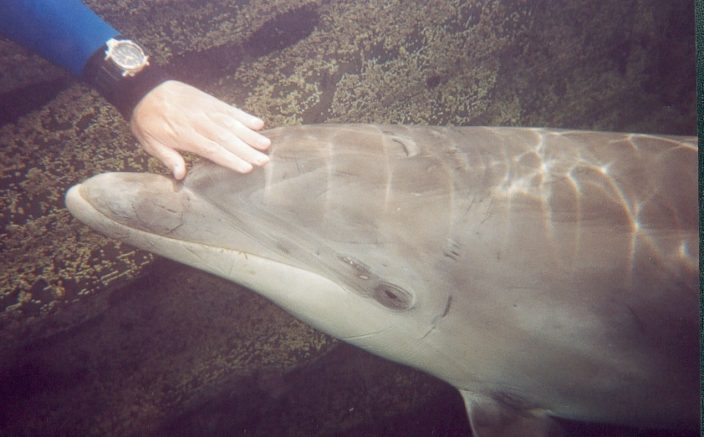
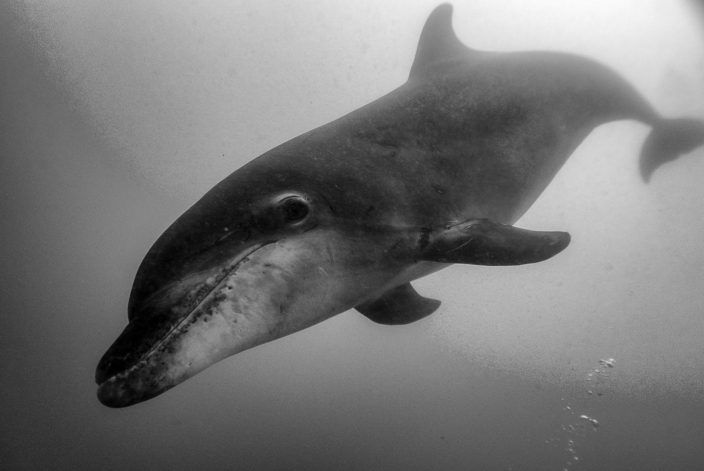
Dusty the Dolphin @ Simon Berrow
A recent paper just published in the journal “Ecology and Evolution” aimed to update our knowledge of bottlenose dolphin genetics in Ireland from individuals either found dead along the shores or sampled while free ranging at sea. Some specific dolphins of interest were also sampled, those that were known as solitary individuals who tend to live alone rather than in pods and often seek out human contact, of which Fungie the Dingle Dolphin was the most famous individual in Ireland. Samples were obtained from Nick, who stranded in Cork Harbour, Finn in Carlingford Lough, Dusty in North Clare, Nimmo in Galway City and Fungie from west Kerry. Samples of bottlenose dolphin DNA were obtained using a number of sampling techniques including recovering sloughed skin and faecal samples and from environmental DNA, or eDNA, where water is collected in the presence of solitary dolphins, or in their known habitat, and filtered. How, however, do you get a sample of DNA from Fungie since he disappeared in October 2020 just as the solitary sampling project began?
Co-author in the study Bogna Griffin explains “Sean O’Callaghan had been interested in Ireland’s unusually high number of solitary bottlenose dolphins, and we had been exploring non-invasive ways to determine which populations they belonged to”. During a research cruise on the Irish Whale and Dolphin Groups research vessel Celtic Mist, IWDG member Denis O’Regan said he had always worn the same wetsuit when swimming with Fungie and had not used it since their final swim together. He swabbed several areas of the wetsuit and sent it Bogna. “Denis kindly collected the swabs, I extracted and pooled the DNA and provided the samples, labelled blindly, to the study”. Subsequent laboratory analysis confirmed that the genetic data obtained from the samples collected was from dolphin DNA (and not human) allowing further analysis and assignment of individuals to their respective source population.
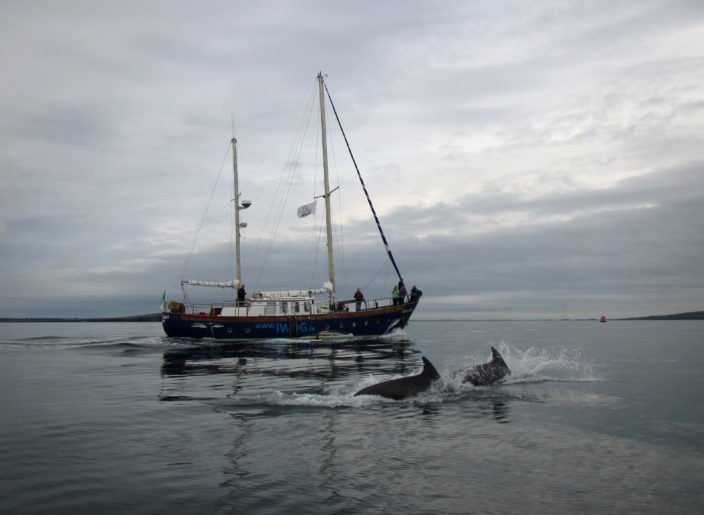
Bottlenose dolphins in the Shannon Estuary with Celtic Mist © Frances Gallagher
To the authors’ great surprise, four of the five solitary dolphins were all from the Offshore population. Only Fungie was different – being of mixed ancestry between the Shannon and the Offshore populations. This is unusual because the research study showed that bottlenose dolphins in Ireland tend to be genetically identified as one specific population or another. It is thought that the Offshore population, which are genetically much more diverse than either the Shannon or Coastal populations are the source population. Following the last great melting of the ice 15-20,000 years ago the sea-level rose up to 200m flooding coastal areas and providing new habitats for dolphins. Individuals from the Offshore population would have moved into these areas as new feeding opportunities occurred and over time these dolphins would have become genetically discrete.
Many of the stranded individuals were also from the Offshore population which also came as a surprise. Dolphins from the Shannon and Coastal populations are not found stranded as frequently as their abundance, or coastal distribution, might suggest. Do they move offshore or move into deep water when dying to a “bottlenose dolphin graveyard”?
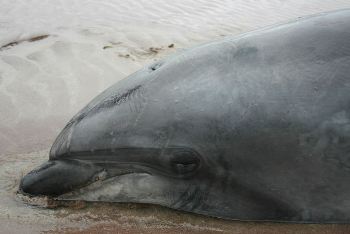
Stranded bottlenose dolphin © Nick Massett
The study was carried out by the late Lorenzo de Bonis as part of his IMBRsea Master’s thesis at the Atlantic Technological University in Galway. Tragically, Lorenzo passed away in a rock-climbing accident while he was finalising this work for publication. The research team completed the publication process in Lorenzo’s memory and as a legacy to his hard work and dedication. Dr Luca Mirimin at ATU who supervised Lorenzo and co-led the work said “Publishing this work was important to advance our knowledge of such iconic marine mammals in Irish waters, but most importantly was a way to ensure that the work of Lorenzo was made publicly available to future generations of scientists. It was an absolute pleasure to work with Lorenzo, he will be greatly missed.”
Co-author on the study and PhD candidate at ATU, Seán O’Callaghan said, “a lot of work has been done to record these unique solitary dolphins, but this study provides a new insight into some of these familiar dolphins using non-invasive sampling techniques and contributes significantly to the wider knowledge of solitary dolphins globally and from where they may originate”
Finn in Carlingford Lough © Damien Smith
Ireland has documented more “solitary” dolphins in recent years than nearly any other country. Most were bottlenose dolphins, of which Ireland hosts a large proportion of the European population. The implications for the management of these solitary dolphins is unclear. “Why these dolphins seek human company rather than socialise with other bottlenose dolphins has long been a mystery” says Dr Simon Berrow of ATU and the Irish Whale and Dolphin Group who initiated the study. This new research on solitary dolphins, which is unique in the world, suggests solitary dolphins in Ireland are from a very different population to the dolphins they may encounter inshore. “Maybe they do not understand each other and use different vocal dialects, confounding communication or perhaps they just have very different ecologies” suggested Dr Berrow “what this study doesn’t explain is why they moved inshore in the first place, but maybe Ireland’s proximity to deep-water and the offshore population facilitates this movement”.
De Bonis, L., Griffin, B., O’Callaghan, S., Daly, M., Maes, J., Berrow, S., and Mirimin, L. (2026) Enhancing intra-specific population genetic studies of bottlenose dolphins (Tursiops truncatus) in Irish waters by integrating least invasive sampling and environmental DNA (eDNA). Ecology and Evolution 16:e74035.
The research is published as an Open Access paper in Methods in Ecology and Evolution and can be obtained here: http://dx.doi.org/10.1002/ece3.74035
The paper is also available on the IWDG members section of our website https://iwdg.ie/members/research/