
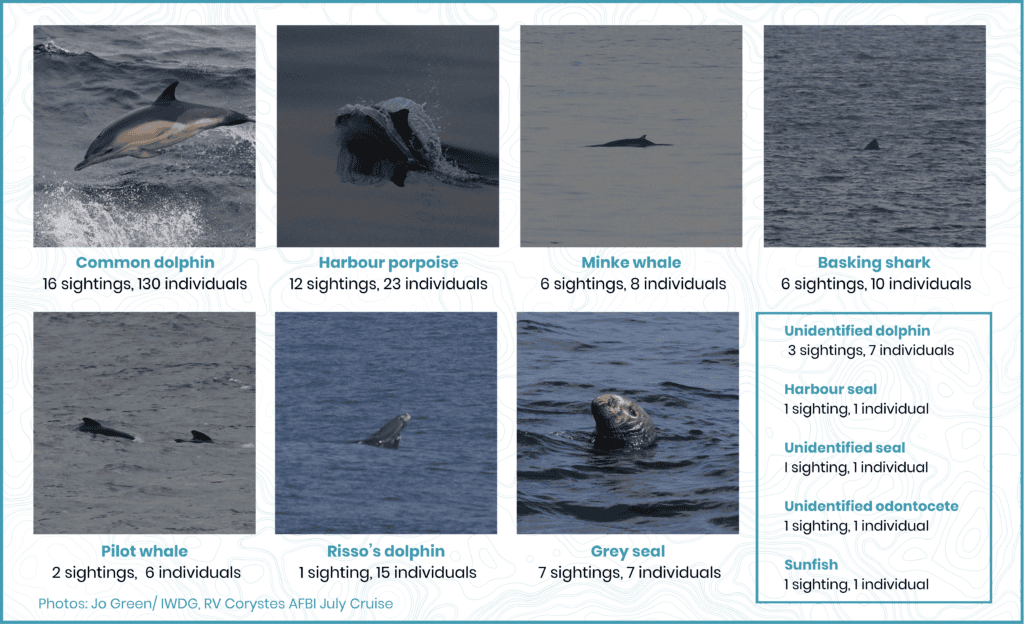
Any time spent at sea looking for whales and dolphins is exciting, and this survey was no different. This July, I headed out with the Agri-Food and Biosciences Institute (AFBI) on the RV Corystes, as the marine mammal observer on their oceanography survey.
The AFBI team were sampling at CTD stations (sampling conductivity, temperature, and depth) across the survey area, servicing moored monitoring stations, and towing a passive acoustic monitoring device during passages. Up at the bridge, seabird researchers from BTO were conducting visual surveys for seabirds, while an observer from the Marine Institute and I (Jo Green, IWDG) carried out effort watches for cetaceans. This data is to go towards the ACCLIMATISE Project, which for IWDG has a particular focus on bottlenose dolphins so we kept a keen eye out for the dolphins, particularly around the north coast of Antrim, Derry, and Donegal.
Day 1: Our busiest day of marine mammal sightings, the Irish Sea
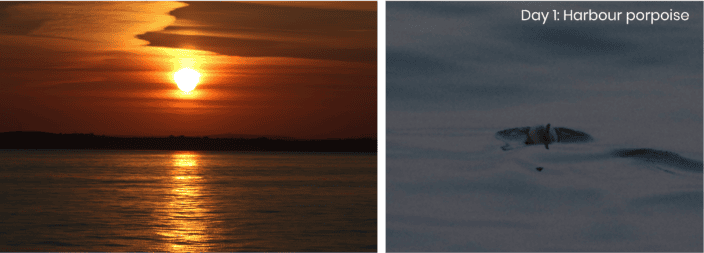
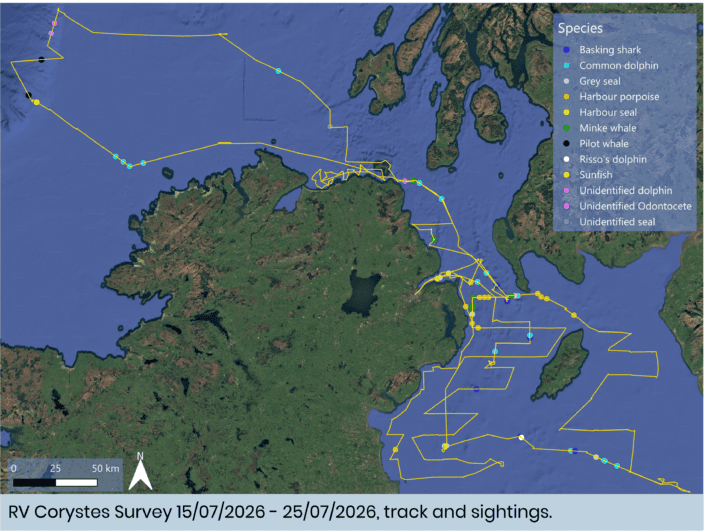
We steamed out from Belfast at 09:00, encountering a harbour seal, two grey seals, and many lions’ mane jellyfish in Belfast Lough. Heading east, then south into the Irish Sea, the evening turned into a flurry of sightings- porpoising harbour porpoises, three travelling minke whales, all heading north, a beautiful sunset and flat calm conditions.
Day 2: Stationary in the Irish Sea with seabirds and seals
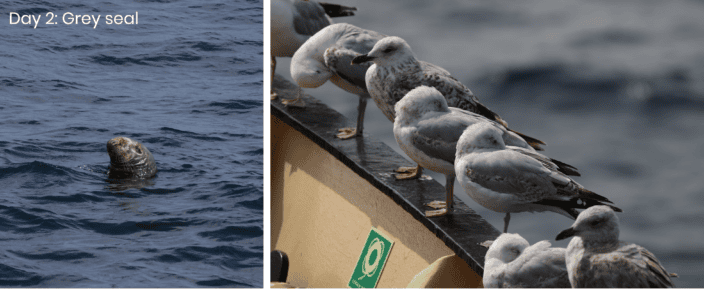
Twenty-four hours of hourly CTD sampling saw us stationary in the Irish Sea on day two, surrounded by gulls and gannets, both on and around the boat. Watches that day yielded two sightings of a curious grey seal, as well as some time spent photographing colour ringed gulls to be reported to their associated ringing group.
Day 3: Risso’s dolphins!
After getting back underway in the morning, we headed east, gulls flying overhead. Sightings were quiet until the afternoon, when we were south of the Isle of Man. A splash was seen ahead, and all eyes focused on the sea. Next thing, a breaching cetacean, and white dorsal fins breaking the surface- Risso’s dolphins! A group of approximately 15 individuals came towards us, with some juveniles seen breaching, and some older, more heavily scarred adults surfacing together and travelling past us. We took some photos, as Risso’s can be identified using photo ID, which were later sent to Siún Ní Cheallaigh for the Irish Risso’s Dolphin Catalogue.

Day 4 to 6: Back to Antrim. Searching for bottlenose.
With no sightings and poor conditions on day 4, day 5 began with calm conditions east of the Isle of Man. As we made our way across the North Channel, we had four harbour porpoise sightings, and despite a worsening sea state we had two common dolphin sightings and saw one grey seal and one minke whale. We made our way back over to the beautiful east Antrim coastline, hopeful for an appearance of the coastal bottlenose dolphins, but to no avail. We did however spot, whilst stopped for a CTD, a large minke whale, surfacing amongst some diving gannets.
On day 6, marine mammal surveying got underway at 07:00 just north of Lough Foyle. We zig zagged close to the coast all day, heading east past Portstewart, Portrush, the Skerries, and Dunluce Castle, areas where bottlenose dolphins had been seen earlier in the day, and in recent weeks. But sadly, the only cetacean sighting on day 6 was a dead floating minke whale. We steamed over to Rathlin Island in the evening, into Church Bay, spotting some puffins along the way.
Day 7: The Shelf Edge
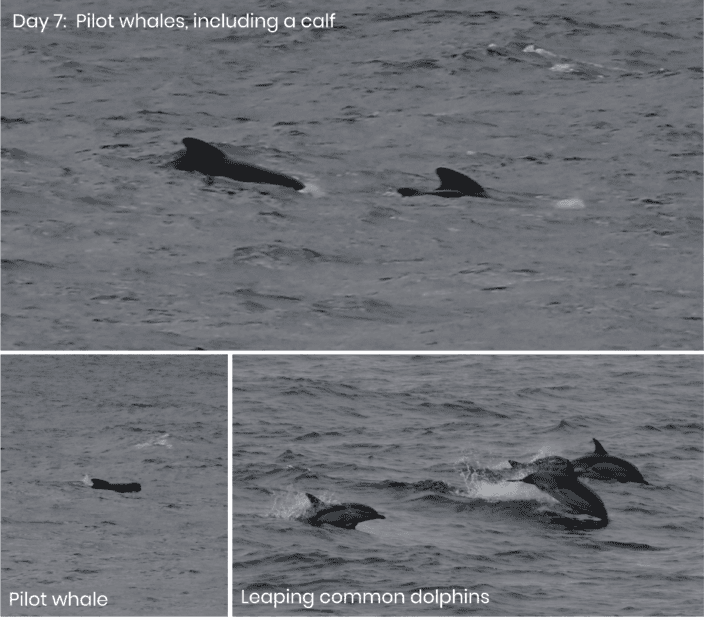
I arrived onto the bridge for one last view of Donegal and Tory Island as we headed west, setting sail for the shelf edge, a little seasick in the rolling swell. The morning watch rewarded us with four common dolphin sightings, including a friendly group heading straight towards us to bow-ride. We had ten sightings today, including a sunfish, some unidentified Odontocetes, and excitingly a group of pilot whales, including a small calf, which were also detected by the hydrophone.
Day 8: Around Rathlin
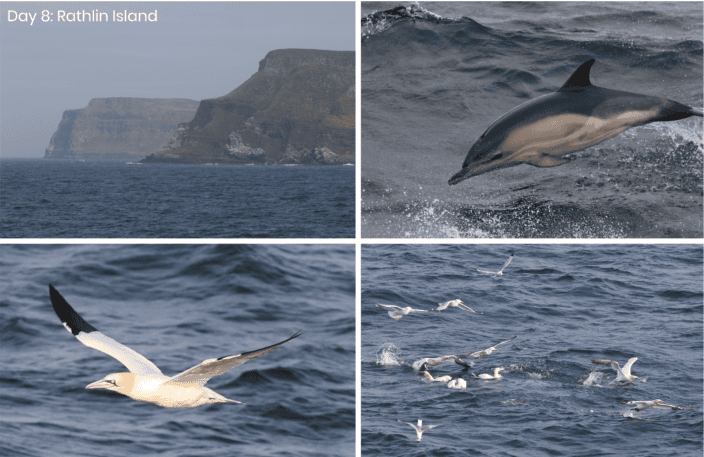
A quiet morning for sightings as we headed southeast from the shelf edge, back to Rathlin Island, encountering a small group of common dolphins and one bottling seal along the way. We travelled around the north coast of Rathlin, surrounded by seabirds, before continuing past Fair Head where we observed a lot of feeding activity- diving gannets and gulls. We looked closely for any cetaceans amongst the activity and soon saw a large minke whale, briefly surfacing just alongside the boat. That evening, a group of common dolphins approached us from all angles to bow-ride, a beautiful sight to watch their agile leaps through the dark blue waves.
Day 9 and 10: Harbour porpoises and basking sharks, the Irish Sea
Surveys began just south of the Copeland Islands, and one harbour porpoise was seen in the morning. We travelled south along the east coast, past Strangford Lough, the Mournes, and down towards the coast of Louth and Dublin. Two more harbour porpoises were seen in the evening, and we rounded Rockabill Island as the sun set.
We headed north again the following day, with no sightings until the evening, when James spotted the distinctive large triangular fin of a basking shark. With the crew closely scanning the area, two more sharks were spotted, all swimming slowly northeast.
Day 11: Returning to Belfast
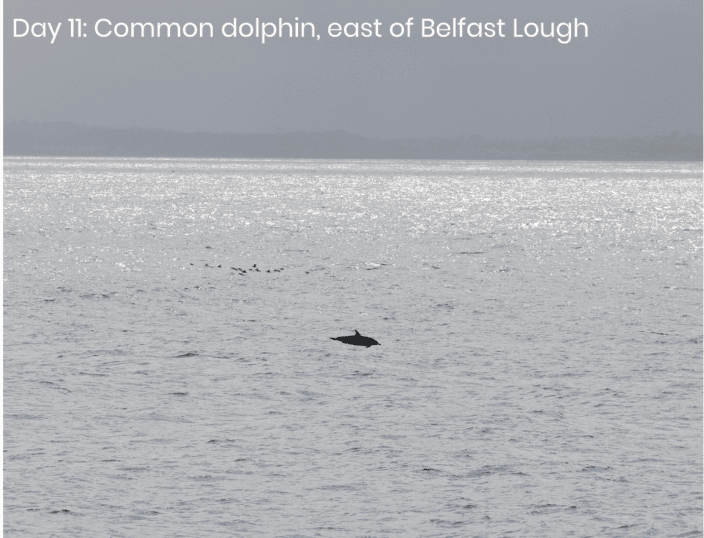
On the last day of the survey, we recorded three common dolphin sightings, and one basking shark sighting. As we zig zagged north, stopping for CTD stations, survey conditions were not ideal. But when we headed back towards Belfast Lough, we encountered a large group of approximately 30 common dolphins. Some approached us, leaping and breaching, before continuing to travel northeast, a fun sighting to complete our survey.
Thank you to AFBI and the RV Corystes crew for running the survey, and for having the IWDG onboard to collect marine mammal data. Thanks to Nova for helping me out with the marine mammal effort watches.
ACCLIMATISE is a project supported by PEACEPLUS, a programme managed by the Special EU Programmes Body (SEUPB).
Written by Jo Green, Citizen Science Officer for the ACCLIMATISE Project.
