
Summer Sightings Summary Roundup 2025
As we are now past the halfway mark in the year, it’s as good a time as any to take a look at what the sightings data might be telling us. With a running total of 1,386 validated unique records year to date, we may be having a quieter year in terms of the volume of sighting reports, although with five months yet to run, it would be premature to write the year off. But relative to the same period in 2024 the number was 1,978, a reduction of 30%.
It’s difficult to second guess why this might be, when the group has hardly ever been busier, but there are a couple of likely contenders.
- Despite a fabulous April -May the weather since June has been disappointing, this always has a knock on impact on reporting levels.
- The demise of recording hotspots like west Cork, where whales it seems are bypassing in favour of the northwest.
- Ongoing technical issues with the IWDG reporting App
We certainly can’t do much about #1. The recent government decision on sprat may in the medium to long term go some way to alleviate #2. But #3, getting our Reporting App back to full functionality is a priority.
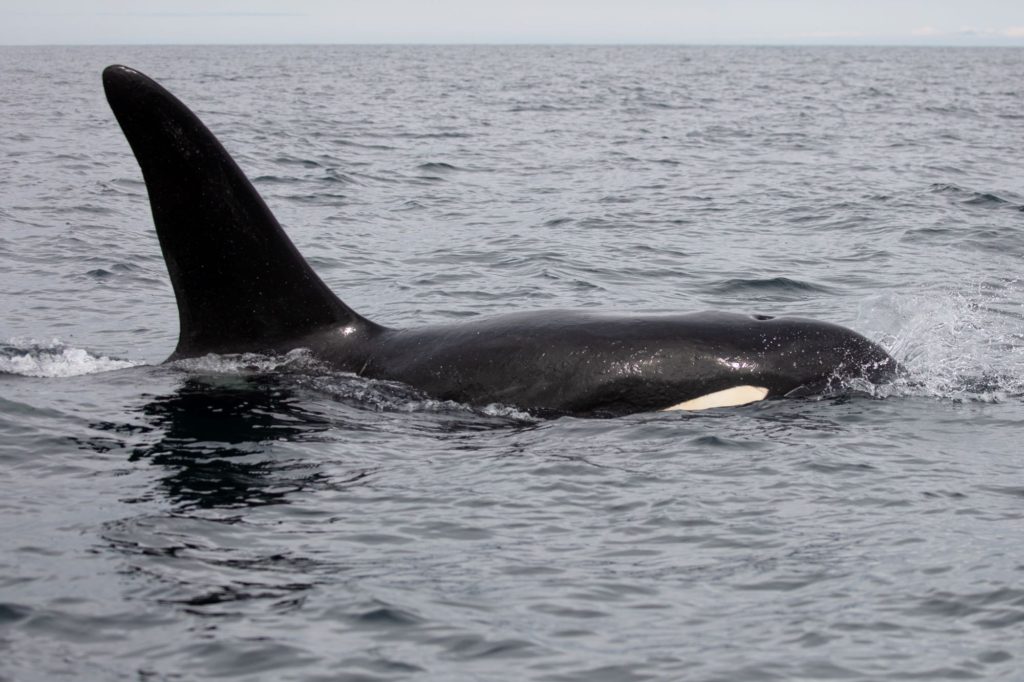
One of the big stories of the summer have been the whereabouts of the killer whale, John Coe (W01), who went off grid after being photographed with his partner Aquarius off Rathlin Island, Co. Antrim on May 5th. We thought it odd that Aquarius turned up alone 41 days later on June 15th around the Blaskets and even more unusual that he remained in the area for up to 10 days till he was last seen near Puffin Island on June 25th. Typically, when they are seen as a pair here, you get a single sighting and that’s it. Gone.
There have been extended periods when the pair separated in Scotland, but they were usually for shorter periods. So when Aquarius showed up again 24 days later this time in Donegal Bay, with sightings between July 19 till time of writing July 31st, confirming he was still alone, our colleagues in Scotland started to imagine the worst and his obituary was being drafted.
There was a collective sigh of relief with the news on July 25th from colleagues in the HWDT that John Coe had been re-sighted after an absence of 81 days off Ardnamurchan Point in the Hebrides. This really only told us one thing, i.e. that he was still alive, but raised many more questions about his whereabouts during his long absence.
It seems unlikely he remained in western Scotland and we can say with reasonable certainty that he wasn’t in Irish waters, so it leaves open the possibility that he ventured further north or offshore. The remarkable thing is that these are marine mammal feeders as evidenced by drone footage captured by Joey Batt on July 19th which clearly shows Aquarius with a small mammal carcass in his mouth , which we now believe to be a common dolphin. “Transient” meat eating ecotypes typically hunt in smaller parties than their fish-eating counterparts, giving them the element of surprise so important for stealth predators, but hunting dolphins on your own is hardly ideal and brings into sharper focus the viability of this pair.
The ranking of our humpback whales says much about how this species is shifting from the Southwest to the Northwest. They were recorded on 26 occasions in Co. Kerry, in the Donegal Bay area on 15 events, with Cork way behind in 3rd place at just 4 four. Whether this is related to climate change, pollution or the industrial extraction of sprat by pair trawlers, it’s impossible to say with certainty, but the recent government announcement could in time shed light on the factors underpinning this northward shift.
Of the ten humpbacks identified so far this season, seven are known to the IWDG Whale Track Project, with three previously unrecorded whales, which have been added to the catalogue, taking it to 139 individuals, bringing us close to Miguel’s population estimate of 156 humpbacks in Irish waters. Oh, and dare we forget to mention it, warm congratulations Miquel on becoming Dr Miguel Blazquez Harvas. Never was a PhD so well earned.
By Padraig Whooley