
During 2025, the IWDG validated 2,478 cetacean and basking shark sighting records, combining both casual and effort related sightings. This is a 16% decrease on 2024. During this period 419 land-based effort watches were carried out from headlands throughout the four provinces, which is similar to 2024. Most sightings reported are mainly from inshore waters of 1-20km but a small number were from places like the Porcupine Seabight, Celtic Deep and offshore off the west coast, which increases the species diversity to include deep diving species such as pilot, sperm and even a blue whale off the Porcupine Shelf on August 21st 2025.
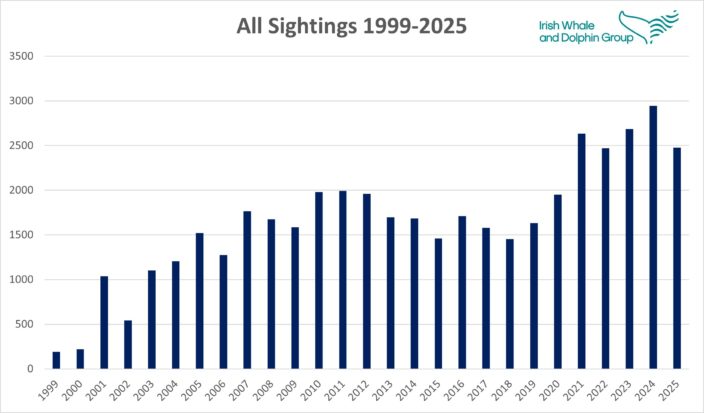
All Species sightings 1999-2025
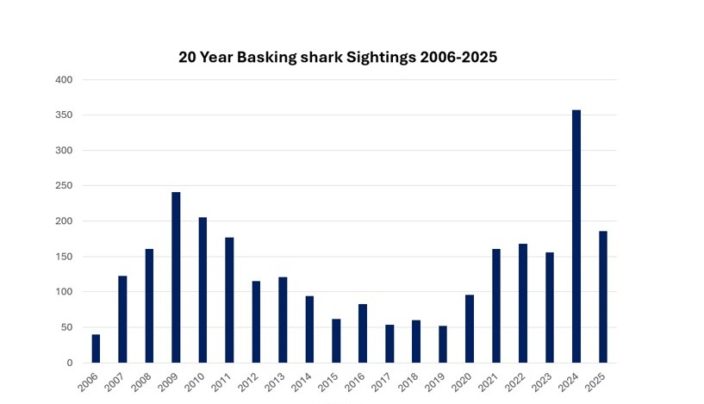
Basking shark sightings 2025
In order of frequency of sighting records, the 10 most commonly seen species were:
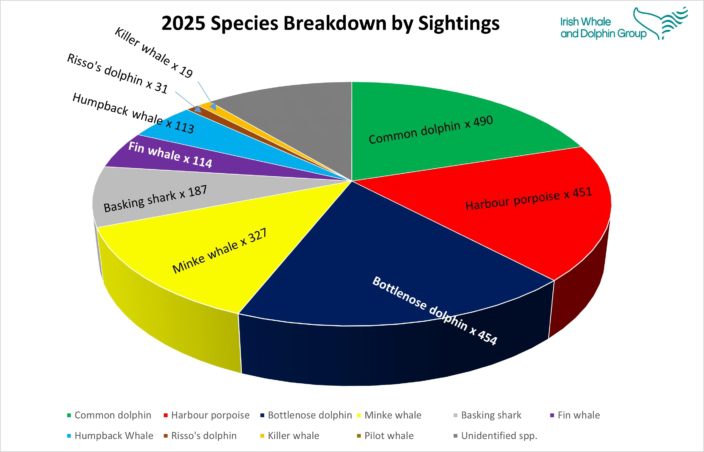
2025 Species breakdown
| 1. Common dolphin x 571 (20%)
2. Bottlenose dolphin x 454 (18%) 3. Harbour porpoise x 451 (18%) 4. Minke whale x 327 (13%) 5. Basking shark x 187 (8%) 6. Fin whale x 114 (5%) 7. Humpback whale x 113 (5%) 8. Risso’s dolphin x 31 (1%) 9. Killer whale x 19 (1%) 10. Pilot whale x 7 – |
|
Sighting summary 2025
The most frequently observed and reported species was the common dolphin with 490 sighting records representing 20% of all sightings validated by IWDG in 2025. 2nd place went to bottlenose dolphins with 454 records (18%). Our smallest cetacean the harbour porpoise came in 3rd with 451 sightings. Minke whales, our smallest rorqual, were again our most frequently reported baleen whale with 327 sightings (13%). The planet’s second largest fish and shark species, the basking shark, although being well down on 2024, which broke all records, still had their 4th best year with 187 sightings (8%). Of our two large rorqual species, fin whale and humpback whales were similar with 114 & 113 sightings respectively (5%).
Completing the summary of “usual suspects” was the mysterious Risso’s dolphin, which in 2025 got a little less mysterious with the commencement of an Irish Risso’s dolphin photo identification catalogue by IWDG Mayo member Siun Ni Cheallaigh. Using data and images provided by IWDG, Siun created a Photo ID catalogue of 103 individually recognisable animals, with more surely to follow in 2026. This brings to four, the number of Photo ID catalogues curated by IWDG. Finally, the killer whales/Orca had a good year with a record 19 sightings in 2025, although most of these were of the same pairing of John Coe and Aquarius from the Scottish “West Coast Community Group”.
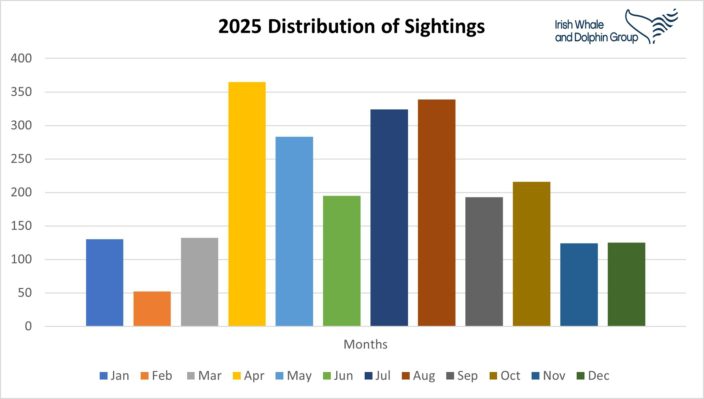
Sighting highlights 2025
Common dolphins seemed to continue their northwards push, but they also pushed inland with many reports of this pelagic species up river systems along the south coast such as the Bandon, Lee, Suir and even the Barrow, while they also made an appearance in the River Shannon, Limerick City and up the Foyle, into Derry City.
Fig. 1 & 2. Common dolphins feeding Dungarvan 28/03/2025 © Fran O’ Connell
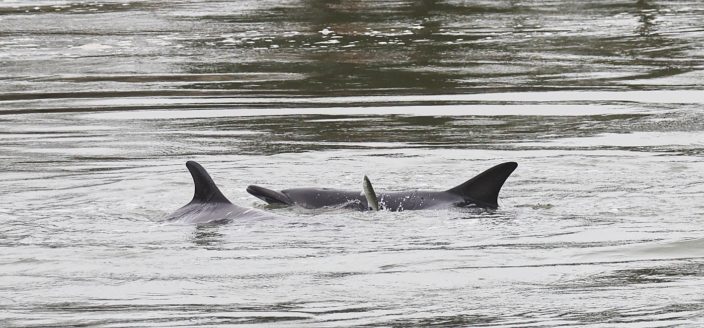
Common dolphins feeding at Dungarvan, Co. Waterford, 28/03/2025 © Fran O’ Connell
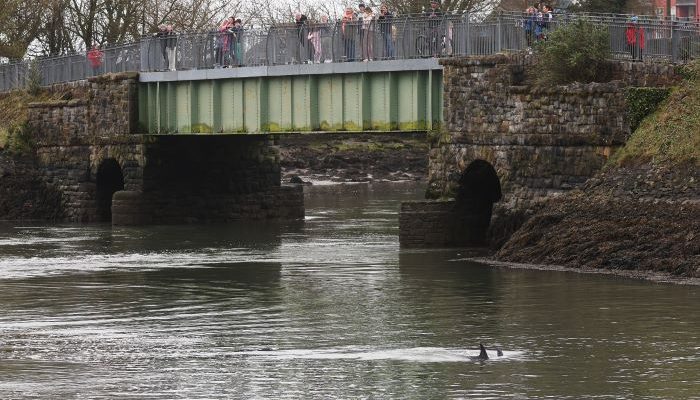
Common dolphins feeding at Dungarvan, Co. Waterford, 28/03/2025 © Fran O’ Connell
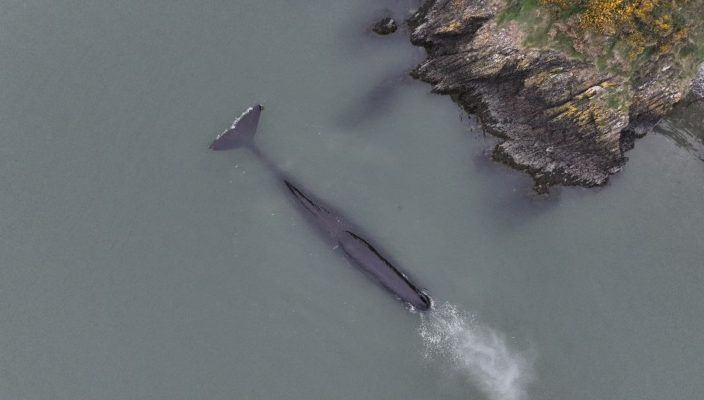
One of the biggest stories of 2025 with a huge social media reach, was that of the sperm whale that entered Waterford Estuary on March 25th. While the feeling was that this deep diving species would not survive the ordeal and we prepared for the inevitable stranding, against all the odds it swam back out to open sea that afternoon, only to appear two weeks later in Ettrick Bay, on the Isle of Bute, Western Scotland on April 8th. It died the following morning on April 9th, got washed back out to sea, returning on April 13th where it was measured as a 16.5 mt adult and confirmed to be a male. This incident was a good example of how sighting and stranding events can merge into more complex events across space and time.
Fig. 3. Sperm whale, Arthurstown, Waterford Estuary, 25/03/2025 © Sarah Kim Watchorn
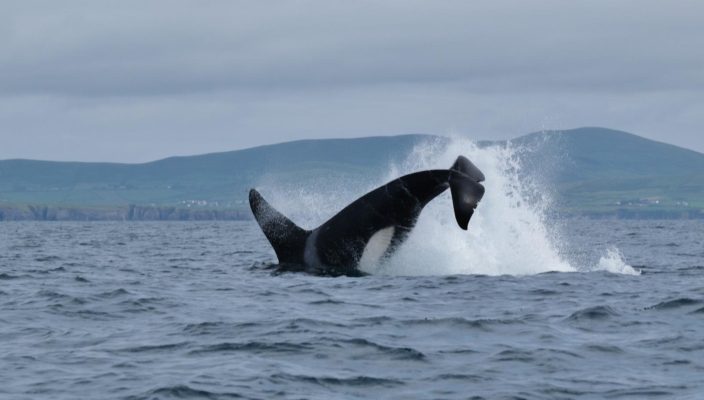
As previously stated the killer whale pairing of John Coe and Aquarius dominated killer whale sightings in 2025, and in doing so caused considerable concern among enthusiasts and researchers on both sides of the Irish Sea. While they were initially recorded together off Rathlin Island, Co. Antrim on May 5th, they then separated, as “Aquarius” was first confirmed alone around the Blasket Islands, Co. Kerry between June 15-25th. A few weeks later he turned up, again alone, in the northwest and between July 19th and August 17th, there were multiple sightings of him in the Donegal Bay area.
Fig. 4: Killer whale “Aquarius”, Dingle Bay, Co. Kerry 18/06/2025 © Nick Massett
With every passing week that John Coe went unreported, concern grew that he may have died, however on August 23rd he finally made an appearance in the North Irish Sea where he was photographed from the Northern Irish AFBI Research vessel RV. Corystes in an area east of Dundalk Bay/ Carlingford Lough. While on the same day Aquarius was off Rathlin O’ Beirne in outer Donegal Bay, so although the duo were separated by a distance of 400kms, they were at least both still alive and seemingly none the worse for their separation. The pair finally reunited on September 15th on their home ground between the Isles of Rum and Eigg in the Hebrides.
Perhaps the biggest story of 2024 was that of the first validated sighting with photographic evidence of a North Atlantic Right Whale (NARW) in Irish waters in over a century, when a sub-adult was recorded off Muckrosss Head, Co. Donegal on July 15th 2024. Not surprisingly we confirmed no further NARW sightings in 2025, but the story re-ignited on November 19th 2025 when an aerial survey carried out by the Centre for Coastal Studies in the US during their first NARW survey of the field season documented a solitary NARW some 23 nm east of Boston, whose callosity pattern was a perfect match for our Donegal Bay animal.
Fig. 5: “Irish” Northern right whale, Boston, US, 19/11/2025, © Centre for Coastal Studies
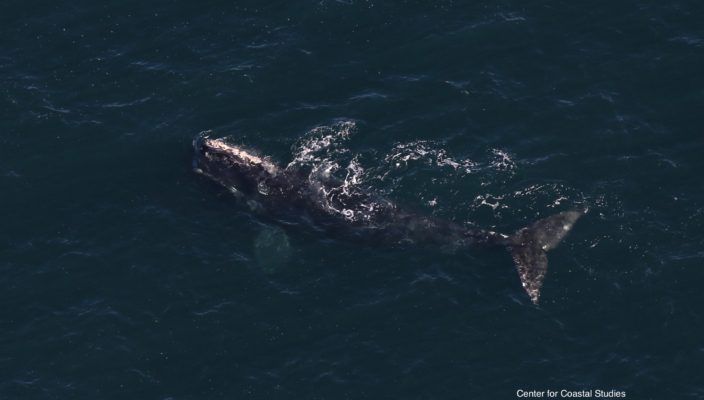
This was the first ever NARW photo-ID match originating from Ireland or any Eastern Atlantic waters to the remnant Western Atlantic population. If more individuals like the whale reported here can find a way to suitable habitats in less high-trafficked areas of the Eastern Atlantic, it may however offer a lifeline for the Western population struggling to overcome anthropogenic risks, like ship strike and entanglement in fishing gear; both of which remain the key obstacles to population recovery of one of the planet’s most endangered whales.
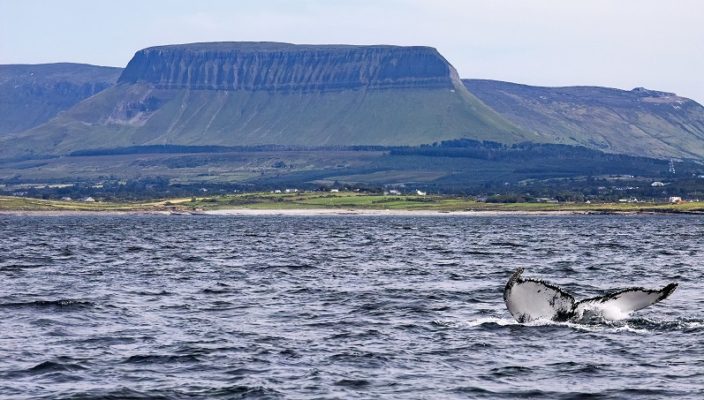
Our humpback whales had a relatively quiet year in 2025, but again the data suggests the continuation of the northwards shift in their distribution, with the biggest sighting hotspot being the Donegal Bay area. By the season’s end, we had documented 14 recognisable humpback individuals, 10 of whom were known to IWDG from previous years, while 4 could not be matched to the Irish humpback photo ID catalogue and so were added to this resource, taking it to 140 individuals. Once again humpback whales were not the only large whale species to find more favourable foraging areas in the northwest, as they were often recorded in Donegal Bay with fin whales.
Fig. 6: Humpback whale #HBIRL047, Donegal Bay, Co. Sligo, 13/07/2025 © Tom Ormonde
In Conclusion
The impact of social media platforms such as Facebook, Twitter (now X) and Instagram on biological recording schemes is of ongoing concern. Up to relatively recently, www.iwdg.ie was the primary Irish platform where people could show others what they were observing. However, now people will post their images or videos on their own platforms, and while a percentage of these will filter down to the IWDG, many presumably do not. Today’s image-rich social media environment has however greatly improved our ability to validate records to species level, which has improved from an historic 86.5% to 89% in 2025.
So, while the Sighting Scheme remains the country’s primary repository for validated cetacean sighting records, the state agency responsible for protecting our wildlife and habitats can’t assume that the biological recording schemes that underpin so much conservation and research can continue to operate indefinitely without central support. Goodwill, Citizen Science and a considerable voluntary effort can only take us so far, and a critical review of our sighting scheme remains a priority.
We’d like to take this opportunity to thank all our members for reporting their “casual” sightings to us, and to those effort watchers who put in so much dedicated time in carrying out more systematic watches from local sites. You have our respect and appreciation.
Pádraig Whooley – IWDG Sightings Officer