
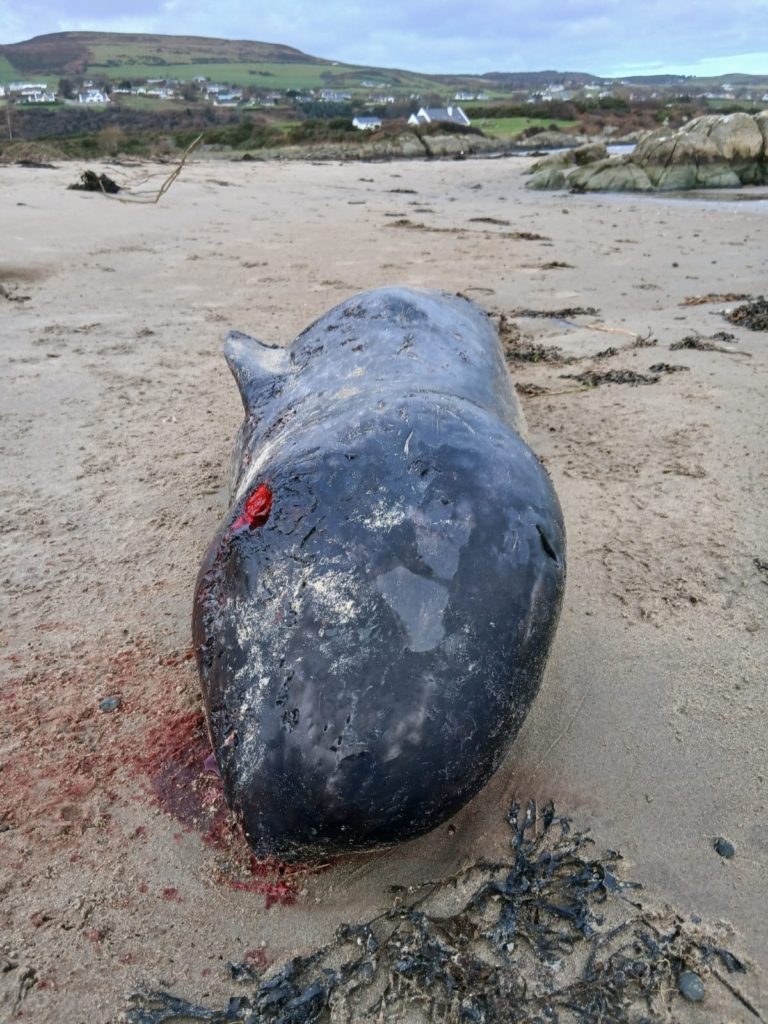
Last weekend, a small 2-3m whale or dolphin was reported to the Irish Whale and Dolphin Group stranded on Sweet Nellies Beach, just north of Greencastle on the Inishowen Peninsular in Co. Dongel.
After reviewing images sent with the report, IWDG Strandings Officer Stephanie Levesque thought it looked like a narwal, a species which had never been recorded in Ireland before. The race was on to recover the carcass to confirm the species and investigate its death.
On Sunday morning NPWS Regional staff found and recovered the animal, where the remains were transported to the Regional Veterinary Lab in Cork. A team including NPWS Marine mammal ecologist Loraine Fay and Simon Berrow, Mags Daly and Stephanie Levesque from the IWDG examined the carcass lead by Cork RVL veterinarian pathologist Jim O’Donovan.
The team confirmed it as a narwhal – the first record for Ireland. It was a young female, measuring 2.42m in length and in quite poor condition. It was very fresh and could have live stranded.
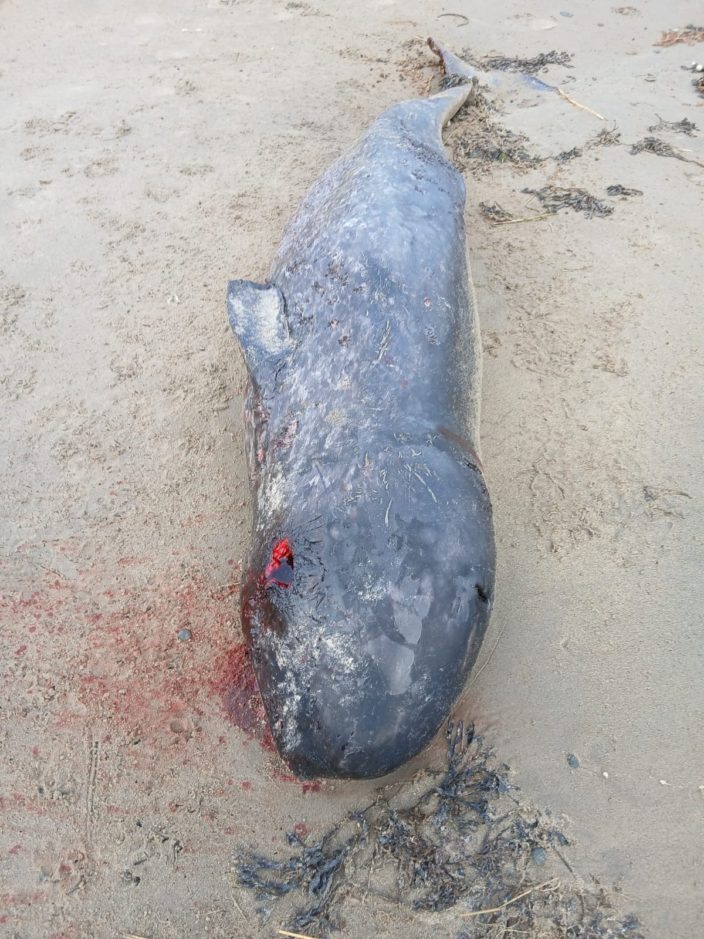
Narwhal on Sweet Nellies Beach, Greencastle. Image by Alena Kunkel.
The whale was first found by Caoimhe, Cara, Aodhán and Saoirse who were walking the beach with their parents. IWDG Stranding Officer Stephanie Levesque said “I asked one of our IWDG local group volunteers Alena Kunkel to go and check it out and I couldn’t believe it when I saw the photographs. After consulting some books, the only thing it could be was a narwhal, but I knew they had never been recorded in Ireland before. I knew the importance of recovering this whale and reached out to our stranding network to see who was available. Through a combination of checking it was still there the following morning, helping the NPWS to transport it to their jeep, and collecting a skin sample in case it was washed out, we were very successful”
Narwhal is a toothed whale found exclusively in the Arctic waters of the north Atlantic, north of 60°. They are rarely recorded outside the Arctic with the last stranding record in western Europe a young male washed up dead in Belgium in 2016. Prior to that record, two females stranded in the Thames Estuary, England in Kent 1949. The only sightings are of two off Orkney and one off Aberdeenshire in Scotland in 1882 and one in the Hebrides in 1976. This is only the 10th stranding record of narwhal in western Europe and only the fourth female recorded. As a young female, there was no tusk. Only males, and the occasional female, have one.
Speaking about the discovery, Minister for Nature, Heritage and Biodiversity Christopher O’Sullivan TD said:
“I’d like to thank everyone who was involved in retrieving the stranded Narwhal for their rapid response and collaboration, from the young people who initially spotted it on the beach and raised the alert, to the dedicated teams in the Irish Whale and Dolphin Group, the Regional Veterinary Laboratory in Cork and the National Parks and Wildlife Service of my own Department. This is a significant event and it is important that we try to find out more about why this species arrived on our coastline. An examination is underway which I hope will reveal important details about its life and history, and shed some light on the reasons why it arrived on our shores. The Narwhal is an arctic species that is mainly found in cooler waters. Findings like this are a stark reminder of the vulnerability of wildlife in the face of a changing climate, and the need to protect them.”
Narwhals are small whales measuring up to 4.6m in length and 1700kg but males are famous for their long tusks, measuring up to 3m in length. They are often dubbed the unicorns of the sea. This stranded narwhal was a female and had no tusk. The word “narwhal” comes from the Old Norse nárhval, meaning ‘corpse-whale’, which possibly refers to the animal’s grey, mottled skin and its habit of remaining motionless when at the water’s surface.
There are an estimated 170,000 living narwhals worldwide. The population is threatened by the effects of climate change, such as reduction in ice cover and human activities such as pollution and hunting. Narwhals have been hunted for thousands of years by Inuit in northern Canada and Greenland for meat and ivory, and regulated subsistence hunting continues to this day.
“It’s a remarkable stranding” said Dr Simon Berrow CEO of the IWDG, “as our waters warm we have seen a northern movement of whales and dolphins in Irish waters as fish move north seeking cooler waters. To have an Arctic species stranded for the first time is somewhat unexpected. However we recorded another Arctic species, a bowhead whale, in Ireland for the first time in 2016 so maybe this reflects a breaking down or Arctic ecosystems as the ice melts”. Clearly one stranding cannot display any trends but it does show the importance of our long term monitoring schemes and the power of citizen scientists sending these reports to the IWDG”
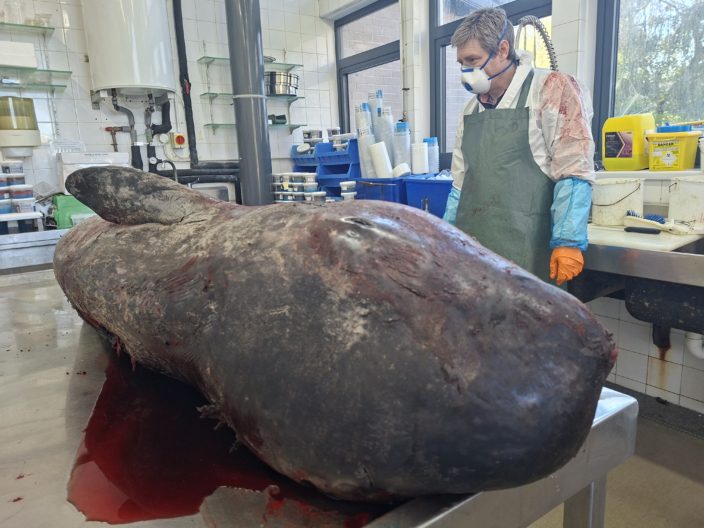
Narwhal in Cork RVL with Jim O’Donovan preparing to conduct a post-mortem examination. Image by Simon Berrow/IWDG
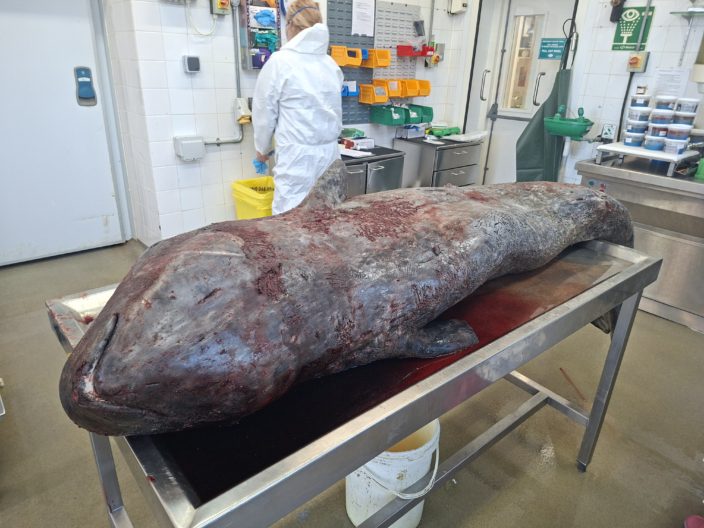
Narwhal in Cork RVL. Image by Simon Berrow/IWDG
Niall Ó Donnchú, Director General of the NPWS said “We can confirm that a female Narwhal, a species never before recorded in Ireland, was discovered in Co Donegal last weekend and has since been retrieved for scientific examination. This is an extraordinary and unprecedented event. I want to acknowledge the swift actions of the family who reported the stranding, as well as the rapid and professional response by the Irish Whale and Dolphin Group and our NPWS regional colleagues. As we await the results, NPWS will continue to work closely with our partners to monitor Ireland’s marine environment and to better understand the impacts of climate and ecological change on vulnerable species. Each event like this reminds us of the importance of sustained scientific vigilance and public awareness in protecting our natural world.”
The narwhal was examined as part of the IWDG Deep Diving and Rare Investigation Programme (DDRIP) scheme, funded by the NPWS, where resources are available to react to strandings of rare or deep-diving species for which little is known about their biology in Irish waters. Results from the post-mortem examination and interesting life-history data will be shared once available. The skeleton has been kept by the IWDG to prepare the skeleton for the National Museum of Ireland (Natural History).
Thanks to ……….
IWDG would like to thank the NPWS for their continued support of the IWDG Stranding Scheme and recovering it for post-mortem examination, Jim O’Donovan and staff at Cork RVL for their continued support and of course Caoimhe, Cara, Aodhán and Saoirse for finding it on the beach, Alena Kunkel for sending photographs and Robin Crockett, James Milliken and Gary Burrows for helping us to recover the whale and Emmett and Pauline Johnston for recoverin the whale to Sligo.
Historical narwhal records from Europe
UK Strandings
- on the Norfolk coast (UK) in 1588,
- one in the Firth of Forth (UK) in 1648,
- a female stranded in the River Elbe near Hamburg (Germany) in Feb 1736, a live stranding in Lincs (UK) in Feb 1800,
- a stranding in Yorkshire (UK) in 1806 (not yet confirmed) a stranding in Shetland (UK) in September 1808,
- two females in the Thames Estuary (UK), one in Essex in Feb and the other in Kent in July, 1949
Netherlands: female captured by a fisherman near a sandbank in the Zuider Zee (Netherlands) in March 1912
Belgium: Found at Bornem in the Antwerp province of Belgium on 27 April 2016
UK Sightings
- a sighting off the Aberdeenshire (UK) coast in 1882,
- two sighted off Orkney in June of that year.
- one off Hebrides in 1976