
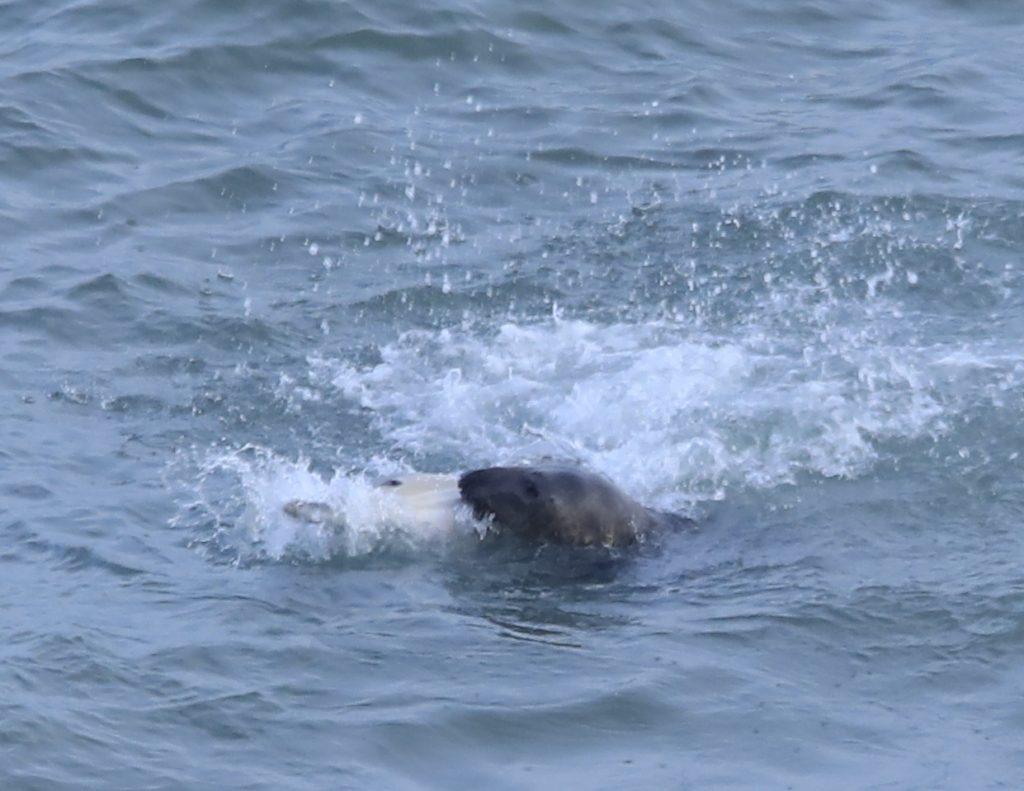
We were discussing only yesterday what our next IWDG “Flukes” magazine might look like, and we’ve settled on the theme of “Change”, which based on this morning’s observations by Dave O’ Connor at Howth Head, could be timely. For Dave, not only records what he sees, but also documents his observations with strong photography. Among his findings are some really interesting behaviours such as the harbour porpoises mating, multiple re-sightings of well-marked individual porpoises, some of whom are likely to be resident year-round and even incidents of herring gulls attacking porpoises. The culmination of Dave’s voluntary effort is the creation of a local Harbour porpoise Photo Identification catalogue which has the potential to morph into something much larger. This morning’s images may be his most significant yet.
We’ve said it many times before here, but the key to being witness to some truly memorable marine wildlife experiences is putting in the time carrying out regular effort (or timed) watches from local vantage points, systematically throughout the year. This means that you are watching in all seasons across multiple years and if you maintain this effort, even for a relatively short number of years, you’ll start to notice the changes. These may be changes in species being seen, changes in arrival and departure times, residency periods, changes in group size and depending on the resolution you are looking at you may even detect changes in prey etc.
If we take the early watch effort from Dublin’s, Howth Head for instance, where Conal O’ Flanagan spent many an afternoon between 1994-2020 on the Nose of Howth watching the local harbour porpoises, and compare what he saw back then with what Dave is seeing now during his 4+ years (2022-2026), the change in encounter rates and species composition is quite striking. For instance, Conal’s data suggests sightings on c. 66% of watches, compared with Dave’s 84%. Almost 100% of what Conal saw were porpoises, and while the diminutive porpoise still dominates at 91%, they are being followed by bottlenose dolphins (6%), common dolphins (2%) and minke whales. It is unlikely that these changes can be easily explained by observer efficacy or optics, as both are very experienced whale watchers with years of experience and use quality optics. So these effort watches are most likely detecting very real change at local level.
This week’s events illustrate this rather well, with no less than three cetacean species being recorded off Howth head in the past three days (Jan 6-9th). This sort of activity would have been simply unimaginable off Howth 20-30 years ago.
We’ll let Dave’s description below speak for itself but for a little background, this is not the first such grey seal Halichoerus grypus occurrence that has been documented by IWDG on the Irish East coast. Some of you may recall Andy Smith’s November 2021 account with unpleasant video of a grey seal (gender unknown) swimming out to a mother and calf harbour porpoise off Clogher Head, Co. Louth, where the seal proceeded to drown and partially eat the calf. More recently was Ciaran O’ Keefe and Johnny Woodlock’s two-hour observation of an interaction again with a grey seal in the antagonist role but the victim being a common dolphin, off Skerries further north along the Dublin coast in March 2024. Ciaran who was former Director of the National Parks and Wildlife Service was in this instance quite satisfied that the seal, whatever its motives, showed no predatory intent.
Dave O’Connor, Wolfhound Adventure Tours & IWDG writes:
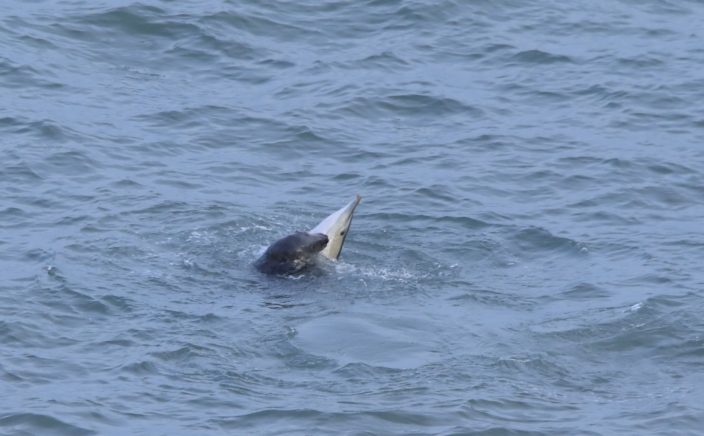
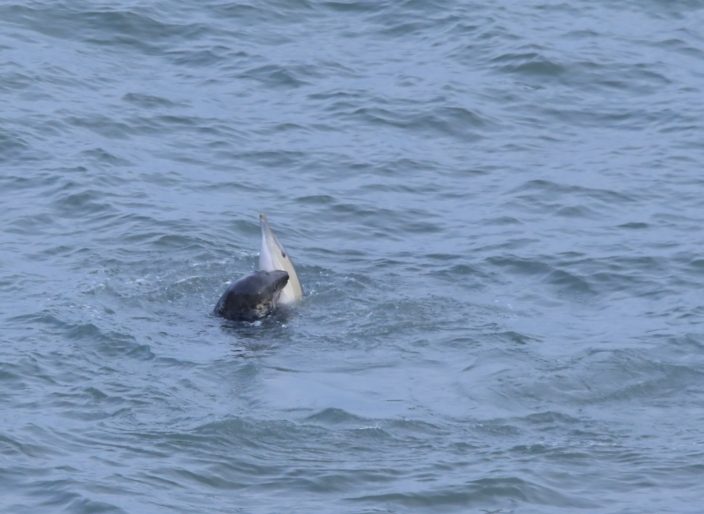
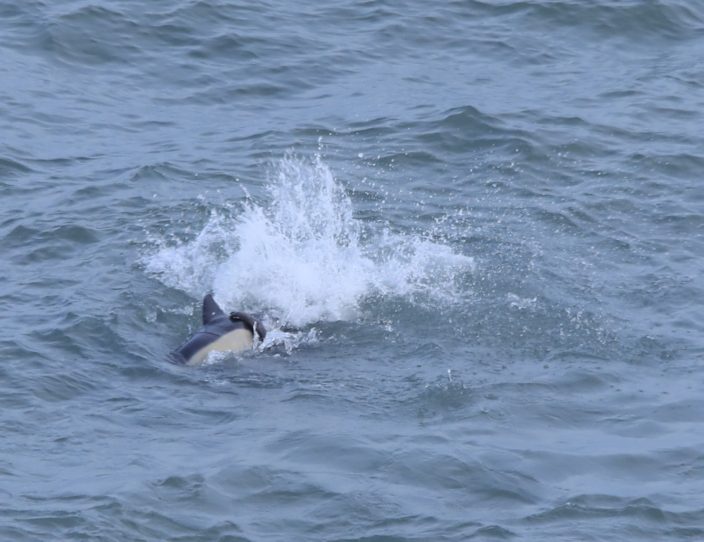
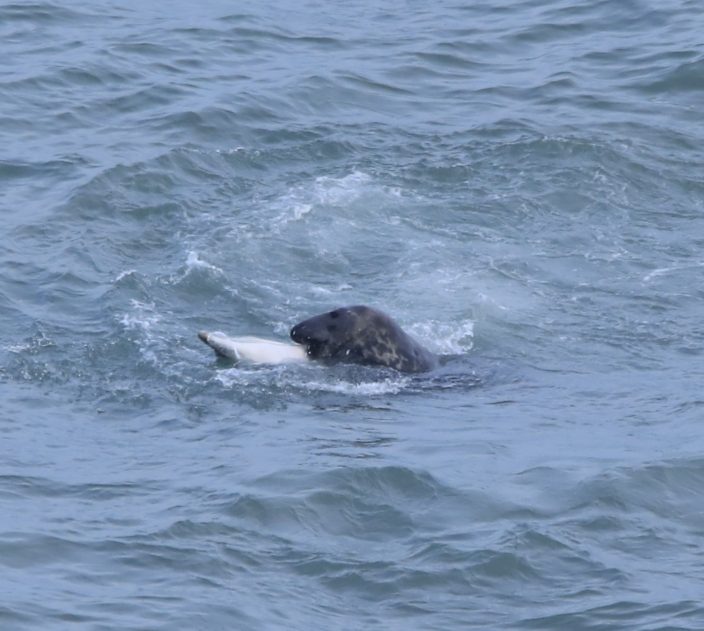
“……. On the morning of Jan 9th 2026 I was up on the Howth Cliff Path conducting one of my regular watches which usually documents our local harbour porpoise population. There had been some dolphin activity in the area in the days running up to the 9th. We’d had both bottlenose and common dolphins in the area on Jan 6th and Jan 7th , respectively. On the 8th of Jan I had found a dead common dolphin floating near the Nose of Howth which appeared to have been fed upon, possibly by seals but definitely by gulls etc. So, I was delighted to see, on the morning of the 9th, heading South near Casana rock a small pod of common dolphins foraging under some gulls. A tourist boat came by and the dolphins changed their direction of travel, heading back North towards the Nose of Howth around 09.45am. They were travelling, but not at top speed. Not breaching etc. I did my best to keep up with them to try and get some good images but they had a couple of hundred meters head-start on me. As I was getting closer to them, at 09.51 a.m. I noticed that one dolphin had sort of stalled in the water. It looked a bit like the behaviour we call logging, when a dolphin or porpoise rests at the surface, but then some vigorous splashing started and I realised this dolphin had been attacked or had got caught in something.
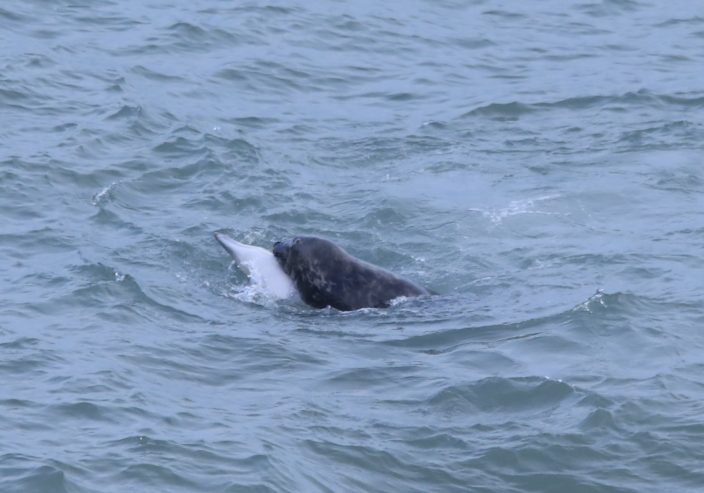
I noticed then that something darker had grabbed onto it and realised then it was probably a grey seal attack. I had heard of this behaviour but never expected to get to see it. So, I just let the camera snap away at the area of all the splashing and these pictures are the result. The seal and the dolphin disappeared under the surface after about 30 seconds and I didn’t see either of them again, despite waiting around the area for another 30 minutes or so. So, it’s possible this story has a happy ending for the dolphin as it may have escaped. I saw the pod swimming north shortly after the attack, towards Lambay but I’ve no clue if the dolphin that was attacked was with the group or not. It’s also possible we could find another dead common dolphin in the area in the coming days. But it was a thrilling and fascinating encounter either-way.”
So, we’ll let you decide as to the nature of this interaction. Was it a predatory attack or just robust play behaviour by an over enthusiastic grey seal? However, as I look further at the images, I’m left considering a third option; could this have been a rather inappropriate romantic embrace, referred to as “coercive copulation” ? Surely grey seals are smart enough to know that mating outside of one’s species just takes you down a biological Cul-du-Sac; but it may help shine some light on the Skerries incident in March 2024 involving the same two species.
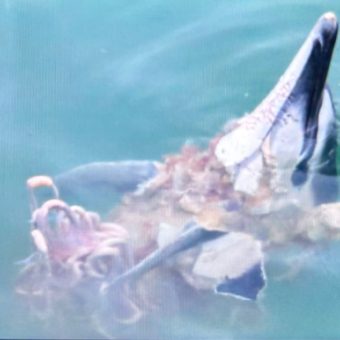
Common dolphin, Jan. 8th 2026, Howth Hd, Co. Dublin © Dave O’ Connor
Was it a coincidence that only the day previous (Jan. 8th) we were sharing gory images of a dead common dolphin with its intestines on display off Howth Head and asking what could possibly have caused such extensive damage? Then the following morning Dave happened to take these images of a bull grey seal interacting with another common dolphin which looked very much like it would rather be elsewhere. Either way, it’s a remarkable observation and an extraordinary capture, which illustrates quite well the old adage.. .. “ if you look, you will see”.
The IWDG’s “Constant Effort Sighting Scheme” is open to anyone with a general interest in biological recording, who has a little free time, a good pair of binoculars, a flexible schedule to make the most of weather windows, and of course a natural curiosity about Ireland’s incredible marine megafauna.
All images below Howth Head, Co. Dublin Jan. 9th 2026 © Dave O’Connor
By Pádraig Whooley, IWDG Sightings Officer
E: sightings@iwdg.ie, Ph. 086 3850568