
The IWDG read with interest the recent Marine Institute Report “Crayfish catch and bycatch in the tangle net fishery off the southwest coast of Ireland in 2021 – 2024” (EMFAF 2021-2027 Marine Institute Report Series). We are very concerned with the high level of bycatch documented in this fishery.
The study examined catch and bycatch data from vessels targeting crayfish with tangle nets for two fleets fishing from Kerry Head south to Brandon Point and in outer Dingle Bay north to the Blasket Islands, Co Kerry between 2021 and 2024. Fishing activity of the vessels was monitored using inshore vessel monitoring systems (iVMS). The combination of observer coverage and skipper reporting enabled high levels of monitoring, necessary for the estimation of bycatch of endangered and protected species where capture rates are low. Annual days at sea per vessel ranged from 58-150 days. Annually, the estimated miles of net hauled by the Tralee fleet ranged from 1,241-1,393 nml, while in Dingle, it ranged from 498-689 nml. Estimates of bycatch of endangered and protected species, raised to Tralee and Dingle fleets, were significant relative to the population status of these species. 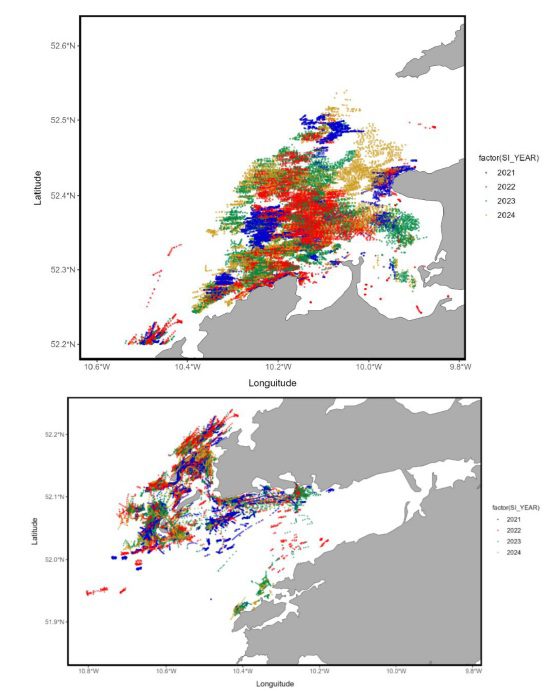
With respect to cetaceans, although only a single harbour porpoise, common dolphin and Risso’s dolphin were observed bycaught. When estimating the total bycatch per species for Tralee and Dingle tangle net fishing vessels, this results in three harbour porpoises, three common dolphins and four Risso’s dolphins bycaught. Coupled with this is the high bycatch rate of endangered skates and rays, grey seals and other non-target species.
The IWDG questions whether this fishery is sustainable and whether it should be permitted in the Blasket Islands SAC, or the Páirc Náisiúnta na Mara, Ciarraí. Although the Blasket Islands SAC only lists harbour porpoise as a qualifying interest and not common or Risso’s dolphin, both these species are listed under Annex IV of the EU Habitats Directive and are entitled to strict protection.
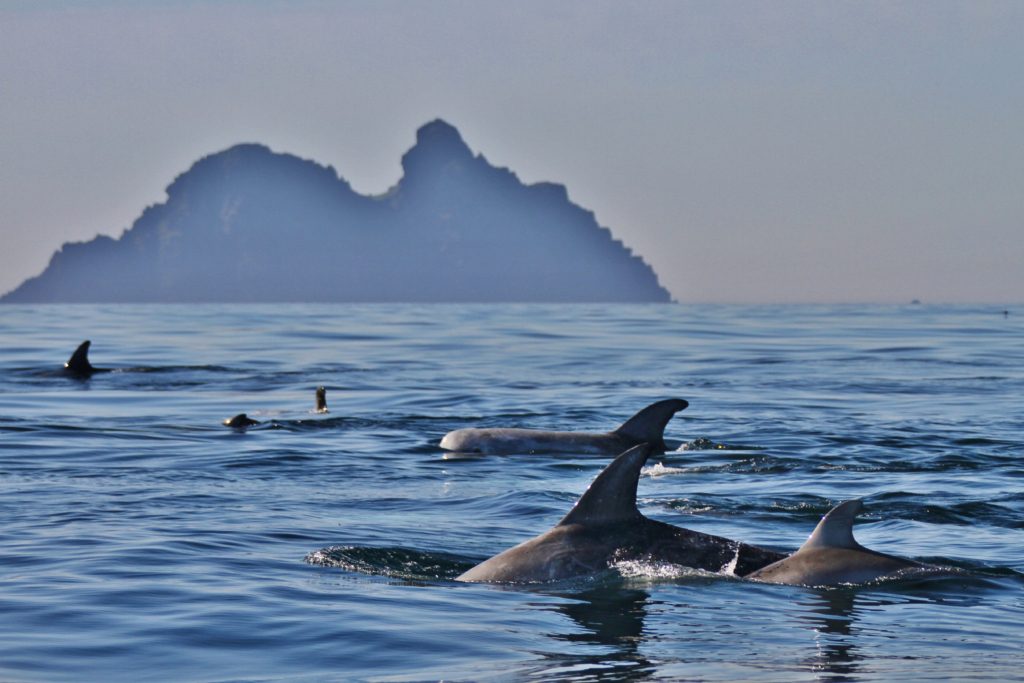
Concerning Risso’s dolphin, this species is only patchily distributed in Ireland with the Blasket Islands recognised as a hotspot. Reported group sizes are rarely very big and although there are no abundance estimates for Risso’s dolphin in Irish waters it’s unlikely that more than a few 100 individuals occur here regularly. A reported bycatch of four Risso’s dolphin could have a significant population-level impact on this small and local distributed species, especially if adult females are taken. A recent ongoing photo-id study of Risso’s dolphins including images obtained from within the Blasket Island SAC has shown high site fidelity, with the same individuals recorded over a 23 year period between 2003 and 2025 (Siún ní Cheallaigh unpubl).
The Marine Institute suggested existing spatial closures for tangle nets are inadequate to mitigate bycatch effects on critically endangered species and switching of fishing gears from tangle nets to pots for crayfish is the optimum solution to eliminate bycatch.
The IWDG congratulate the Marine Institute on this very thorough study and also acknowledge the support of the crayfish fishers from Dingle and Fenit, however given the high level of bycatch of non-target species, the protected status of many of these species and that some of this fishing activity occurs within a marine protected area, the IWDG strongly supports a phasing out of this fishery over a reasonable time frame with appropriate compensation to anyone displaced if this bycatch cannot by significantly reduced or eliminated.
The report is available here: https://oar.marine.ie/items/c2f2cea1-711f-4d9c-95c7-eb08e47ddba2
IWDG letter to Ministers below:
IWDG calls for a phasing out of tangle net fishery for crayfish off southwest Ireland