
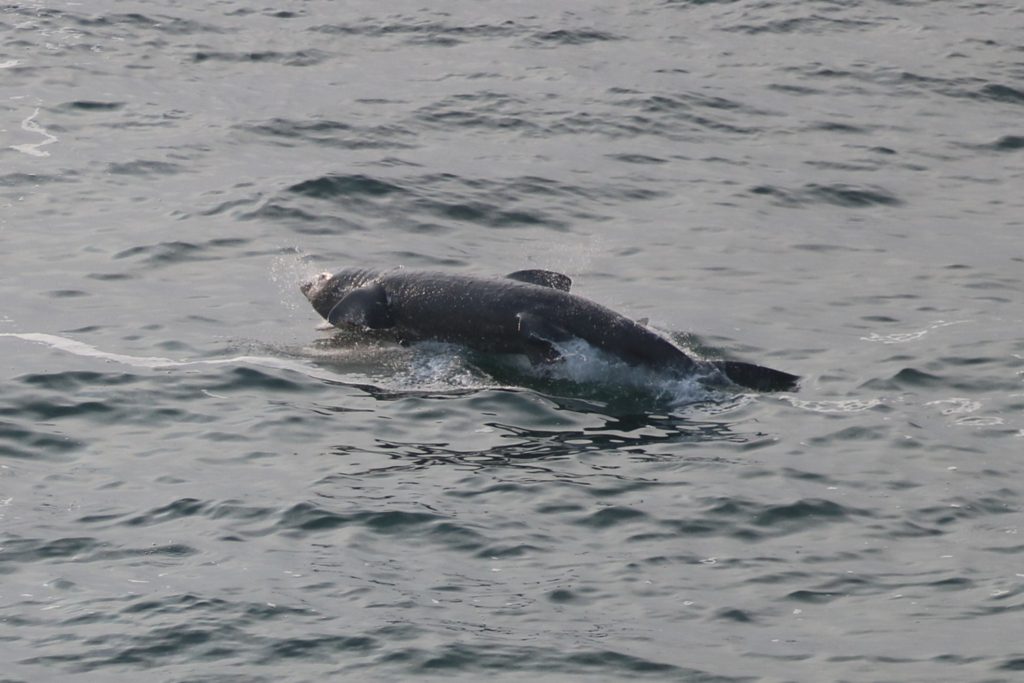
August not only brought us great weather, it also brought back the basking sharks. Earlier this year, the sharks had been spotted feeding around the west coast of Ireland, however they seem to have returned to the West of Clare under different circumstances. Most people are familiar with iconic images of slow-moving basking sharks with their jaws opened wide. This was not the view that hundreds of people were met with this August. Off the coast of Loop Head, the basking sharks aggregated in large numbers, forming giant circles known as Toruses. This peculiar behaviour is believed to be part of their courtship, as both males and females interact with one another in these large groups. Actual mating, however, has never been seen or recorded.
Toruses were not the only fantastic behaviour witnessed, as the sharks regularly breached clean out of the water. The reason for this behaviour remains an enigma that scientists are desperate to crack. Some support the “parasite removal” theory, as large lampreys are known to attach to the pelvic area of basking sharks and may be knocked loose when the animals re-enter the water with a splash. Others think it may be a form of communication—but what are they trying to communicate? Is it to entice a mate? A display of dominance? Or do these sharks simply enjoy the practice?
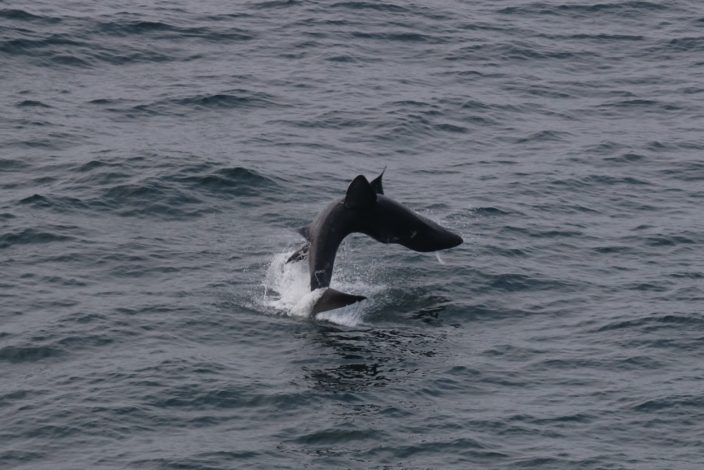
Photo by Jack O’Callaghan
The IWDG spent many hours on the cliffs collecting data on the behavior. Inter-breach intervals (the time between breaches) and the general location of each breach were noted. This may give us insight into whether the sharks are responding to each other’s breaches or if the breaches are being triggered by something else. Data from last year’s breaching was analysed by master’s thesis student Fátima Pérez Neira and suggested that the sharks may, in fact, be responding to one another. The more data we collect, the closer we will get to an answer.
Photographs taken by our team and others on Loop Head provide further insight, as the area of impact may tell us more about the sharks’ reasoning. Additionally, ventral shots of the breach can help us identify the sex of the shark. If you took any pictures or videos, please share them with emilie.deloose@iwdg.ie along with the date and time the picture was taken. You too can help unravel this mystery.
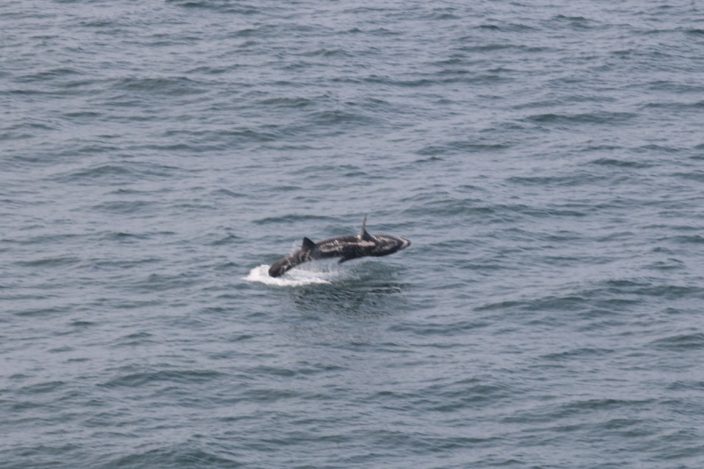
Photo by Jack O’Callaghan
Data collection was not only conducted from land, as the IWDG also headed out with a rib together with shark researcher Dr. Nick Payne from Trinity College, Dublin and UCC MSc student Hayley Ní Chonaill. From the RIB, both slime and water samples were collected. All basking sharks are coated in a layer of mucous/slime in which their DNA can be found. This non-invasive method of collecting DNA can help us identify the sharks and therefore track their movement. The water samples can provide us with eDNA (environmental DNA), which can be used to identify the different species found in the area.
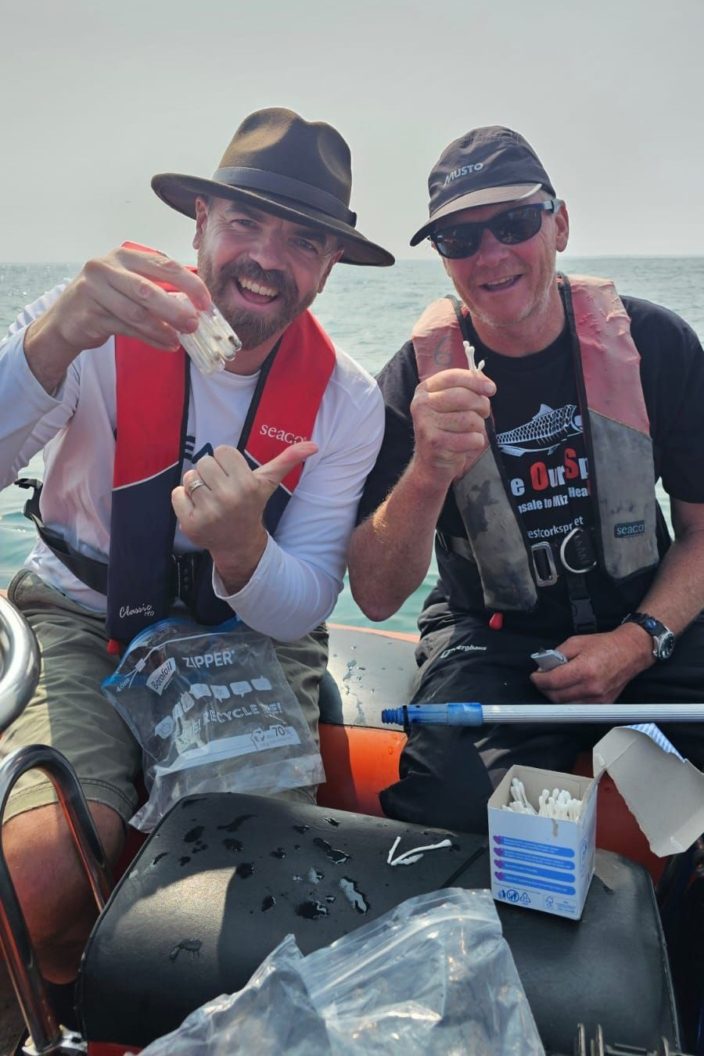
Photo by Emilie De Loose
Overall, the opportunity to collect basking shark data was not wasted during this exhilarating but mad-dash encounter. Ireland appears to be becoming an increasingly important area for basking sharks. Despite this species’ large size and habit of showing up at the surface, very little is known about their biology, behavior, movement, and distribution. They remain endangered under the IUCN due to intensive historical fishing, slow recovery, and continuous threats from fisheries, bycatch, and changes in their ocean environment. Learning more about one of
Ireland’s ocean giants is crucial to preserving them. Bolstering their protection in Irish waters, creating safe havens in the form of marine protected areas, or enforcing temporary restrictions during mass aggregations could play a key role in bringing the basking sharks back to healthy populations.
We would also like to remind all members of the public to be cautious around marine wildlife. While basking sharks are non-aggressive, they are massive and can therefore still cause serious harm to you and your vessel. Unfortunately, basking sharks have been struck by ships (both small leisure vessels and larger commercial vessels) in Irish waters and may suffer negatively from harassment. Please adhere to the Irish Basking Shark Group code of conduct when around basking sharks—for both your safety and the sharks’ comfort. As of 2022, basking sharks enjoy legal protection in Irish waters from hunting, injury, and wilful destruction of their breeding and resting places under the Wildlife Act.
Learn more about basking sharks: https://www.baskingshark.ie/
Emilie De Loose