
Celtic Mist Survey Cruise Leg 10: Arklow-Kinsale
Skipper: Pat
First Mate: Angela
Marine Biologist: Patrick
Marine Biologist: Sarah
Crew: Rosalee, Marian, Eileen, Aoife
Hello there! My name is Sarah and this summer I joined Leg 10 of the Irish Whale & Dolphin Group’s coastal survey on board the RV Celtic Mist. This was my second year volunteering as my summer holidays. I joined as the assistant biologist, ready to help with identification tips, crew questions, and cracking almighty sea related puns. It’s a tough job but somebody’s got to do it! Having an academic and professional background in marine science has its benefits for this role but for the most part participants have a very varied level of knowledge of marine megafauna (that’s fancy science talk for larger sized sea animals). This is what this floating classroom for nature observing is all about- giving passionate but not necessarily proficient wildlife lovers the chance to a) contribute to valuable research, b) have a nice time away from life’s distractions on land, and c) make some new friends in the process.
Once we had been welcomed aboard and assigned our cabins and subsequent cabin mates, we began orientating ourselves with the boat -“The light switch for this is here. I never would have found it either if someone hadn’t shown me” and “Mind your head here, here, here…” We received a full and detailed safety briefing from Skipper Pat as well as crucial etiquette surrounding ‘hitting the head’ (‘head’ being the nautical term for toilet). The Celtic Mist is like any venerable beauty of a certain vintage – the waterworks can be delicate and often the first thing to act up!
The first exercise in crew bonding is the supermarket sweep. A fun, fail-proof icebreaker, there is no quicker way to identify within the group the secret MasterChefs, the sugar savages, or the bag-packing Olympians, than the task of stuffing the galley with a week’s supplies. It is a subtle first test of teamwork and communication, essential qualities on any sailing trip. There is also something about time on the Celtic Mist that creates an instant comradery amongst its crew. Some may already know each other from working in the science field, are members of water-based clubs, or previous trips with the IWDG. However, throughout the week further links are often made (the fine art of tracing connections by the Irish is unparalleled) and there is no limit to the excitement and glee derived from such discoveries.
With the excitement and anticipation of setting off on our first day bubbling up in the form of a restless first sleep, we found ourselves assembled at 6 am, wearing sleepy smiles and full rain gear, only to receive bad news. An update to the forecast in the early hours had declared a small craft warning for our section of the coastline. We were staying put. There was only one thing to do. Boil the kettle. With an extra day to explore Arklow, we used the time to pick up some extra essentials for the boat, go for walks or sea swims, watch the men’s senior hurling final, and cook up our first dinner together. As strange luck would have it, our extra night’s stay resulted in us getting to enjoy the fireworks display for the Seabreeze Festival happening in the town, which was a welcome treat before the forecasted heavy rain swept in.
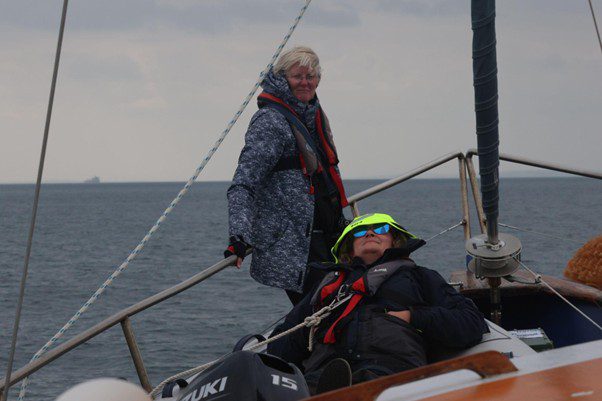
Between boarding in Arklow, Co. Wicklow and disembarking in Kinsale Co. Cork, the crew enjoyed and endured a variety of weather and sea conditions. Our first day sailing south was a test of our sea legs and overall weather hardiness. During the long, wet, and bumpy trip to Dunmore East, there remained a cheerful air and a generosity of spirit toward anyone feeling the effects of the undulating swell. I was very impressed by the instinctive nature of this recently blended crew and there was no shortage of good humour, hot beverages, and an instant dedication to scouring the horizon for marine life. Chief Biologist for the survey season, Paddy, gave an engaging introduction to the crew about the kind of data we are there to gather, what to expect and look out for, techniques for spotting animals, and how to keep observer’s fatigue at bay. I will say it now- briefly nodding off is inevitable and I defy anyone to prove otherwise! Paddy on a whole was a fantastic leader, positive vibes personified. An astute observer of not only sea creatures but also of people, he had each of our quirks pegged fairly early I imagine, allowing us to show our strengths while providing gentle guidance throughout. A maturity beyond his years.
Spotting conditions on this first day were not ideal, with the sea flicking up white caps that had us all hallucinating breaching dorsal fins. Regardless of this, coming around the Saltee Islands welcomed the spectacle of one of Ireland’s largest gannetries (large nesting colony of gannets). We enjoyed watching them dive like torpedoes into the water from high up in the sky, and catching a glimpse of their striking icy blue eyes as they glided past the boat. Other seabirds of note included guillemots with their fledglings in tow, and manx shearwaters as they dipped and swooped close to the water’s surface. At one point during the day, noticing that a wind farm along the coastline seemed to be sticking with us, we learned the powerful influence of the tide on our progress, making us feel we were on an invisible treadmill. As we finally made it past Hook Head, with our day’s finish line not far off in the distance, golden evening light burst through the grey clouds, lighting up the eight hundred odd year-old lighthouse and the faces of the crew. Under the guidance of Pat, Robbie and Paddy, we readied our stations for our 17-metre vessel to enter port.
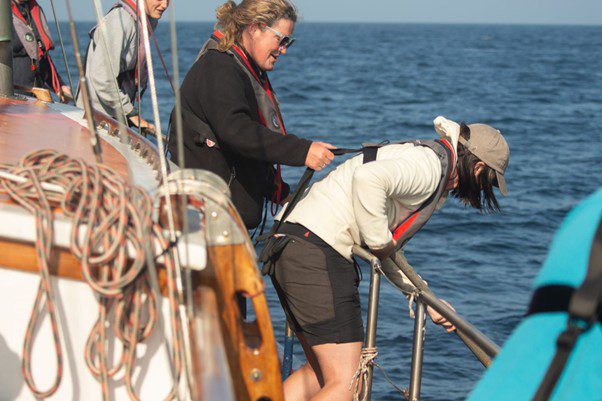
I’d like to mention at this point what a wonderful experience it is to sail into Ireland’s harbours, marinas, and ports. It is a beautiful vantage point, standing on the bow of the Celtic Mist as she slowly and smoothly is brought to berth. This manoeuvre is often watched with care and curiosity by any bystander and, in our case when coming into Dunmore East after 10pm, with a smile from Angie, our replacement first mate, ready to catch the line. Angel by name and by nature, she had also ordered pizzas from the local sailing club, saving us having to feed ourselves so late in the day. We were instantly charmed. Other folks who either came to greet us, see the famous vessel, or provide some small repairs during the week, were all kind and welcoming, enhancing the sense of ‘coastal community’.
Our second day was a more relaxed affair, as we ventured back in the direction of the Saltees, following our chosen waypoint, taking turns at the helm, and even giving the sails some airing. Often on this survey there is a spectrum of sailing experience amongst the crew, which is one of the reasons it is so enjoyable. I confess to having limited and patchy sailing experience, largely composed of time on this very vessel and little else. It is a great introduction to the basics of sailing and being part of a crew. The tasks themselves are fairly straightforward with no great intricacy or strength involved. It’s the terminology that is the most difficult information to retain for most! With a considerably calmer sea state, we had some small amounts of luck with sightings, even of a sunfish (Mola mola), but it could be described as generally uneventful in terms of cetaceans.
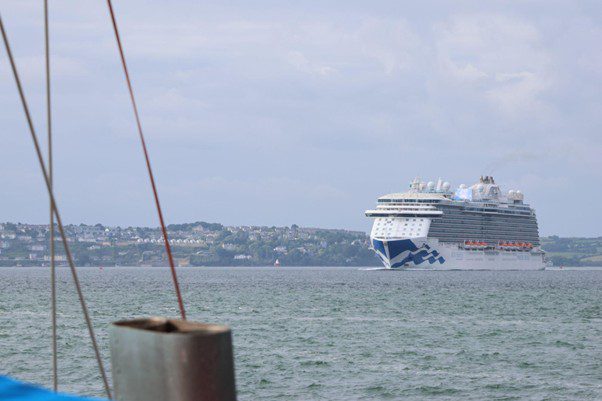
The next day saw us head west again, with Cork Harbour as our target destination. The Copper Coast was a lovely landscape to watch slowly go by, with glimpses of Dungarvan, Ardmore, Youghal, and Ballycotton. A minke whale was the standout sighting of the day. We spent this night safely tucked away in Crosshaven, the Celtic Mist utterly dwarfed on its way in by a cruise liner as it departed Cobh, heading to God knows where. Over the course of the week, we also did some emergency drills to keep us on our toes. Who knew hypothetically sinking the boat or having a man overboard could be serious and fun simultaneously? We all certainly appreciated the exercise.
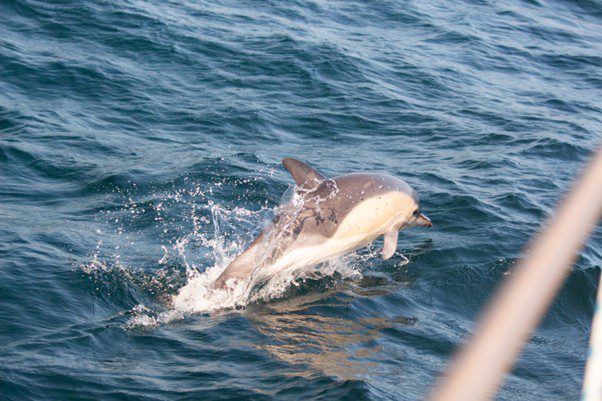
The following day, Thursday, we made our way from Crosshaven to Kinsale, our final stop. With the weather improving more each day, this day in particular brought sunny blue skies and a flat-calm ocean with not much glare, perfect for spotting. So, like all other days, we watched, and we waited. We had the highest number of sighting events this final day at sea, with small groups of common dolphins (Delphinus delphis) periodically approaching the boat to bow ride, arousing whoops and hollers from the crew as the cameras followed their every splash (my phone’s storage level reaching critical capacity before too long). We arrived into Kinsale sun-kissed, elated and ultimately startled by how quickly the days went by. We enjoyed a final feast together on the boat, sharing highlights and personal reflections on what the trip gave us. This moment put a firm seal on our bond as a crew, and I hope other trips this survey season have the fortune of experiencing something similar to this.
See you all next year!
Sarah Hegarty – Marine Biologist, Celtic Mist