
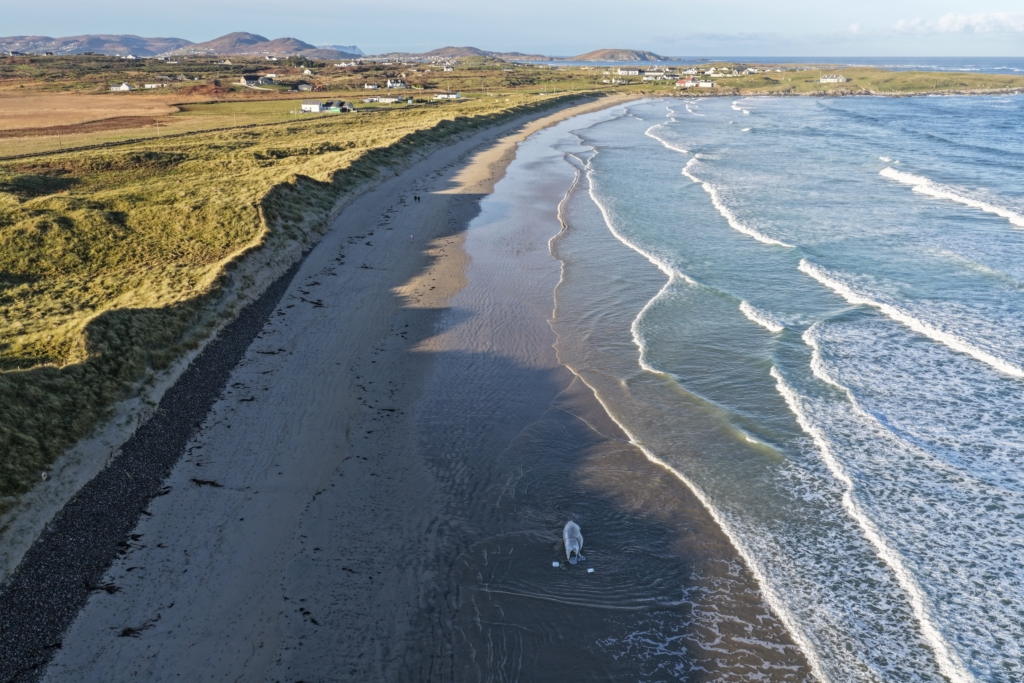
Early this morning, the IWDG office was alerted to a stranded whale on Ballyheirnan beach in County Donegal by a local, Darren Roche. He had come across the unfortunate cetacean while on his morning walk and told us it looked to be entangled.
One of our brilliant volunteers, David McGloin, offered to go out and collect pictures for us, so we could confirm the stranding and get more information. Sure enough, a dead male minke whale of approximate 5 meters lay stranded on the beach. Its upper body and head were entangled in ropes, with two makeshift and unmarked buoys still attached. It had most likely gotten entangled in the lines of a pot.
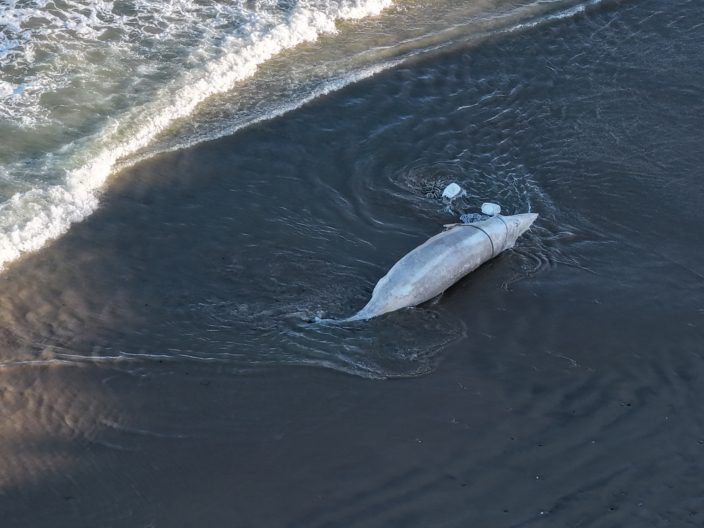
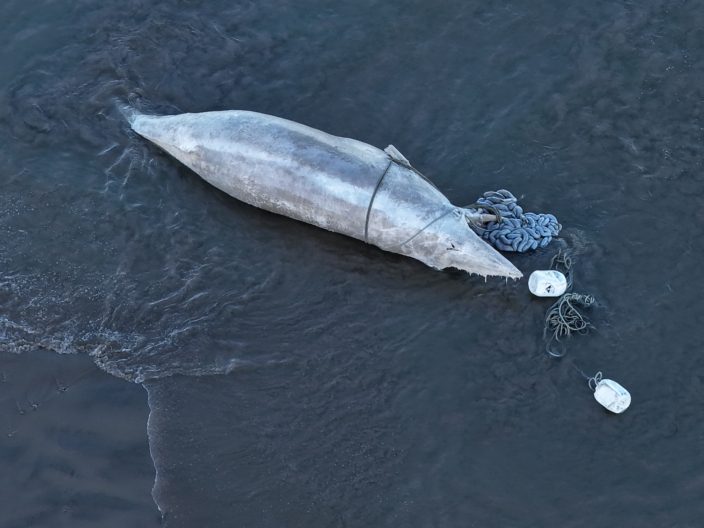
In 2022, a published paper estimated the number of whales entangled per year in the Scottish creel fisheries. Based on fisheries interviews they concluded approximately 30 minke and 6 humpback whales were entangled annually, with a mortality rate of 83% for the minke whales. They suggested these numbers were unsustainable for both the minke and humpback whale population. The whale populations of Scotland and Ireland overlap greatly, and their pot fishing industries are similar. Therefore the IWDG, together with the Atlantic Technological University and the Marine Institute decided to assess the potential threat that the creel fisheries may pose in Ireland.
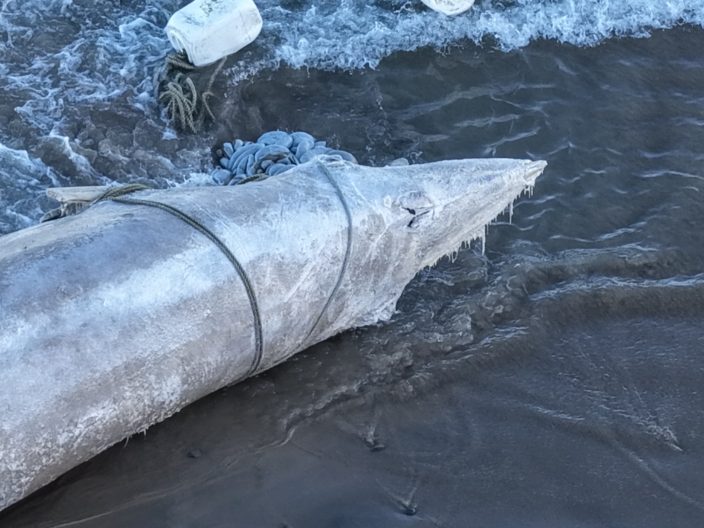
That resulting paper and master thesis of IMBRSea student Julie Fichete, was published in 2025. It found that the entanglement risk for minke whales was substantial in Ireland. The risk was highest in the south, southwest due to the high presence of both whales and creel fisheries. However, with the recent shift in large whale sightings towards the north, northwest of Ireland and the high pot fishing efforts off the north coast of Donegal, this risk may shift further north.
This paper provided the first estimation of entanglement risk of pot fisheries for large whales in Ireland, but the IWDG believes further research is necessary to assess the threat. The majority of the creel fisheries in Ireland are small-scale, with ships under 12 meters in length and without AIS. Estimating the true creel fishing effort is further complicated due to the high number of unreported recreational pots and abandoned gear.
Luckily, the issue of large whale entanglement in creel fisheries may have an elegant solution. The vast majority of the entanglements occur in the floating groundlines. Groundlines are the ropes used to attach the pots/creels to each other. The use of buoyant rope causes them to form large arches in the water. When a whale dives to feed, the rope can become attached in or around its mouth, its pectoral fin or the fluke.
While larger whales may be able to surface and drag the lines and pots, the smaller minke whales typically cannot and will drown. Even large whale species tend to succumb to exhaustion or injury if not disentangled. As a potential solution, the Scottish Entanglement Association (SEA), a group of consisting of Scottish fishermen and Scottish marine conservation groups, trialled negatively buoyant groundlines.
Nephrops and crab fishers re-rigged 61 fleets with the sinking groundlines and tested them for ~ 15 months. Little to no issues were reported regarding handling, splicing or deploying the gear, it performed well on the hauler, and they found that it tangled less than the positively buoyant rope. Underwater footage showed that the lines rested lightly on the seafloor and may even cause less disturbance or damage to the seafloor than the positively buoyant rope. While there were slight issues in areas close to shore with hard substrate, these were areas with very low whale presence and where such mitigation measures were not a priority.
After the successful trials, SEA is now advocating for the deployment of the sinking lines across the Scottish creel fishery fleet. They are trying to work with the government to find a solution that would minimize or negate the cost of re-rigging the gear and are advocating to keep the change voluntary rather than mandatory. Seeing as the IWDG has found that Ireland’s large whales are likely suffering a similar unsustainable risk of entanglement in creel fisheries, we will keep a close eye on this potential solution. In the meantime, the IWDG is constantly improving its stranding responses by implementing BEEP (Bycatch Evidence Evaluation Protocol) developed by the Cornwall Wildlife Trust, expanding the list of photographs taken at strandings and increasing the training opportunities for those active in the stranding
network.
As our work continues, our bycatch and entanglement database is becoming increasingly robust and comprehensive. These databases will help us continue to monitor and research these threats in Ireland and help support the creation and implementation of conservation measures.
Relevant papers:
Fichefet, J., De Loose, E., Dudley, R., Martin, G., Tully, O., & Berrow, S. (2026). Assessing
the risk of whale entanglement in pot fisheries in Irish waters. Frontiers in Marine Science,
13, 1749710.: file:///C:/Users/User/Downloads/fmars-13-1749710.pdf
Leaper, R., MacLennan, E., Brownlow, A., Calderan, S. V., Dyke, K., Evans, P. G., … &;
Ryan, C. (2022). Estimates of humpback and minke whale entanglements in the Scottish
static pot (creel) fishery. Endangered species research, 49, 217-232.:
https://pure.hw.ac.uk/ws/portalfiles/portal/83577883/n049p217.pdf
Calderan, S., Cisternino, B., De Noia, M., Leaper, R., MacLennan, E., &; Philp, B. (2025).
Successful collaborative trials of simple gear modifications to reduce entanglement of
whales and other megafauna in Scotland’s static pot (creel) fisheries. ICES Journal of
Marine Science, 82(6), fsae157.: https://academic.oup.com/icesjms/article/82/6/fsae157/7908625
– Emilie De Loose
Project Officer for the Atlantic Whale Deal
All images by David McGloin
16/11/2026