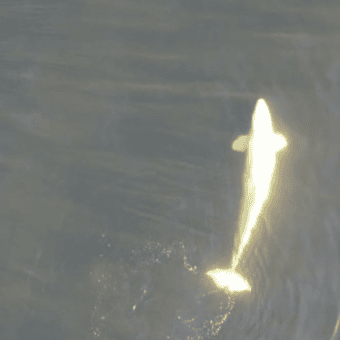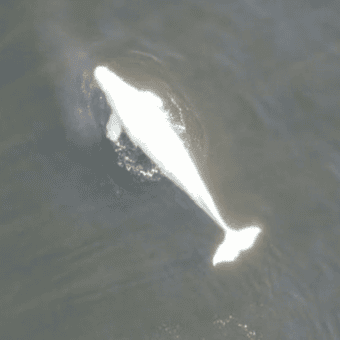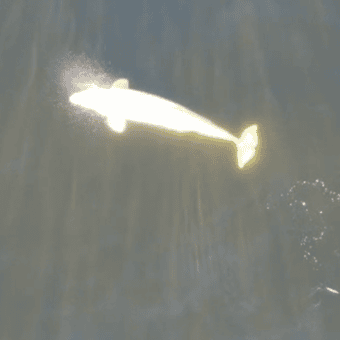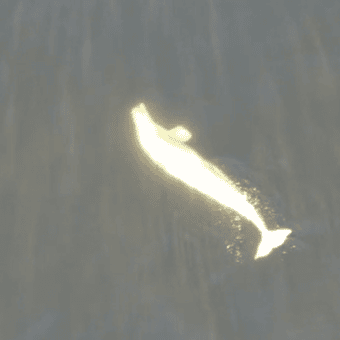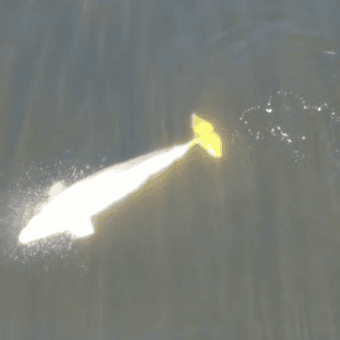
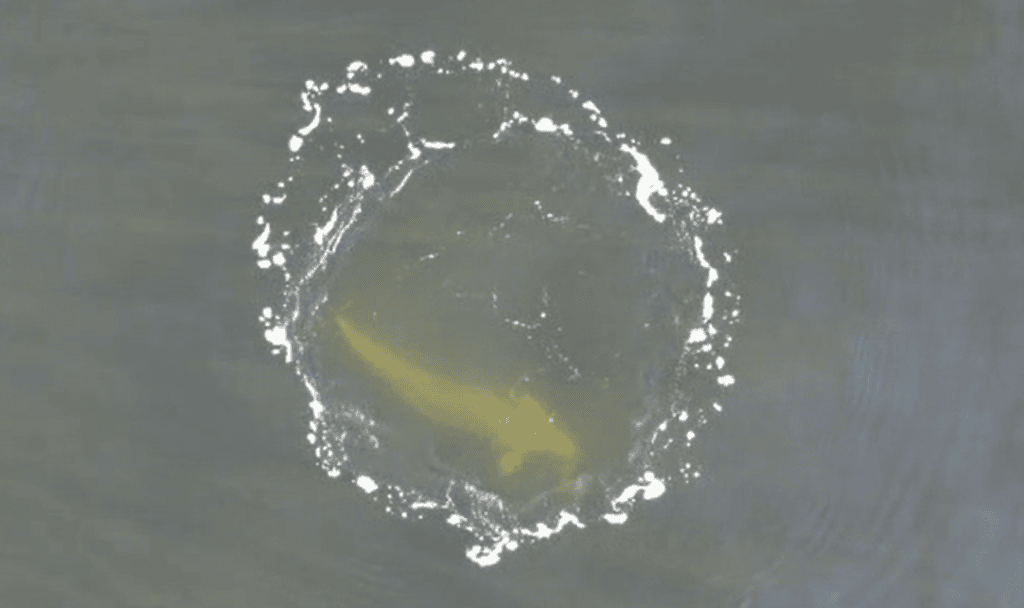
On Saturday 17th Oct 2026, Sebastian Szumlański was at Fintra, Donegal Bay and observed what he thought was a pale dolphin close to shore in shallow, brackish water, in an area known locally as the Secret Waterfall. He launched his drone to capture the event and yesterday he showed the video to a friend who has done some photography out on Mullaghmore based Whale Watching boat, Kiwi Girl, with Declan Kilgannon, who shared the footage with IWDG. The video confirms this to be another beluga in Irish waters and only the second such validated record by IWDG in our 35-yr history and only the sixth record ever documented.
The beluga is a medium-size whale species that typically inhabit the freezing waters of the Arctic and sub-Arctic. Adults reach up to 5 mts in length and are a brilliant white colour; a likely adaptation for avoiding their only natural land predator, the polar bear. They belong to the sub-order of toothed whales, but are in a very distinctive family of Monodontidae, which includes the narwhal; another Arctic species which was first documented in Ireland in November 2025, when a juvenile, female stranded on Sweet Nellies Beach, north of Greencastle on the Inishowen Peninsula in Co. Donegal. It is interesting that within an 11-month period, IWDG has validated our first narwhal and a beluga in Co. Donegal. This is likely evidence of just how rapidly things are changing in Irish waters.
Belugas have been reported on five previous occasions around the Irish coast. The first known record dates back to September 1948 off Clare Island, Clew Bay, Co. Mayo (Irish Naturalist Journal, INJ). There was then a 40-year gap before the next record which was in Cork Harbour in June 1988 (Carmody M. & Wilson J., INJ). The next sighting and the first to be validated by IWDG with supporting photographic evidence was of a solitary adult beluga within metres of the shore off Dunseverick, Co. Antrim in July 2015 (Watson G.), a gap of 27 years. This was soon followed by an aerial record on 2nd Dec. 2015 of a group of three belugas c.200 nautical miles (370km) off the Irish southwest, seen from a twin engine high wing aircraft, flying at a speed of 90-100 knots at an altitude of 183 mts, during a dedicated cetacean and seabird survey under the ObSERVE progect. Alas, there were no supporting images from this encounter. (Jessopp M., INJ).
This latest 2026 Donegal Bay sighting suggests the intervals between confirmed Irish beluga records is closing, as this sighting narrows the gap to 11 yrs. Whether this is due to increased forays of this Arctic vagrant in response to fragmentation of Arctic sea ice, or an increase in observer effort remains unclear. But the increased regularity with which IWDG is writing about species such as the bowhead whale, walrus, narwhal and beluga, would suggest Ireland is being visited by these Arctic specialists more often. Pers. Comms. with Daniel Palacios of the US Right Whale Ecology Program at the Centre for Coastal Studies, Provincetown, suggests that a little like here in Ireland, they do get belugas showing up ” every once in a while” along the Massachusetts coast, and their arrival is thought to coincide with years of low ice extent in the Arctic.
We can’t really say much about this individual other than its colour and size would confirm this to be an adult, of unknown gender. While the videos gave us no initial cause for concern as to its welfare, as it seemed to us to be swimming strongly and breathing normally; this early opinion however came with a certain health warning, as we’ve no real experience of this species here. But the team at GREMM (Group for Research & Education of Marine Mammals) based in Tadoussac, Quebec, with a resident population of c.1,000 belugas, have years of experience monitoring the St. Lawrence River population, and Jade-Audrey Lavergne has kindly offered some useful insights based on the footage we shared with them.
Firstly, they had a consensus that our beluga was emaciated….”still subtle and could be worse”. Their reasoning for this was based on the its tail fluke looking too large, in contrast to the rest of its body, i.e. its reduced body mass made the tail fluke stand out more. They also observed that its skin can be seen curving inside near the dorsal crest and that this folding of the skin is an indication of emaciation, albeit on the lower end of the scale. On a brighter note, there was nothing in its behaviour to suggest it was in distress and it even seemed curious about the drone, suggesting it was alert. Whilst they couldn’t be certain, they felt that it was an adult and the absence of broad shoulders, typical of male belugas, suggested it was most likely female.
It is also evidently in brackish and very shallow water, which is quite common among populations of belugas such as those in the St. Lawrence River, who frequently aggregate in river mouths, regularly swimming hundreds of kilometers up river systems, until fresh water freezing in autumn, provides the cue to return to the safety of open sea.
Pers. Comms. with Arctic whale expert Mads Peter Heide Jǿrgensen confirm that a solitary beluga has also been seen over the summer period in Norway, Denmark and Finalnd and there is always the possibility that this could be the same individual. We’ll keep you posted on this if we can confirm the match.
If you are fortunate enough to observe this charismatic whale, we’d ask you as always to try and get images or video and report your sighting (with images) to IWDG on www.iwdg.ie, so we can monitor its progress and track its movements in Irish waters.
We live in interesting times.
Link to short Irish Times interview with IWDG Sightings Officer 21/10/2026: https://www.instagram.com/
By Pádraig Whooley
IWDG Sightings Officer
email: sightings@iwdg.ie, Ph. 086 3850568.
All images on this article are © Sebastian Szumlański