Climate change and biodiversity loss are critical global challenges that undermine public health, ecosystem stability, and the well-being of humans and animals. As an island nation, Ireland’s economy, communities, and food systems depend heavily on the health and productivity of its marine ecosystem. Ensuring their long-term resilience requires the implementation of science-based approaches to assess, monitor and safeguard the health of the marine ecosystem.
Marine mammal strandings provide valuable insight into ocean health, conservation pressures, and anthropogenic impacts. In Ireland, stranding response is supported by committed organisations and individuals, including the Irish Whale and Dolphin Group (IWDG), the National Parks and Wildlife Service (NPWS), and a wide network of volunteers and scientists. However, challenges remain in relation to coordination, funding, training, post-mortem capacity, and the systematic use of stranding data to inform marine ecosystem health. These challenges are compounded by the fact that post-mortem examinations, including determining causes of death, assessing overall health and collecting samples for pollutant analysis, have, to date, been supported largely through short-term project funding, and carried out on an ad hoc basis.
This workshop was convened to bring together key national and international stakeholders involved in marine mammal stranding response, post-mortem examination (PME), research, policy, and conservation. The purpose was to share perspectives, explore current strengths and gaps within the Irish system, and consider how stranding response and post-mortem data could be better coordinated and utilised to inform marine ecosystem health, conservation, and policy.
Long-Term State Investment Is a Prerequisite for Meaningful Impact
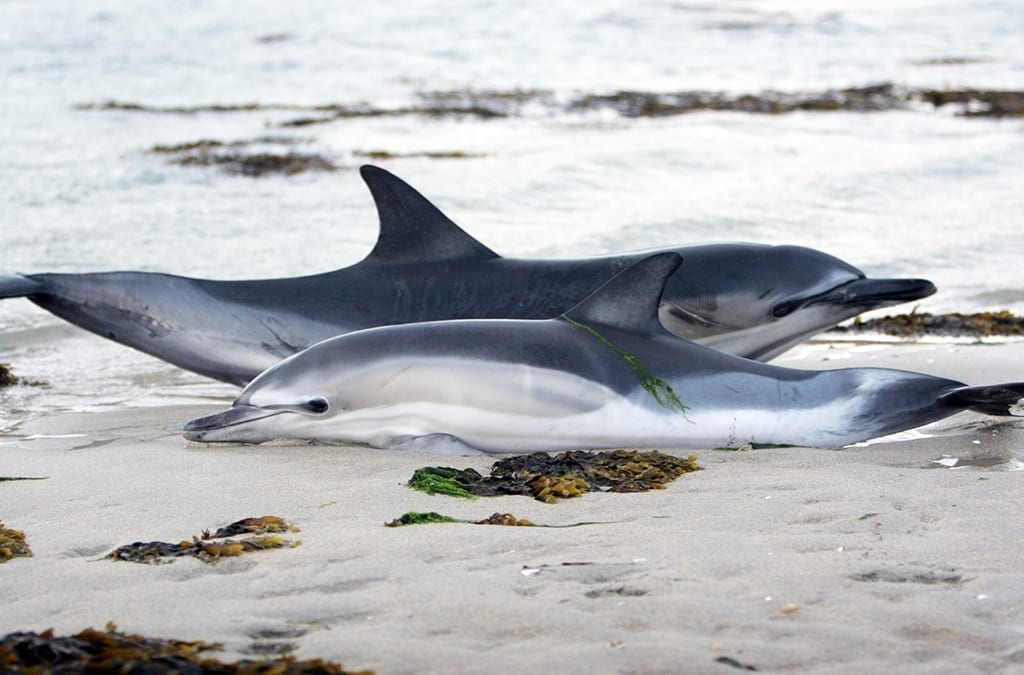
Female striped dolphin was live stranded at Tarmon, Blacksod, Co. Mayo
A strong and recurring theme throughout the workshop was that long-term State investment is fundamental to any effective national marine mammal stranding and PME programme. Participants emphasised that while Ireland benefits from considerable expertise, commitment, and volunteer engagement, reliance on short-term or project-based funding constrains continuity, limits capacity, and undermines our ability to generate data that will help address current challenges including climate change, biodiversity loss and future pandemics. It was noted that Ireland already has a significant infrastructure through the Regional Veterinary Laboratories, local authorities and third-level institutes including University College Dublin (School of Veterinary Medicine) and the emerging schools of veterinary medicine in Atlantic Technological University and South East Technological University.
Key points raised included:
- Long-term funding is essential to collect robust data capable of detecting trends in pollution exposure, disease prevalence, nutritional stress, and population health,
- Stable resourcing enables integration of PME findings to strengthen the quality of data available to inform policy,
- Sustained programmes are more likely to attract and retain specialist expertise, including veterinary pathologists, veterinary microbiologists, researchers and technical staff, and to promote excellence in third level training/education and capacity-building,
- Long-term investment places Ireland in a stronger position to contribute to, and benefit from, EU research funding and international monitoring and assessment frameworks,
- Short-term funding cycles are fundamentally incompatible with the time horizons required to assess cumulative impacts of climate-related change, habitat fragmentation and biodiversity loss and their pressures on the marine environment,
- An Irish cetacean post-mortem scheme aligns with five United Nations Sustainable Development Goals (Goals 14, 13, 3, 4 and 2).
Participants emphasised that long-term sustainable funding is essential to strengthen data collection and integration, thereby informing evidence-based policymaking across the EU.
Strategic Priorities Aligned to System-Level Findings
Following the completion of the workshop, it was evident that a structured, time-bound National Marine Mammal Strandings and PME Action Plan should be developed to translate the strategic priorities identified below into coordinated actions and delivery pathways. The Action Plan should:
- Set out short, medium- and long- term actions associated with each strategic priority and establish SMART goals
- Define governance arrangements and clarify institutional roles and responsibilities
- Identify chain of events leading to action, interdependencies between stakeholders and enabling actions
- Outline indicative resource requirements and potential funding mechanisms
- Establish arrangements for monitoring progress, review, and adaptive update
- The Action Plan would provide the mechanism through which the strategic priorities are given practical effect, ensuring coherence, accountability, and alignment with national marine, biodiversity, and environmental policy frameworks.
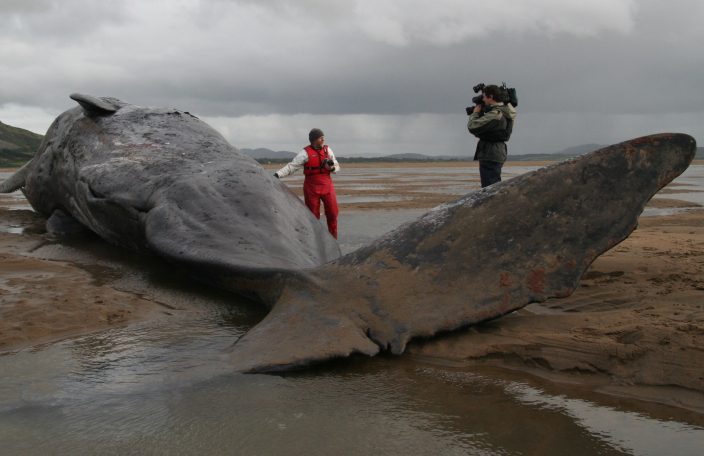
Image of Don explaining the biology of a sperm whale that live stranded on the beach in Ballisadare Bay in September 2006. Photo by Will Woodrow
Priority 1: Secure Long-Term State Investment
Participants identified sustained State funding as the foundational requirement for an effective marine mammal stranding and post-mortem programme. Long-term investment is needed to support continuous post-mortem activity, research capacity and data time-series, coordination functions, and training, and to enable Ireland to generate ecosystem-level insights over appropriate time horizons.
Priority 2: Strengthen Alignment with International Conventions and Frameworks
Participants emphasised the importance of embedding Ireland’s stranding and post-mortem activity within established international frameworks, particularly through ASCOBANS, the Bonn Convention (CMS), and the IWC Strandings Initiative. Alignment was seen as a practical mechanism for standardisation, shared expertise, coordinated data flows, and accountability, rather than an abstract policy aspiration. Although Ireland lies within the ASCOBANS maritime area, and Irish scientists are actively leading the development of conservation initiatives under the agreement, Ireland’s absence from the agreement hinders the effective implementation of these measures at the species-range level.
Priority 3: Embed Post-Mortem Examination within Marine Ecosystem Health Monitoring
Participants agreed that PME data should be formally recognised and utilised as a core component of Ireland’s marine ecosystem health monitoring. This includes its use in assessing pollution, disease, population health, and cumulative pressures, and in informing marine spatial planning and environmental risk assessment. Work in this area, led by the Marine Institute and the Atlantic Technological University, has included developing marine mammal biodiversity indicators within the OSPAR Commission. However, further progress relies on the consistent availability of carcasses for post mortem examination, disease surveillance and pollutant sampling, supported by comprehensive data on health and life history status, to inform development of actions and targeted measures. For such, long term resource allocation is required.
Priority 4: Reduce Fragmentation through Improved Coordination and Data Integration
Rather than creating entirely new structures, participants prioritised improved linkage between existing organisations, datasets, and expertise. This includes clearer interfaces between response, pathology, research, and policy, and better integration of biological, toxicological, spatial, and population-level data to support ecosystem-level interpretation.
Priority 5: Strengthen Communication, Feedback, and Knowledge Transfer
Participants highlighted the need for clearer communication pathways and feedback loops to ensure that information generated through stranding response and post-mortem examination is shared effectively, translated into policy-relevant outputs, and communicated back to responders, volunteers, participating organisations and the general public.
Biodiversity loss and climate change pose significant risks to public health, ecosystems resilience, and socio-economic stability. Safeguarding marine ecosystem health is a national priority that requires political commitment, integrated governance, and long-term funding. Timely investment in the Irish Cetacean Post-Mortem Scheme will strengthen marine monitoring , meet the EU and other international obligations, and secure the health and well-being of citizens.
For the full report please see Marine Mammal Workshop Summary
In collaboration with: