Joint Press Release: Provided by the Center for Coastal Studies, the New England Aquarium, and the Irish Whale & Dolphin Group.
Published verbatim as submitted.
Unique Encounter with Right Whale off Boston Reveals Unusual European Connection
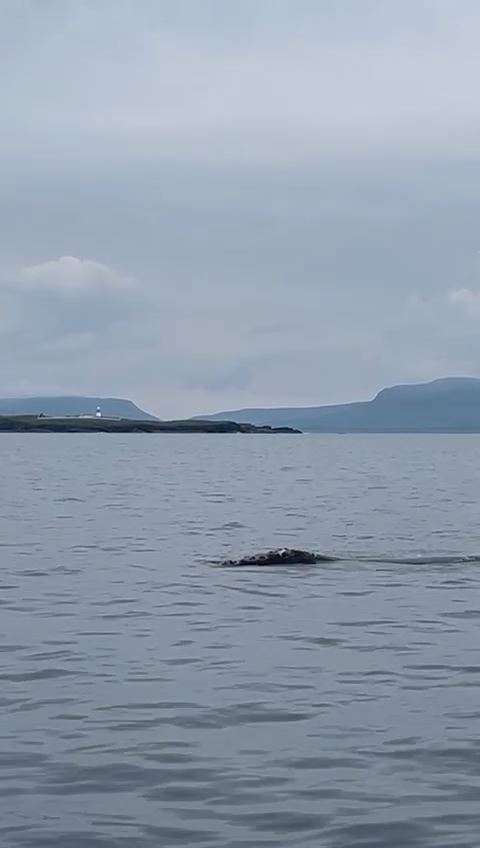
BOSTON, MASS. (Dec. 3, 2025) – Researchers have discovered that a North Atlantic right whale recently sighted in Massachusetts waters is the same individual reported off Ireland last year, an extraordinary connection showing the whale traveled 3,000 miles across the Atlantic Ocean.
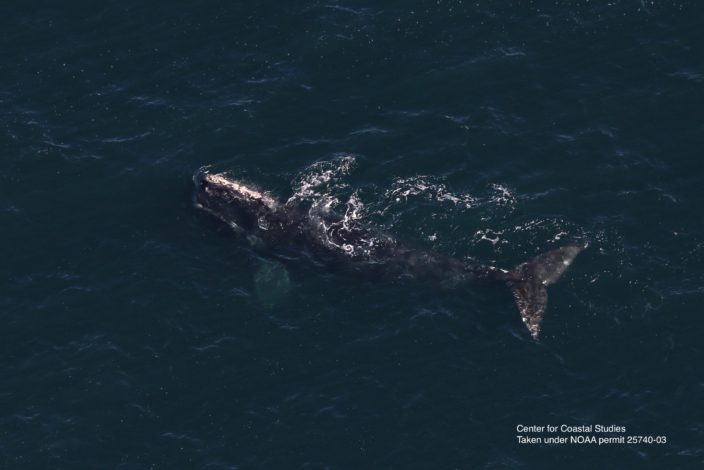
Right whale photographed off Boston on Nov. 19, 2025, previously located in Donegal Bay, Ireland, in July 2024. CREDIT: Center for Coastal Studies, taken under NOAA permit 25740
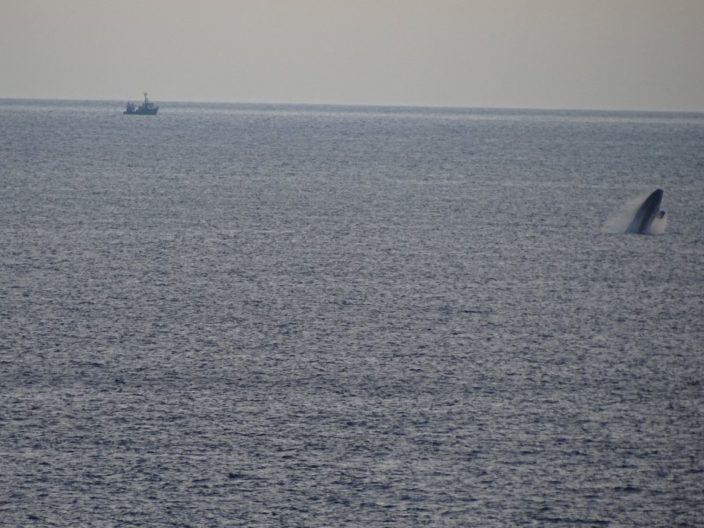
This image of the whale breaching off Muckross, Ireland, was compelling evidence that this was either a North Atlantic right or a bowhead whale. CREDIT: Franca Van Der Veer
While conducting an aerial survey on Wednesday, Nov. 19, observers from the Center for Coastal Studies (CCS) Right Whale Ecology Program sighted a North Atlantic right whale off the coast of Boston that scientists in the New England Aquarium’s Anderson Cabot Center for Ocean Life confirmed had previously only been seen in Donegal Bay, Ireland, in July 2024, reported by the Irish Whale & Dolphin Group. While there are rare instances of known North Atlantic right whales from the western Atlantic traveling to the eastern Atlantic and back, this appears to be the first documented case of a whale initially sighted in the eastern North Atlantic and later resighted in the western North Atlantic. The sighting suggests that historical North Atlantic right whale habitats may still hold value and that right whales continue to search widely for suitable habitat.
CCS researchers Ryan Schosberg and Annie Bartlett were conducting the Center’s second aerial survey of the 2025-2026 season in Massachusetts Bay when they made the sighting. The flights are designed to monitor the right whale population and determine when regulations designed to safeguard right whales go into effect.
“About four-and-a-half hours into the survey, we broke from our trackline to document a group of humpback whales about 23 nautical miles east of Boston. While photographing the humpbacks, we were surprised to spot a lone right whale feeding at the surface nearby. We quickly diverted to photo-document the whale, our first right whale sighting of the season. The first sighting of the year is always exciting, but we didn’t yet realize just how remarkable this one would turn out to be,” said Schosberg.
North Atlantic right whales are critically endangered, with a population estimated at just 384. Every year, CCS documents roughly half of the entire right whale population in and around Cape Cod Bay, so it’s uncommon for the Center to encounter an individual it doesn’t recognize or can’t quickly find in the greater North Atlantic Right Whale Catalog. CCS researchers quickly realized this whale didn’t match any known right whales and reached out to colleagues at the Anderson Cabot Center for Ocean Life at the New England Aquarium, the curators of the North Atlantic Right Whale Catalog, for their assessment.
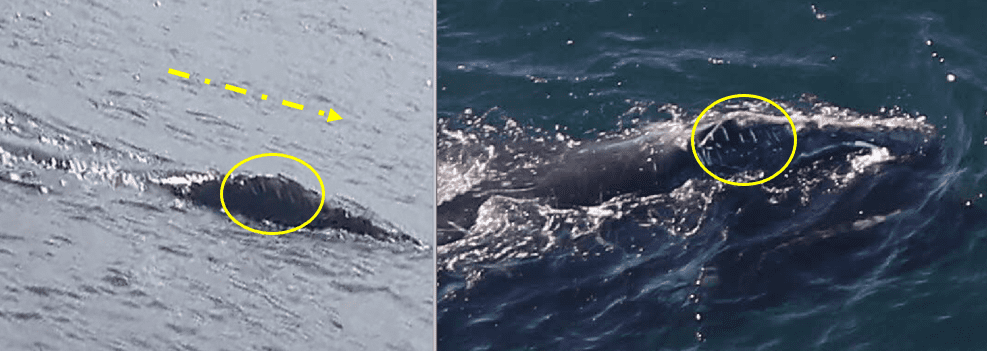
An image from July 15, 2024, off Drumanoo, Ireland, shows the individually unique pattern of callosities on the left side of the whale’s head. CREDIT: Gerard Johnston
The New England Aquarium has been studying North Atlantic right whales for more than 40 years. In collaboration with an extensive network of individuals and research organizations along the eastern seaboard, Aquarium researchers have collected millions of right whale photos and catalog the natural markings on whales such as callosities. The scientists track the whales’ life stories including births, injuries, migration patterns, and age to create detailed histories of each individual whale. Historically, right whales were regularly found in European waters, but that population was thought to be eliminated by whaling efforts. Despite this, right whale sightings still trickle in from this area every few years, though many of these sightings aren’t photographed well enough to be compared to the Catalog, or the whales are never seen again.
“While the photos from the 2024 Ireland sighting showed some unique features, we were unsure the quality of the photos would be sufficient to identify the whale in the future. After a flurry of matching effort and emails, we were excited to discover the first ever photo-ID match between Ireland and the U.S. East Coast,” said Lindsey Jones, a scientist in the Aquarium’s Anderson Cabot Center who manages the North Atlantic Right Whale Catalog.
“The next day, when the Aquarium’s catalog team sent over a potential match, I was shocked. I remembered the Irish whale sighting from July 2024 and how we’d tried to match that to a known individual in the catalog without success. It was an impressive match by their team, and such an exciting international right whale story,” said Schosberg.
In addition to this whale, data from the Catalog show that six other right whales first photographed along the North American coast have made appearances in European waters.
“Securing any international photo ID matches of large whales requires a lot of effort and a fair bit of luck. When these matches are made across ocean basins, you need to get even luckier. So, we had zero expectation of matching this solitary right whale from Donegal Bay in July 2024, the first validated Irish record with photographic evidence in over a century,” said Pádraig Whooley, Sightings Officer at the Irish Whale & Dolphin Group, who recognized the unusual whale sighting in 2024 and shared information with the Aquarium for identification.
“But where else would one expect to find a right whale with Irish connections if not off Boston?” added Whooley.
“Seeing a whale photographed in Ireland reappear off Boston is extraordinary. Encounters like this highlight both their resilience and the importance of international cooperation to support their recovery,” said Dr. Daniel Palacios, Director of the Right Whale Ecology Program at the Center for Coastal Studies.
The Center for Coastal Studies Right Whale Ecology Program has been conducting aerial surveys in Massachusetts waters and the greater Gulf of Maine in collaboration with the Massachusetts Division of Marine Fisheries since 1998. Right whale season in Massachusetts typically runs from December through mid-May, though in recent years CCS has also flown supplemental surveys in October and November to document individuals arriving early to local waters.
CCS right whale research and response operations are conducted in partnership with the Massachusetts Division of Marine Fisheries and NOAA under federal permits issued by the National Marine Fisheries Service. Support also comes from the Massachusetts Environmental Trust and contributions from other foundations, businesses and CCS supporters through the Center’s Right Whale Emergency Initiative.
ABOUT THE CENTER FOR COASTAL STUDIES: The Center for Coastal Studies (CCS) in Provincetown, MA is a non-profit organization dedicated to understanding, preserving and protecting marine ecosystems and the coastal environment through applied research, education and public policy initiatives. For more information go to www.coastalstudies.org.
ABOUT THE NEW ENGLAND AQUARIUM: The New England Aquarium is a nonprofit research and conservation organization that has protected and cared for our ocean and marine animals for more than 55 years. We provide science-based solutions and help shape policies that create measurable change to address threats the ocean faces. We inspire action through discovery and help create engaged, resilient communities.
ABOUT IRISH WHALE & DOLPHIN GROUP: The IWDG is an All-Ireland NGO established in 1990 and is dedicated to the research and better understanding of whales, dolphins and porpoises in Irish waters by delivery of the Irish Cetacean Sighting and Stranding Schemes.
Pam Bechtold Snyder, Director of Marketing and Communications, New England Aquarium—617-686-5068; psnyder@neaq.org
Douglas Karlson, Director of Communications, Center for Coastal Studies – 508-241-1650; dkarlson@coastalstudies.org
Source:
Center for Coastal Studies
New England Aquarium
Irish Whale & Dolphin Group
Published with permission. All text © respective organisations.