
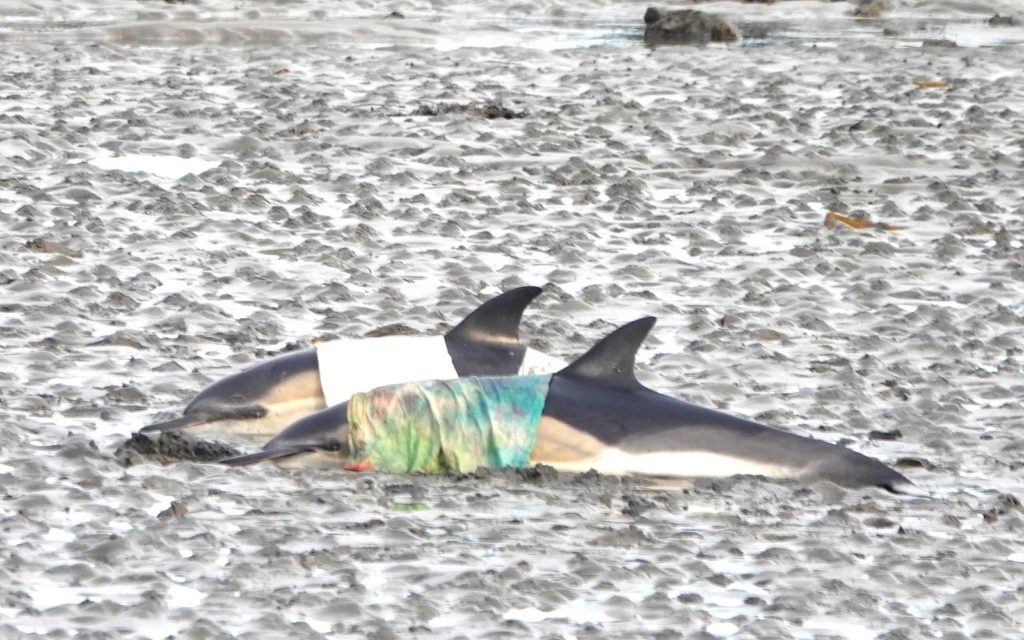
An early morning message from Gemma O’Connor, IWDG Live Stranding Coordinator, just before 9am alerted us once again to an estimated 8 dolphins circling on a dropping tide in Ballyvaughan, Co. Clare. Having assisted with a previous mass live stranding at the same location before Christmas, we were familiar with the terrain and felt well prepared to respond. We headed for North Clare on a chilly January morning.
When we arrived at approximately 11.15am, just 15 minutes before low tide, IWDG stranding network volunteer Melissa was already on site. She had been monitoring the situation, identifying the locations of the dolphins and assessing their condition from a safe distance. Thankfully, all dolphins were upright and appeared calm. With sufficient water for refloating not expected until after 2pm, the priority was to keep the animals comfortable while ensuring volunteer safety.
Local kayakers were on standby to assist with herding the dolphins out once they refloated.
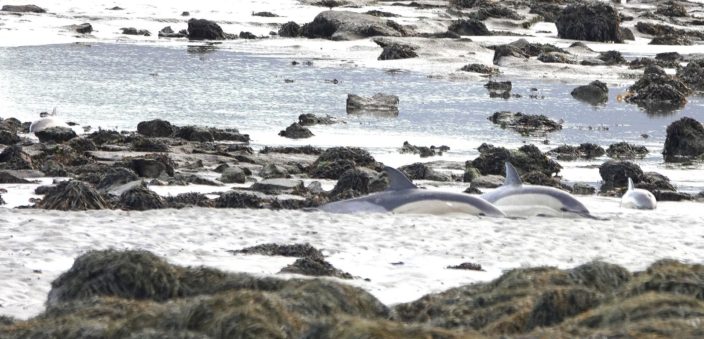
The dolphins were spread across three areas:
To the east of the channel were two adults and two calves. One calf was separated and out of sight from the others. Two volunteers gently lifted the calf using a makeshift stretcher and re-positioned it head-to-head with its group. This eastern basin was expected to fill first as the tide returned.
Further west, beside the deepest channel, were another two dolphins — a mother and calf. From previous experience we knew this area would fill shortly after the eastern basin. Both animals were upright, calm, and breathing normally.
The final group, two adults, were positioned slightly south toward the pier and would be the last to refloat.
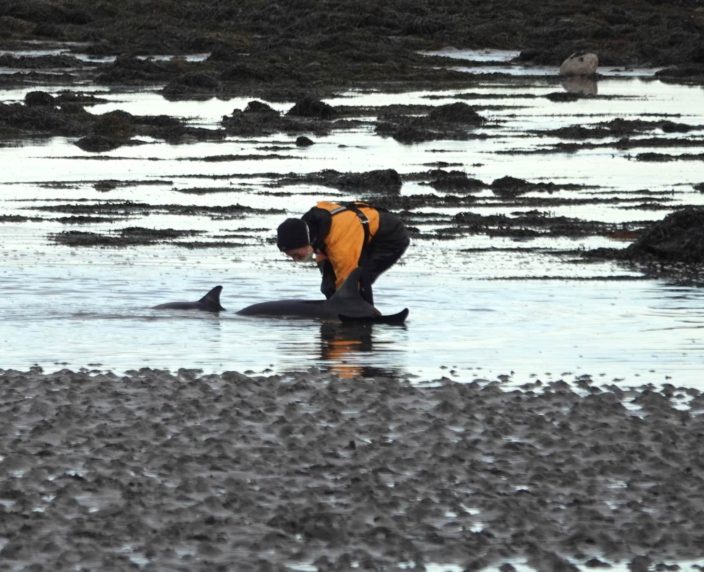
Melissa (IWDG) and Penny (NPWS) monitored the western groups, keeping gulls away and cooling the animals where necessary, while Brendan(IWDG) and Kevin(IWDG) did the same with the eastern group.
At around 1.45pm, as the water began to reach the dolphins, they became more alert. I entered the water to assist with the eastern group of four. The tide came in quickly and the dolphins began to move, occasionally becoming trapped between rocks or tangled in seaweed. It was a coordinated effort to keep them pointed out toward the channel, keeping calves alongside adults, and gently freeing pectoral fins when needed.
As water levels continued to rise, the dolphins began to float. One calf repeatedly attempted to swim backward, and volunteers worked carefully to keep the group oriented in the correct direction whenever they tried to turn back toward shore.
Once conditions allowed, the kayakers — Carles, Helen, and Oisín — were able to assist, floating in very shallow water and taking over herding as depths increased. Carlos helped keep the group of four moving into deeper water, while Oisín supported Brendan and Kevin in guiding the mother-and-calf pair along the channel and out through the deeper basin.
A particularly poignant moment for Kevin came when the calf paused to suckle as it left the channel, the mother rolling slightly onto her side to allow her hungry calf to feed before continuing on to sea.
Helen then joined myself, Kevin, and Brendan to assist with the final two adults near the pier. One of these dolphins appeared distressed and was struggling with breathing, and I was unsure she would survive. Gemma advised giving the animal time, suspecting shock, while local vet nurse Melanie remained on standby at the pier. It was a huge relief when the dolphin recovered and swam off with the group.
By around 3pm all volunteers were safely out of the water, welcomed ashore by the shore crew with food and drinks. There was a real buzz among everyone involved — a hard day, but with a happy ending.
Sincere thanks to:
• Gemma O’Connor, IWDG Live Stranding Coordinator, for her constant remote support while assisting with another stranding elsewhere
• Mary, for raising the initial alert
• Melissa, IWDG Stranding Network volunteer, first on site monitoring the situation
• Penny Bartlett, National Parks and Wildlife Service (NPWS)
• Carles, Helen, and Oisín, the fantastic kayaking team
• Melanie, Vet nurse
• Brendan Quinn and Kevin Heapes both IWDG volunteers, once again in the water all day supporting and coaxing dolphins back to safety
• Cian Nilan, IWDG Outreach Officer, for logistics, shore marshalling, and keeping everyone fed and watered
• Tony Whelan, for filming
• Róisín Garvey (IWDG), for much-needed coffee, chocolate, and support
• Tess, Patrick, and Tess’s family for shore support
‘Ní neart go cur le Chéile’
A fantastic team effort coordinated by the IWDG and a reminder of what can be achieved when people come together for wildlife in need, and remember if you do come upon a live stranding:
• Call the IWDG Emergency Stranding Hotline immediately with this information on 097 28118
• Do not drag the animal, especially by the tail — this can cause serious or life-ending injury.
• Take a photo or short video for IWDG.
• Record the location on Google Maps or note GPS coordinates.
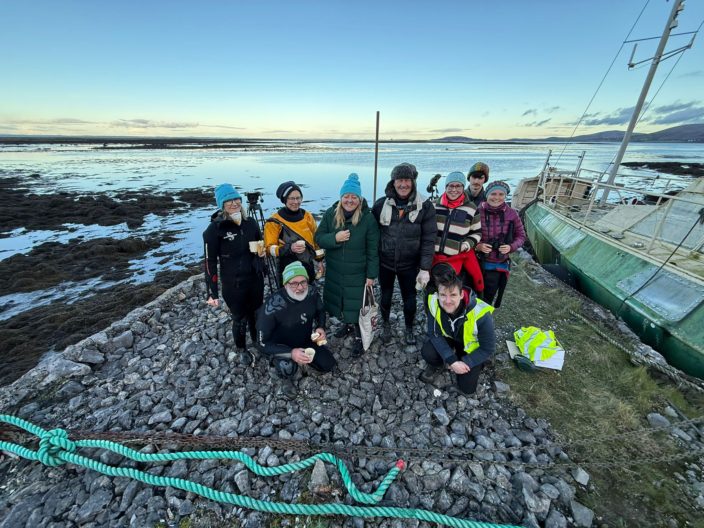
Trea Heapes
IWDG Clare and responder on the day
All images Trea Heapes/IWDG