
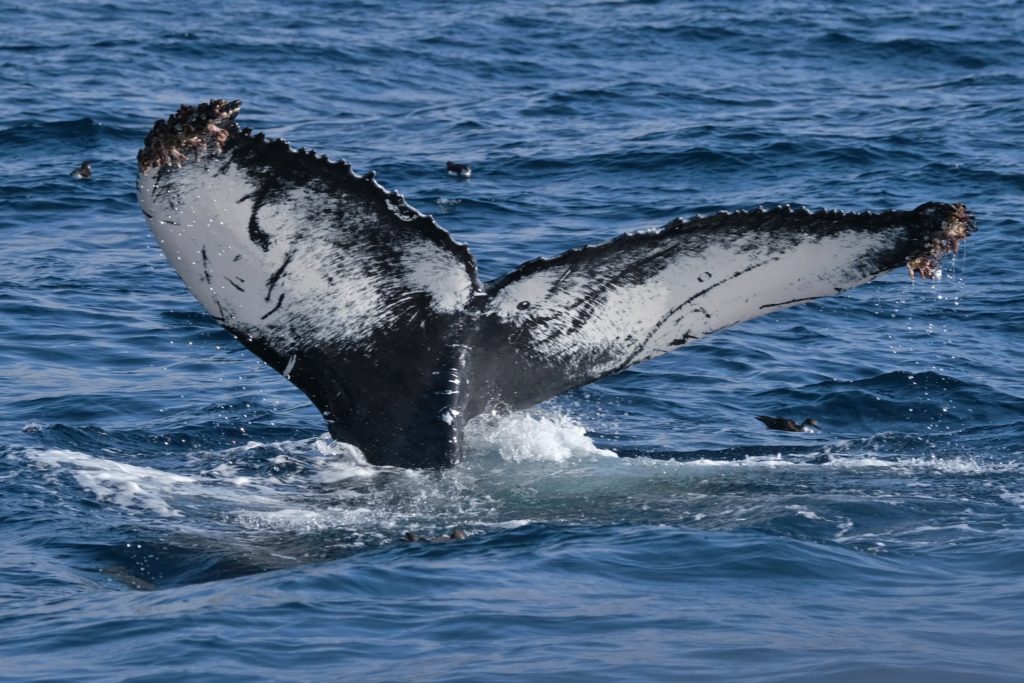
As the first humpback (#102) appears in Donegal Bay for the third out of the last four years and its fifth year IWDG have recorded this individual in Ireland since 2020, a new publication which embraces the value of citizen science and the IWDG WhaleTrack Ireland project is out.
As part of his PhD Dr Miguel Blázquez was given access to the IWDG Humpback whale catalogue containing over 1000 encounters with humpbacks which resulted in photo-id data spanning over 20 years. His paper “Humpback Whale (Megaptera novaeangliae) Site Fidelity, Residency, and Movement Patterns in Ireland Based on Citizen Science Data” was just published in Marine Mammal Science.
Miguel assessed humpback whale site-fidelity to Ireland both within years and across years by calculating resighting rates. Humpback whales showed high site fidelity to Irish waters, with a mean interannual resighting rate of 70%, and 25% of identified individuals were resighted in five or more different years. Mean residency time across the whole dataset was around a month (32 days) and modelled at a minimum of 20 days, with a minimum estimated home range of 100 km, suggesting these are foraging/exploratory behaviours rather than migratory movements.
The average arrival date occurred significantly between 2004–2023, advancing by 9 days per year, while in contrast, the absolute departure date showed no significant trend, whereas the average departure did occur significantly earlier advancing 8 days per year. Earlier arrivals in Irish waters were significantly correlated with rising global ocean temperatures.
A typical challenge inherent to utilizing long-term citizen science data is the absence of systematic search effort, such as dedicated observation hours or predefined transect routes. However, the Irish Humpback Whale Photo-identification Catalogue represents a unique dataset. In the absence of sustained systematic surveys, which are limited by the high cost of dedicated research vessels, the low abundance of humpback whales in Irish waters, and the typically unfavourable weather conditions, the comprehensive citizen science effort carried out by the IWDG represents the only practical alternative for documenting humpback whale ecology in this region.
This study offers the most comprehensive data on humpback whale residency and movement in European waters, highlighting the value of citizen science and rigorous data management for marine conservation.
Congratulations to Miguel and his coauthors and of course the dedicated work by Pádraig Whooley and Nick Massett to maintain the catalogue and make it available to researchers to add value and help us understand how these iconic whales are using Irish waters.
Blázquez, M., Whooley, P., Massett, N., O’Brien, J., Wenzel, F., O’Connor, I. and Berrow, S.D. (2026) Humpback Whale (Megaptera novaeangliae) Site Fidelity, Residency, and Movement Patterns in Ireland based on Citizen Science Data. Marine Mammal Science 42(3), e70188.
A full copy of the research is available here (https://doi.org/10.1111/mms.70188) or on the Members Section of the IWDG website https://iwdg.ie/members/research/
Photo credit: Nick Massett