
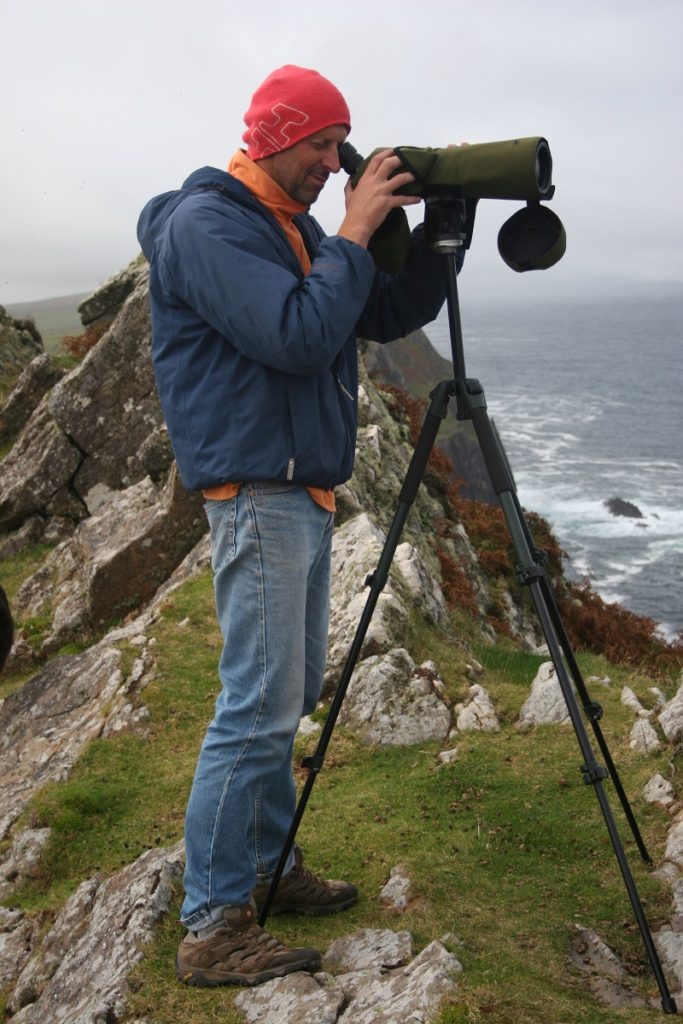
The IWDG coordinate three sighting schemes: the Casual scheme where sightings are made while going about your business, Ship surveys where sightings are collected with recording effort on ships of opportunity and the Effort scheme where timed watches are carried out from land which may, or may not, result ion a sighting being recorded. The Effort scheme has been running since the 1990s at certain headlands providing excellent dataset to explore changes in species occurrence over time in our coastal zone.
Casual or Effort Sighting
There has consistently been some confusion among the public, IWDG members and perhaps even among some IWDG personnel, as to what exactly constitutes an “effort watch” and/or an “effort sighting”, and when reporting sightings whether they should be reported as “Casual” or “Effort related”. This is something of a constant, indeed as we get ever more reliant on our smartphones, the trajectory seems to be going in only one direction. More confusion!
So why is this issue so prevalent today, when in the past a short phone conversation or one of our explainer documents attached to an email was sufficient to clarify the matter and we could all move on. Not so, it would appear today. I find myself spending a lot more of my time discussing this matter as more people are finding it difficult to grasp the concept of an “effort watch”. So, what has changed?
I believe much of the confusion is due to the wildfire nature of social media, as let’s face it, we all seem to know everything today the moment it happens. So, in the early days of the IWDG if you wanted to find out what the local whale activity was like, you really had to put in the long hours watching from your local headland or if you were lucky from a local boat. This level of dedication today may seem a little excessive to some, but it raises a fundamental question in biological recording. Are we willing to invest our time watching vast expanses of sea without any expectation as to the likely outcome, or are we only willing to make this investment when we’ve an expectation of a result, made possible by WhatsApp groups and/or social media platforms?
It is I believe the difference between looking for animals and looking at them, which is a pretty stark difference. I hope that this article will help clarify the matter, but if my experience in recent years is anything to go by, this may be wishful thinking. So rather than this being the end of the matter, I think this should be seen as the start of a conversation, that will hopefully bring greater clarity to what we understand when we use the “E” word (EFFORT).
So let’s set out our stall as to what we mean when we refer to “effort” in the context of reporting sightings to IWDG; and please understand that we are not referring to “effort” in the general sense. i.e. we understand that there is some effort involved in sitting up on a clifftop scoping for hours, we understand that there is effort involved in reporting your sightings, and indeed in assisting us in the validation process, but none of this constitutes the “effort” with a big E that we’re referring to here.
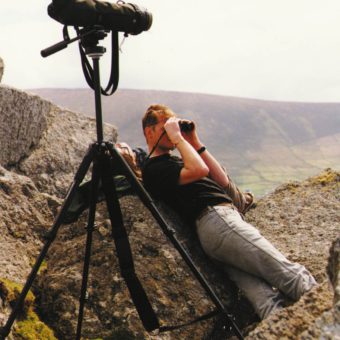
Simon Berrow watching from Slea Head, Co Kerry on a rare visit south from the Banner county to the Kingdom.
So when you are sitting down to report a sighting to IWDG, before you can proceed you’ll need to be clear as to whether this is a “casual” (opportunistic) sighting or an “effort” related sighting (systematic/ monitoring). Confused?…… read on.
Casual sighting
This would typically apply where you were fortunate enough to have an incidental or chance sighting of cetaceans (or basking sharks) while doing something else, such as: swimming, fishing, walking, sailing or any other activity. So far so good and certainly no controversy….yet! However, it would equally apply where you had heard through IWDG, your own network, or on social media that there was local activity and where you had a reasonable expectation that you would also see this activity. Simply recording your start and end time of a watch, does not qualify a watch as an “effort watch/sighting” when your decision to carry out the watch has been influenced by prior knowledge of activity in the area at the time.
One example of this are drone operators who at certain times of the year will spend long hours and I mean 6-7 hr days either up on the Waterford cliffs in winter searching for fin whales to drone, along the West Clare coast in autumn looking for basking shark torus or in Donegal Bay hoping to catch humpbacks breaching or bubble-netting in late summer. Clearly, they are putting in a lot of effort in the general sense but explaining why these were not the same as “effort watches” predictably leads to frustration and the sightings soon dry up, which is a shame, as the actual sightings are very valuable and are valid data. Our issue was with the somewhat tainted “effort” aspect, as they were clearly cherry picking the times and locations to maximise their encounters, which was completely understandable given what media content providers do. I’d adopt the same strategy myself if my goal was simply to optimise sightings and in so doing get great visuals. But this is not what IWDG or conservation is about.
In the above scenario you could make the case that the watches were valid as effort watches, if and only if they were systematic and carried out regularly in all months throughout the four seasons, but this is not and is almost never the case. It’s the selective nature where the argument falls apart. I’d draw something of a comparison with the contributions of birders who spend their time twitching rarities, the results of their “effort” has for similar reasons low, if any conservation value at all.
Effort Watch/Sightings
These are quite different, and fundamental to all Effort (dedicated or timed) watches is the key component that your decision to carry out your watch at your chosen location, is randomised, thus eliminating any bias in favour of sightings. Of course, your decision should not be random when it comes to the weather, as hopefully you’ll have selected for suitable weather conditions in terms of sea state, swell and visibility.
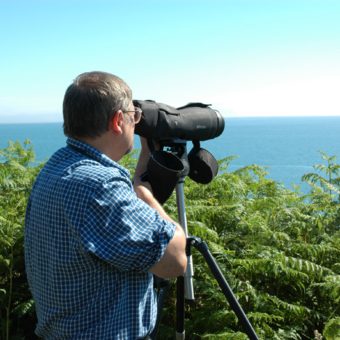
David Williams at Bloody Bridge, Co. Down. Flying the flag for effort watch monitoring in Northern Ireland
So for instance, if you heard through the grapevine that there was good whale or basking shark activity off your local headland, or there were lots of dolphins in the bay, and you went out that same day or the following day, based on this information, to carry out a watch; even if you did record your Effort (start and end time) this would not qualify as an effort watch, as you’ve introduced a significant bias in favour of sightings. And so, we’d typically record any sightings from such a watch as “Casual”.
If however, you had already decided in advance to carry out a watch, and then subsequently heard of local sightings, then there is no issue. The point is that your decision to carry out the watch was random and not based on prior knowledge, and in such a circumstance the data from such a watch could be reported as Effort Watch sightings.
Another situation that could arise in this era of instant messaging and social media is that you start an effort watch and during that watch your phone pings with an alert of activity in a certain area, which ultimately directs you to focusing your watch search in that area, which puts you onto the animals. This scenario is perhaps less cut and dry, but we could make the case that you have again biased your watch results in favour of sightings and such sightings should be considered as “casual” sightings, however you might have observed and recorded these sightings on your watch anyway.
Other factors that should apply to an effort watch, is that we ask recorders to carry out watches during periods of suitable calm weather with sea state of <3 and visibility of >10Km. Good optics such as reasonable quality binoculars, or even better a spotting scope are central to an effort watch. We also ideally ask observers to ensure that their Effort watch should be of at least 60-minute duration, but ideally 90-100 minutes. This ensures that a reasonable amount of watch effort has been carried out to maximise the chances of seeing something if it was present. So, you can see that there is an element of forward planning in an effort watch.
The fact that what we call “Gold Standard” Effort watches require: good optics, suitable weather, a good location, no prior knowledge of a likely outcome, means that relatively few sightings qualify for this category. So a useful rule of thumb is that if you are uncertain, or have to ask, then you should probably just report your sighting as “Casual”, as let’s face it if you tick all the above “effort watch” boxes, it’s very unlikely you’d find yourself asking how should I report them?
None of this should undermine the importance of casual sightings data which are very much our “bread and butter” and make up 85-90% of sightings reported to IWDG every year. They give us the all-important “big picture” of what species are occurring where and when. But when sighting schemes start to blur the boundaries, you end up with anomalies that simply bear no resemblance to the facts on the ground. Put simply, if I cherry pick when and where I’m going to go looking for say humpback whales, I could if I really set my mind to it, see them on almost every watch (>80%), by avoiding those places and periods when I know they are absent. The real figure even for our most experienced observers is a much lower humpback encounter rate across the years.
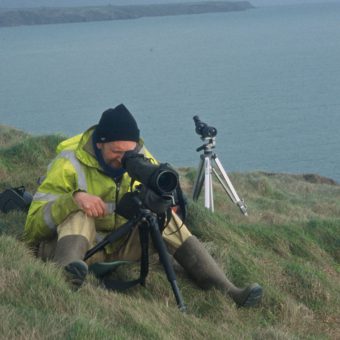
Andrew Malcolm, Ram Head, Ardmore, Co. Waterford. Ireland’s 2nd most regularly watched effort site.
So I took this opportunity to analyse one such observer, Nick Massett (feature image above), who will be known to many of you as our most prolific whale recorder over many years. A glance at his effort watch humpback data from his Slea Head, Co Kerry Vantage Point, during what was the best decadal period for humpbacks in Kerry (2011-2020), show his effort watches produced yearly humpback encounter rates ranging from 5.5% to 48%, a 10 year average of 23%. Again, this is our most experienced observer, who can take full advantage of the best weather windows as he pretty much lives onsite, using a good quality spotting scope, and most importantly if Nick goes out to do a watch knowing he’s likely to see humpbacks due to prior knowledge, he’ll report them as “casual” sightings.
The point I’m making is that unless we remove the inherent bias that’s creeping into our effort statistics, we are going to be left with a situation where our most experienced observers have far lower encounter rates, than far less experienced newcomers, because the level playing field that existed for so long no longer exists. This discrepancy is just too big to ignore. This is essential if we are to use these data to inform conservation policies and action sand flag any real changes in species distribution and abundance.
So if in doubt, please record your sightings as a “Casual” on www.iwdg.ie. But don’t hesitate to drop me an email on sightings@iwdg.ie if you’ve any suggestions on how we might sort this conundrum. If you’d like to learn more about our Constant Effort Sighting Scheme, which could perhaps benefit from a name change, then drop us a line, as we are always looking for people who have some field experience, good optics and a little time on their hands who’d be interested in carrying out regular dedicated, effort (timed) watches from a local headland or vantage point.
This issue and many others will be up for discussion at our next Residential Weekend Whale Watching and Species ID course which for the first time will be held in Mullaghmore, Co. Sligo September 18-20th. There are still a few spaces left. For more details or bookings see Eventbrite link
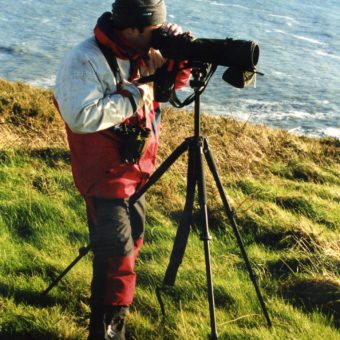
IWDG’s Pádraig Whooley, Ballycotton, East Cork c.1999….doing effort watches along the Cork coast before he knew what they were!
Pádraig Whooley,
IWDG Sightings Officer