IWDG are proud to be partners in the ACCLIMATISE Project: A Changing Climate Impact Monitoring and Assessment Toolbox for Irish Seas. This project, led by the Agri-Food and Biosciences Institute (AFBI), aims to support climate change adaptation by developing monitoring tools, strategies and action plans for more effective, ecosystem-based marine management.
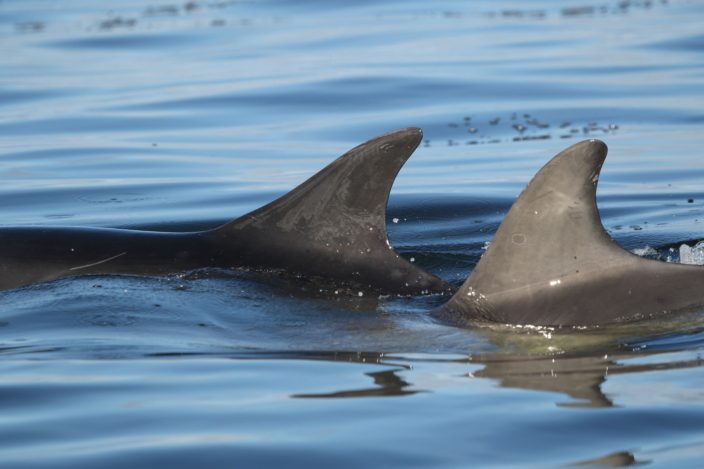
Photograph by Mags Daly, IWDG.
Photo-identification and connectivity of bottlenose dolphins inhabiting the waters of Northern Ireland and Donegal
IWDG are responsible for Activity 2.2 of the ACCLIMATISE Project. We will be drawing on citizen science and cross-border collaboration to investigate the abundance, distribution, and social connectivity of bottlenose dolphins across Northern Ireland, Donegal and adjacent waters.
Six coastal populations of bottlenose dolphins inhabit the UK and Ireland with a small number of individuals displaying long range movements between regions. The home ranges of two populations, coastal Ireland and West Scotland, overlap in Northern Ireland. For this reason, cross-border collaboration is essential for researching these cetaceans and informing an effective transboundary action plan for bottlenose dolphins.
Photo-identification
Photo-identification (photo-ID) is a widely used method for studying marine mammal populations. Images are used to identify unique and permanent marks, which differentiate individuals of the population. Bottlenose dolphins are typically recognised by unique nicks and notches on their dorsal fins, as well as dorsal fin shape, scars, skin lesions, and pigmentation.
Through photo-ID, we can track individuals through time, and learn about a population’s distribution, abundance and social structure. An AFBI led photo-ID study published in 2020 identified 54 well-marked individuals in the waters of Ireland’s north coast (Gibson et al, 2020). Targeting social media as a source of citizen science data, they found a geographic concentration of re-sightings along Ireland’s north coast, suggesting interannual site fidelity, i.e., the same individual bottlenose dolphins were returning to the same areas each year.
The results of this study provided a scientific rationale for targeting these waters for future research and highlighted the importance of citizen scientists for learning crucial information about our marine mammal populations. A big thank you to all the citizen scientists that contributed their photos to AFBI and IWDG for this study!
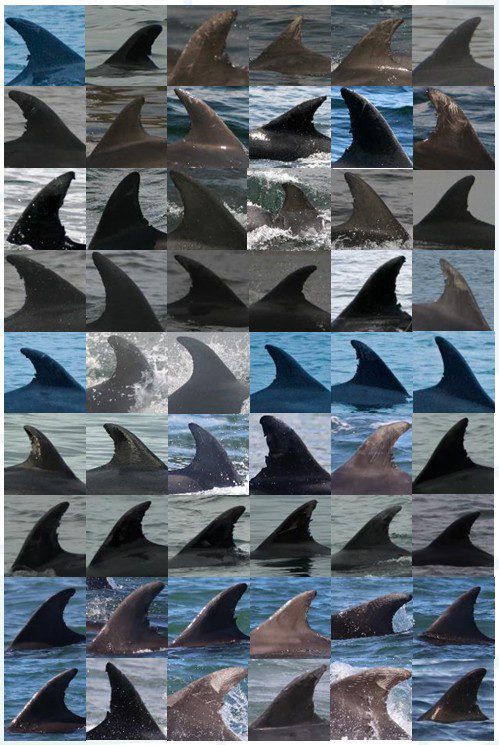
AFBI Coastal Bottlenose Dolphin Photo-ID catalogue (Credit: AFBI, 2018)
Project Aims
As part of ACCLIMATISE, we aim to highlight the importance of Northern Ireland and Donegal as a location of spatial overlap for genetically discrete bottlenose dolphin communities. By improving our understanding of their social structure, distribution, and conservation status, we can ensure this area is effectively recognised and managed.
Through community engagement, citizen science initiatives, and dedicated outreach events, we will be encouraging people to report their sightings through the IWDG Sightings Scheme and send in their photographs of bottlenose dolphins. Following on from previous research (Gibson et al., 2020), we will also be utilizing social media as an additional source of images to expand the existing photo-ID catalogue for bottlenose dolphins of Ireland’s north coast.
By cross-matching individuals across all bottlenose dolphin catalogues from Ireland and the UK we are aiming to improve our understanding of these animal’s movements between areas. This information is vital for effective transboundary conservation management. The resulting dataset will contribute to updated abundance estimates and an improved understanding of the social structure for the coastal population of bottlenose dolphins around the island of Ireland.
Citizen Science
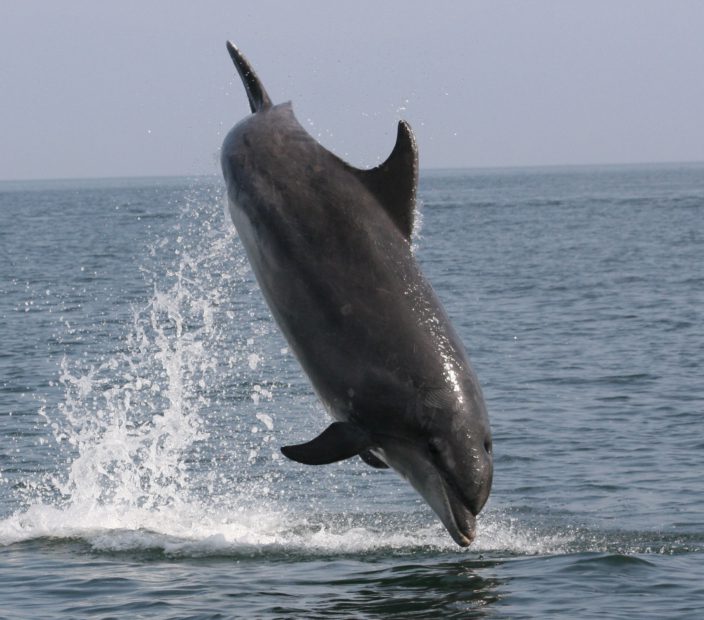
Bottlenose Dolphin – Nick Masset
We need your help! Like many IWDG Projects, our part of the ACCLIMATISE project hugely relies on the contribution of citizen scientists.
If you have recorded or photographed bottlenose dolphins in the waters of Northern Ireland or Donegal please get in touch with jo.green@iwdg.ie
Any contribution is highly appreciated and vital for learning more about our bottlenose dolphin populations!
Follow our Instagram @acclimatise_dolphinproject.
A project supported by PEACEPLUS, a programme managed by the Special EU Programmes Body (SEUPB).
References
See the existing catalogue, compiled by AFBI, for bottlenose dolphins in Northern Ireland and Donegal.
Gibson CE, Williams D, Dunlop R, Beck S. Using social media as a cost-effective resource in the photo-identification of a coastal bottlenose dolphin community. Aquatic Conserv: Mar Freshw Ecosyst. 2020; 30:1702–1710. https://doi.org/10.1002/aqc.33561710