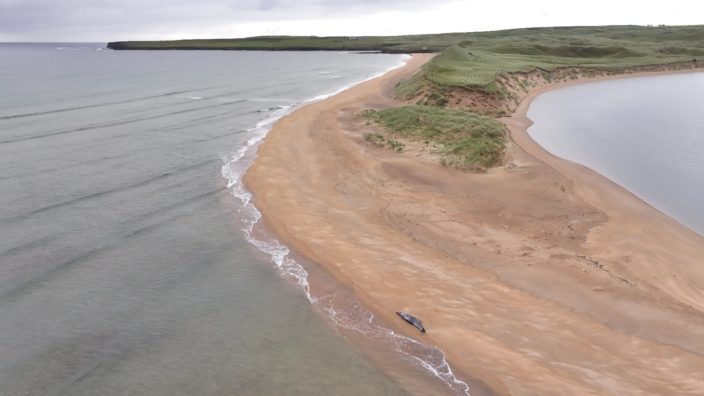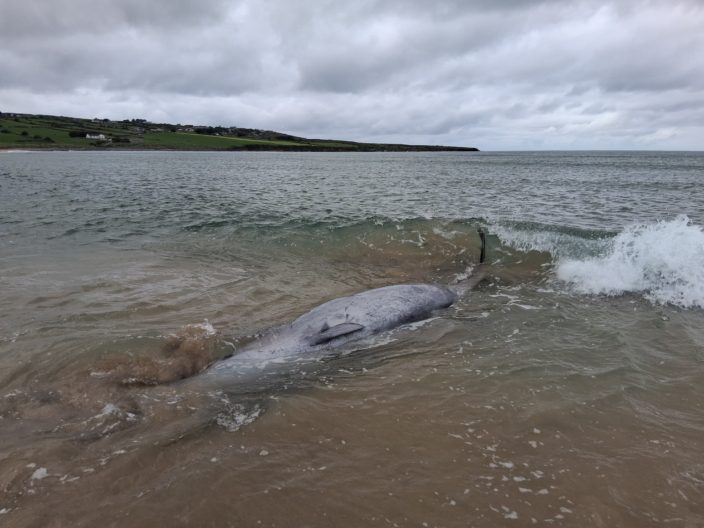
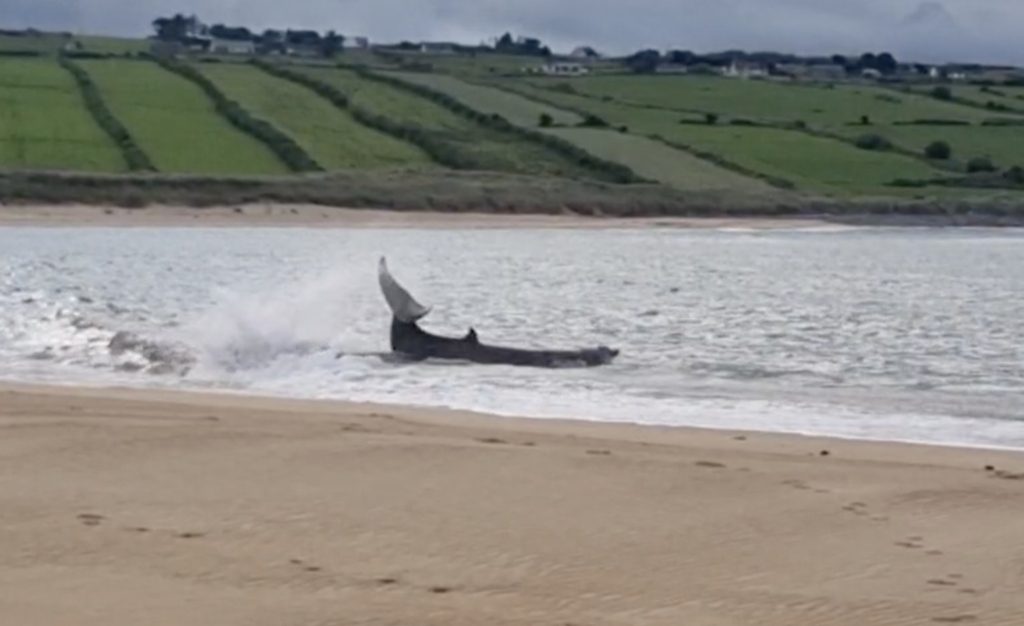
On the evening of Sunday July 27th, two rare deep-diving True’s beaked whales live stranded at Kilcummin Back Strand, Co. Mayo. (Castlelacken on google maps). This mother and calf pair were seen swimming rapidly into shallow waters just before peak high tide, and subsequently beaching themselves on the shore.
Unfortunately, the mother whale died within moments of stranding, while the calf managed to free itself and swim away. Sadly, a post mortem led by Dr. Frank O’Sullivan of Dublin Zoo revealed the mother was lactating, indicating that this was a maternally dependent calf, which will likely not survive. By the following weekend, the calf was found deceased and in a state of decomposition across a channel of water, not too far from the initial live stranding location.
The rare footage recorded by a member of the public offers a rare opportunity to witness pre-stranding behaviour, providing invaluable insight into this elusive species. This was a very distressing incident for those present, and the Irish Whale and Dolphin Group (IWDG) is extremely grateful to the members of the public who quickly alerted us via the IWDG emergency hotline, and to our trained IWDG Live stranding responders who immediately responded. True’s Beaked whales are an elusive, deep-diving species that inhabit offshore waters beyond the continental shelf. They are adapted to dive to depths of over 800 metres in search of squid and deep-sea fish. Their presence in shallow coastal waters is well outside their natural habitat and often signals a serious underlying issue such as illness, injury, or acoustic trauma.
All photo credits: Angela Kelly, & Cathy
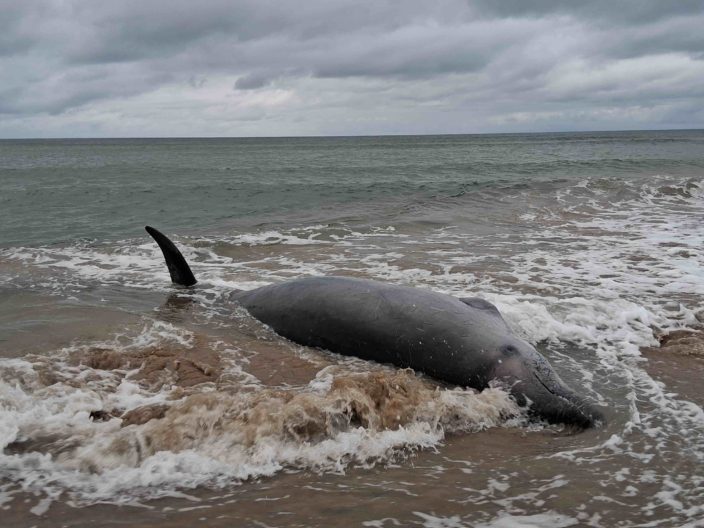
Live strandings of beaked whales are particularly concerning as, unlike coastal dolphins, these animals are not suitable candidates for refloating due to the distance from their natural habitat, and the high likelihood of re-stranding.
Multiple strandings of deep-diving species in different regions in a short time may indicate a shared acoustic event. Two Sowerby’s beaked whales also live stranded on Saturday in the Netherlands. In the Netherlands, live-stranded beaked whales are typically euthanised, as the North Sea lies far outside their natural habitat. In this case, one died and the other was euthanised after it had been refloated several times by members of the public. In a further concerning development, four Northern bottlenose whales—another deep-diving beaked whale species, stranded last week in Orkney off the north coast of Scotland. While we do not know if these events are linked, multiple strandings of deep-diving species in a short time frame are always a cause for concern and close monitoring.
A post-mortem examination of the whale that died in Kilcummin Back Strand was carried out in situ on Monday led by Dr. Frank O’Sullivan, with the assistance of veterinary students Luke Mase and Noah McNaughton. Many thanks to those living locally who were very kind and helpful to the veterinary team also. Due to time limitations and incoming tides, the whales head was removed for further examination at University College Dublin.These examinations can reveal crucial information about the animal’s health, nutrition, injuries, stomach contents, and disease. Ireland currently does not have a state-funded post-mortem scheme for whales, dolphins, or porpoises, so the IWDG extends sincere thanks to the veterinary team volunteering their time and expertise to investigate this case.
If you ever come across a live stranded whale, dolphin or porpoise, please call the IWDG hotline at 0 (97) 28 118