
In mid May we asked the question…” where have all our humpbacks gone?” See article https://iwdg.ie/where-have-all-our-humpbacks-gone/ and it seemed like a reasonable question at the time, given their tardiness this season. But they were always going to show up somewhere eventually and of course pretty much the same afternoon we posted the article, we learned that there had been a group of three humpbacks a few days earlier in outer Donegal Bay. And so based on previous years we had good reason to believe that this initial sighting would open the floodgates for more in the northwest. Instead, we’ve hardly had a trickle, as 2026 thus far anyway will be remembered as the year our humpbacks were not only late, but they were also at their lowest numbers in well over a decade.
The Instagram reels and influencer revelatory accounts don’t really tell the whole story, in fact they don’t even come close, and so you could be forgiven for thinking that it’s business as usual in the northwest. It’s not. While the sightings data reveals that 9 of our 13 humpback sightings so far this year have been in Donegal Bay, all but one of these records have been of the same one individual #HBIRL102. So you could make a case that there are as many humpbacks currently in the Southeast off Carnsore Point in Wexford, which had a breaching humpback yesterday. The only difference is that with so much focus on Donegal Bay, #102 has just been reported over multiple days, but it’s still only one animal. (see map)
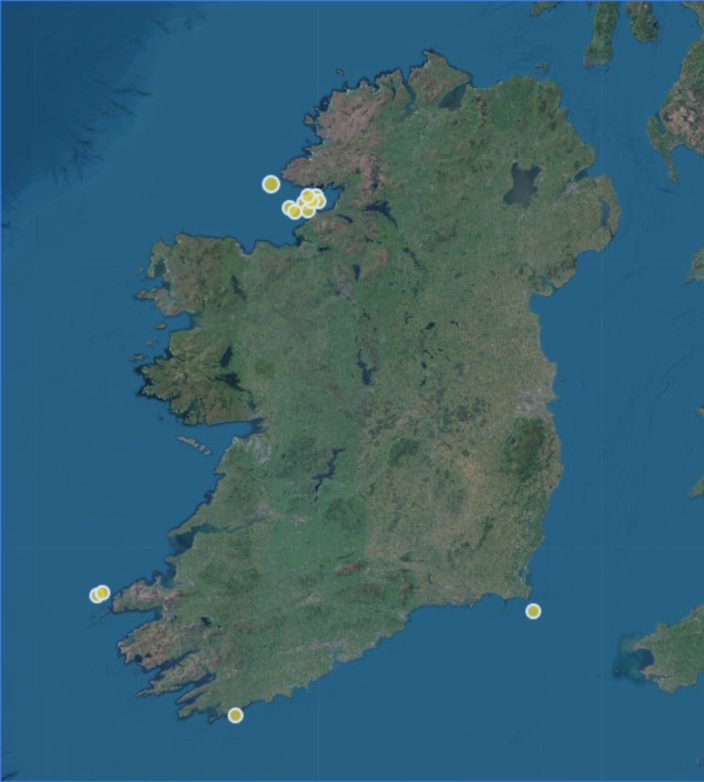
Map of Irish Humpback sightings to date in 2026
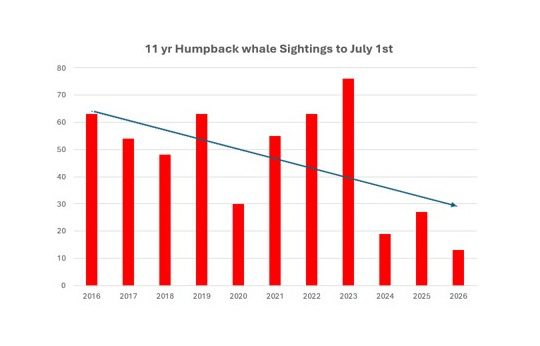
So although it’s premature to write this humpback season off, as we enter July we are approaching the season’s midpoint, so I thought it would be interesting to contrast this season’s sightings from the first record to date (July 1st) with those of the previous decade for the same period, as it covers the first 3 months of what is usually a 7-8 month humpback season and the figures and trendline speak for themselves.
As discussed before and as demonstrated so well in Miguel Blázquez’s paper which featured this week on RTÉ News, we have 20+ years of good data that shows our humpbacks are arriving earlier, and as is so often the case, once you go public on something the whales inevitably see this as an opportunity to prove you wrong. So 2026 saw a reversal of this trend with their late arrival, but this is only part of the story. The more interesting figure is the apparent crash in humpback sightings being reported to IWDG since 2024.
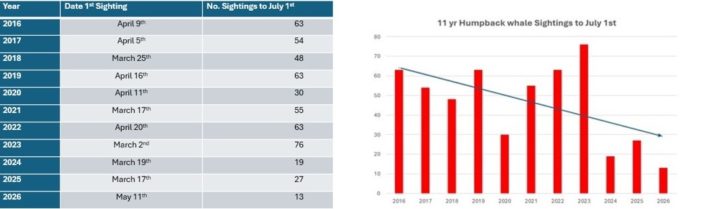
The 10 yr average based on the above is 51 sightings up to July 1st , so 13 humpback sightings this year for the same period, represents a dramatic 75% decline in sightings for the season to date. The photo ID data is telling us the very same. For instance by this time last year (2025) we had photo identified four individuals, against this year’s one. Another 75% reduction.
I appreciate it’s still early days and the numbers that matter most are those at the end of the season, but if the current low level of humpback activity continues over the coming months it will be of some concern as it may suggest we are well on the way to losing one of our most iconic species.
On a brighter note…. Yesterday we received a message from our partners at Happy Whale relating to a long-distance resighting of #HBIRL043 an individual we have documented on 30 dates between 2015-2021 in West Cork and Kerry in 2015, 2018, 2019, 2020 & 2021. Some of our newer followers may need to be reminded that not so terribly long ago, humpbacks were really only recorded in our SW waters and almost never in the northwest. Our last record of it in the Irish southwest was off the Stags in West Cork on June 7th 2021 and after a 75-day gap it was photographed in the rugged Arctic Archipelago of Svalbard, nestled between northern Norway and the North Pole on Aug. 21st, some 1,000 km inside the Arctic Circle. However, it’s latest sighting from March 14th 2026 places it in the somewhat less rugged Lesser Antilles tropical island of St. Martin and brings to five the number of “Irish” humpbacks that have been recorded in the Caribbean breeding area, which compares with 10 for the Cabo Verde, west African breeding area. The gap between these two areas does seem to be closing!
Three images below of HBIRL043 (NA10416) in the Celtic Sea, Berents Sea and Caribbean Sea
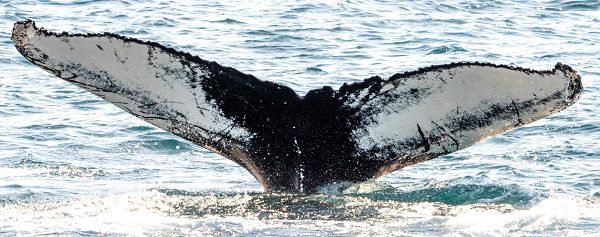
Fig 1. #HBIRL043, West Cork, Irl., May 2nd 2021 © Calvin Jones
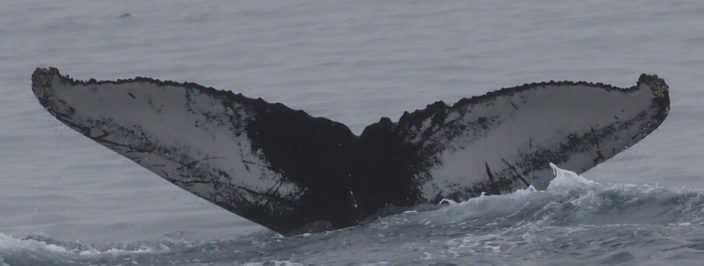
Fig 2. #HBIRL043, Svalbard, N. Norway Aug. 21st 2021 © Christian Engelke
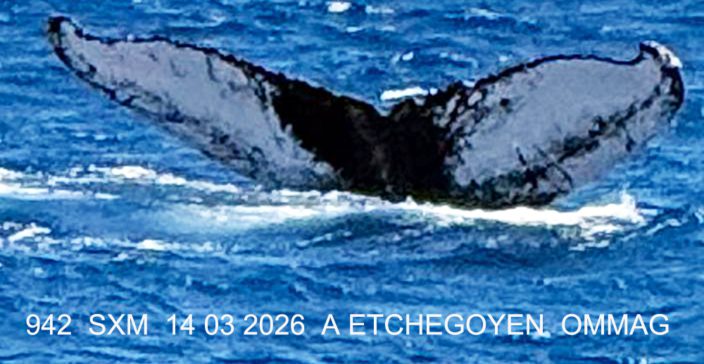
Fig 3: HBIRL043 St. Martin (Fr.), Lesser Antilles, Caribbean, March 14th 2026 © OMMAG
Even though Irish coastal waters may not be attracting hungry humpbacks in anything like the numbers it once did, we can take some comfort from the fact that this change may simply reflect a local range shift rather than a population in decline. Globally humpback whales are doing very well since we stopped killing them, with most populations showing strong year on year growth. So what’s driving the changes we are seeing in Irish waters and are they also being detected by recording schemes in other Northeast Atlantic feeding areas? We’ll get back to you on this big question.
Map below shows only the extent of the known range of this one individual; it may well be visiting more locations that are even further afield, that are yet to be discovered. But it would be nice to be reporting on #HBIRL43 in Irish coastal waters. Our loss is someone else’s gain.
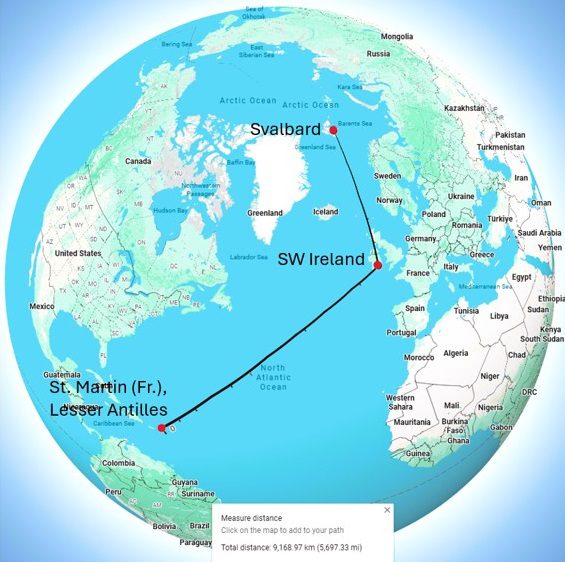
Where else is HBIRL043 going?
If you are fortunate enough to see a whale in the 30-50 ft length range, with a visible bushy blow, that lifted its powerful tail flukes or long white pectoral fins clear of the water, then it’s most likely a humpback whale; it could even be #HBIRL043. We’d love to hear your story, so we can continue to tell 43’s.
By Pádraig Whooley, IWDG Sightings Officer