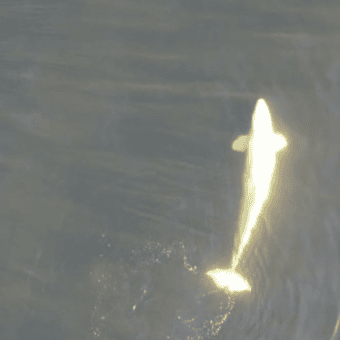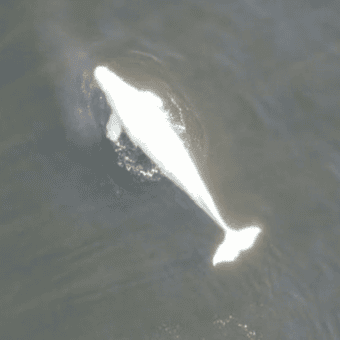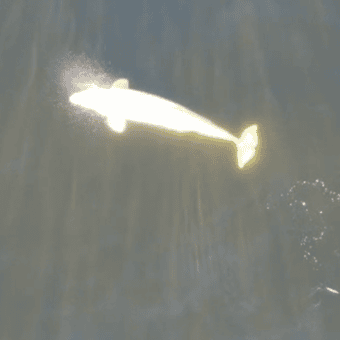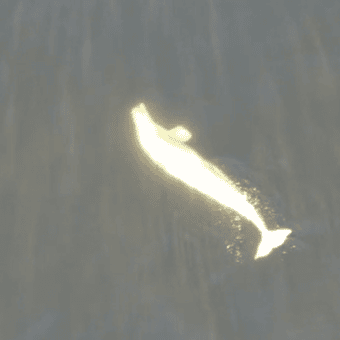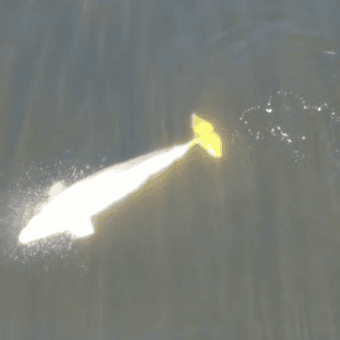
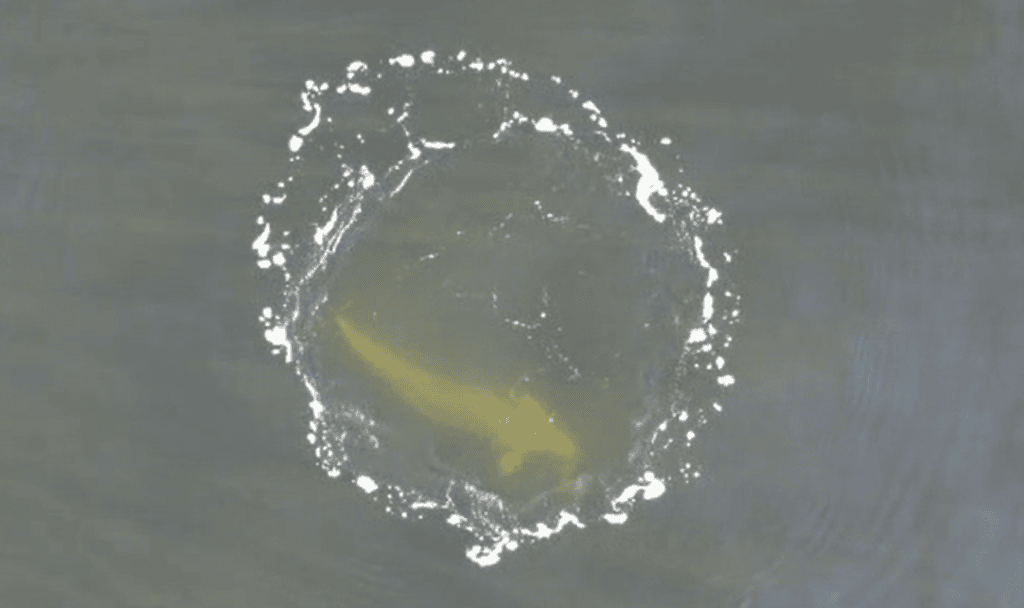
On Saturday 17th Oct 2026, Sebastian Szumlański was at Fintra, Donegal Bay and observed what he thought was a pale dolphin close to shore in shallow, brackish water, in an area known locally as the Secret Waterfall. He launched his drone to capture the event and yesterday he showed the video to a friend who has done some photography out on Mullaghmore based Whale Watching boat, Kiwi Girl, with Declan Kilgannon, who shared the footage with IWDG. The video confirms this to be another beluga in Irish waters and only the second such validated record by IWDG in our 35-yr history.
The beluga is a medium-size whale species that typically inhabit the freezing waters of the Arctic and sub-Arctic. Adults reach up to 5 mts in length and are a brilliant white colour; a likely adaptation for avoiding their only natural land predator, the polar bear. They belong to the sub-order of toothed whales, but are in a very distinctive family of Monodontidae, which includes the narwhal; another Arctic species which was first documented in Ireland in November 2025, when a juvenile, female stranded on Sweet Nellies Beach, north of Greencastle on the Inishowen Peninsula in Co. Donegal. It is interesting that within an 11-month period, IWDG has validated our first narwhal and a beluga in Co. Donegal. This is likely evidence of just how rapidly things are changing in Irish waters.
Belugas have been reported on at least four previous occasions around the Irish coast. The first known record dates back to September 1948 off Clare Island, Clew Bay, Co. Mayo (Irish Naturalist Journal, INJ). There was then a 40-year gap before the next record which was in Cork Harbour in June 1988 (Carmody M. & Wilson J, INJ). The next sighting and the first to be validated by IWDG with supporting photographic evidence was of a solitary adult beluga within metres of the shore off Dunseverick, Co. Antrim in July 2015 (Watson G.), a gap of 27 years.
This latest development suggests the intervals between confirmed Irish beluga records is closing, as this sighting narrows the gap to 11 yrs. Whether this is due to increased forays of this Arctic vagrant in response to fragmentation of Arctic sea ice, or an increase in observer watch effort remains unclear. But the increased regularity with which IWDG is writing about species such as the bowhead whale, walrus, narwhal and beluga, would suggest Ireland is being visited by these Arctic specialists more often.
We can’t really say much about this individual other than its colour and size would confirm this to be an adult, of unknown gender. The videos do not give us cause for concern for its welfare, as it seems to be swimming strongly and breathing normally. It is also evidently in brackish and very shallow water, which is quite common among populations of belugas such as those in the St. Lawrence River, Canada, who frequently aggregate in river mouths, regularly swimming hundreds of kilometers up river systems, until fresh water freezing in autumn, provides the cue to return to the safety of open sea.
Pers. Comms. with Arctic whale expert Mads Peter Heide Jǿrgensen confirm that a solitary beluga has also been seen over the summer period in Norway, Denmark and Finalnd and there is always the possibility that this could be the same individual. We’ll keep you posted on this if we can confirm the match.
If you are fortunate enough to observe this charismatic whale, we’d ask you as always to try and get images or video and report your sighting (with images) to IWDG on www.iwdg.ie, so we can monitor its progress and track its movements in Irish waters.
We live in interesting times.
By Pádraig Whooley
IWDG Sightings Officer
email: sightings@iwdg.ie, Ph. 086 3850568.
All images on this article are © Sebastian Szumlański