
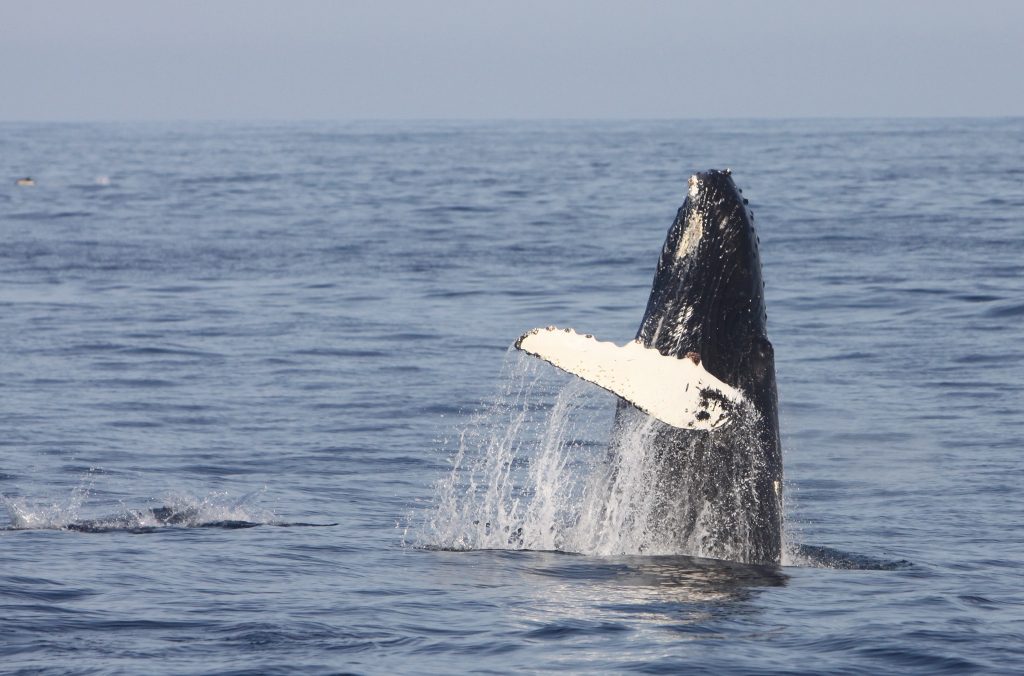
I can’t be the only person wondering what’s happening to our humpback whales this year? A review of IWDG sightings data over the past decade (2016-2025) shows that during this period our first recorded humpbacks have been reported between March 2nd and April 20th, with a median date of March 27th (see graph below). At time of writing (May 14th) we’ve overshot this mark by 47 days, which could be significant for a species that is such a creature of habit, displaying both remarkable spatial and temporal fidelity.
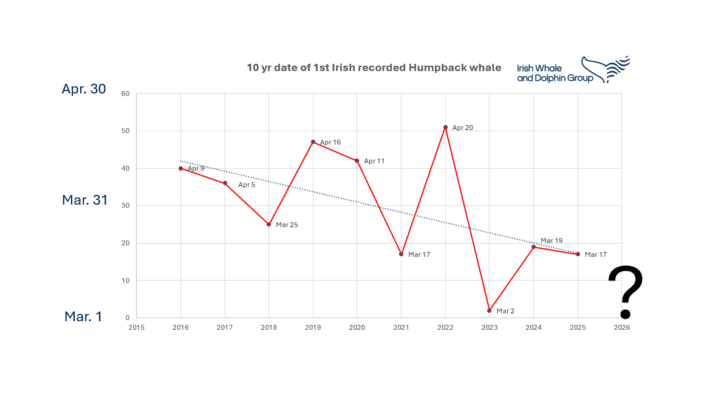
10 Yr HB 1st arrival dates 2016-2025 © IWDG
And rest assured that it’s not for any lack of looking, as from around the St. Patrick’s weekend scopes have been scanning for the first distant blows from all the usual southwest hotspots in Cork and Kerry and for the past month the Donegal Bay Trust have been out regularly on MV Kiwi Girl and with plenty of IWDG eyes scanning during calm weather from both the Sligo and Donegal sides of this increasingly important bay.
So wondering whether this situation has been replicated in other feeding areas, we reached out to International partners with whom we collaborate on humpback photo ID and one interesting response was from Pedrin Lopez from the Cabo Verde breeding area, whose reply may offer something by way of an explanation for the apparent late arrival this season of humpbacks in which he writes “…. In Boa Vista, this season most of the familiar males, apparently, arrived later than usual. That is from early April on….” So it’s entirely likely that if many of the males arrived later than usual on the breeding grounds, that they’d not leave till later which of course delays their arrival on the higher latitude feeding areas, such as Ireland.
Admittedly, while the explanation for their tardiness is speculative, that’s where the speculation ends. But the question isn’t so much when will the first humpbacks arrive, rather where? If recent years are anything to go by, you’d place your bets on the northwest being the most likely area, as in 2024 the season 1st humpback was recorded off Glencolmcille , Co. Donegal (March 19th ) and in 2025 it was off Dun na mBó on the Mullet Peninsula, Co. Mayo (March 17th).
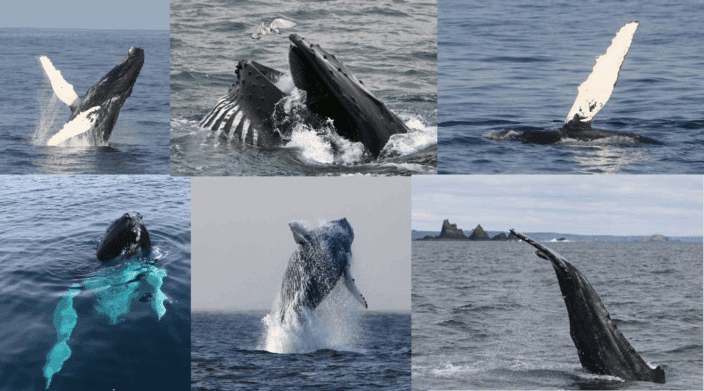
Humpbacks, the most charismatic of our large whales, courtesy IWDG
Minkes whales also seem to be having a relatively quiet season with just 80 validated Irish sighting records to date up to May 15th of 118 individuals, which compares with 99 sightings of 179 individuals for the same period in 2025. So our smallest rorqual is showing a 19% decline in sightings for the year to date. But as sighting reports are a fairly crude metric, could group size offer any more comfort? Alas, not thus far, as the mean group size in 2025 was 1.8 minke whales per encounter, which has fallen to 1.47 this year, a similar decline of 18.3% in group size. So fewer minke whale sightings and lower numbers. Our Marine Protected Areas (MPA) bill can’t come soon enough!
But whale watchers and wildlife enthusiasts are by default an optimistic pod…. we have to be! It’s still way too early to write the season off, and risks it becoming something of a self-fulfilling prophecy. But these early indicators suggest that the 2026 season will not be without its challenges as both climate change and dwindling availability of forage fish in our coastal waters see our large whales shift their distribution both further north and with increasing regularity away from former southwest hotspots they held for many years.
So next week’s Whale Watch Ireland 2026 event on Saturday 23rd May has never been so important, as it will hopefully bring out hundreds, if not thousands, of wildlife enthusiasts to headlands and vantage points around our Island to help us search for that illusive first humpback of the season. Better late than never.
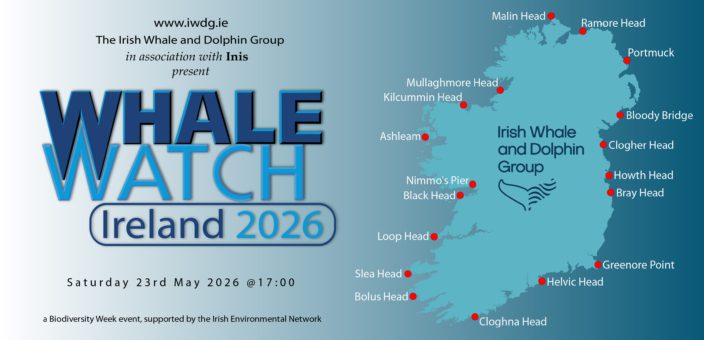
Come join us at one of these 18 sites to learn more about the whale watching and the work of the IWDG.
By way of an inducement, IWDG will donate a prize of one of our hoodies to the first sighting on our new Reporting App of a humpback whale in Irish waters this season. The only criteria is that the record needs to be validated to species level, so your record will ideally come with one or more of the following:
- A record photo or video clip attached that confirms species
- A good description, that rules out the possibility of your whale being any other species
- Corroboration by others
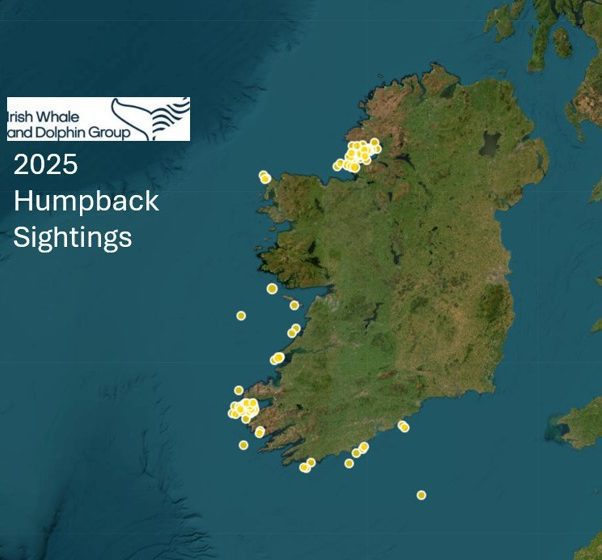
Map of 2025 humpback sightings….how different will this map look in 2026 ?
Your sightings are critical in helping IWDG build the bigger picture. Here’s hoping for calm seas and clear skies on Whale Watch day next Saturday 23rd. We look forward to seeing you there.
Postscript: No sooner had we written this article than IWDG received word of a humpback whale sighting on May 11th in outer Donegal Bay several miles to the southwest of Rathlin O’ Beirne. The sighting was courtesy of ORCA UK volunteer/surveyors on a Saga Tours cruise ship, Spirit of Adventure that had left Killybegs and confirm 3 humpbacks feeding. Alas on photo ID images were obtained but great to be able to document our first and only humpbacks to date (May 23rd)
By Pádraig Whooley,
IWDG Sightings Officer